•
5 min read time
View Transcript
Overview
Across LATAM, stablecoins are being used to solve practical payment and treasury problems: dollar access, faster cross-border settlement, lower FX friction, and better control over money movement. But the region does not behave like one market, and the hardest work starts when companies connect stablecoins to local fiat rails, liquidity providers, compliance workflows, and last-mile payout networks.
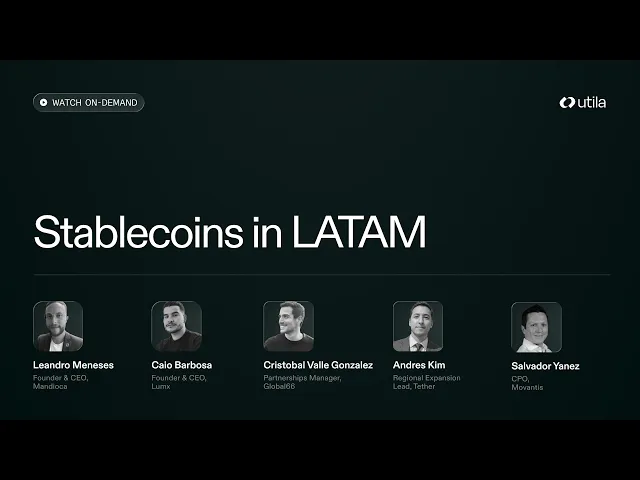
That is why Utila brought together LATAM fintech and payments leaders for Episode 07 of the Stablecoin Builder Series. Adrielle Andrade and James Ross Vázquez of Utila are joined by Caio Barbosa of Lumx, Leandro Meneses of Mandioca, Andres Kim of Tether, Cristobal Valle Gonzalez of Global66, and Salvador “Chava” Yanez of Movantis to discuss how stablecoins are being used across the region, what breaks when companies connect fiat rails to on-chain infrastructure, and what builders need to control when stablecoin payment flows move into production.
Key Takeaways
LATAM stablecoin adoption depends on local market conditions
The panel repeatedly pushed back on treating LATAM as a single market. Stablecoin usage in Bolivia, Brazil, Colombia, Venezuela, Mexico, Argentina, and Chile reflects different combinations of dollar access, FX volatility, banking friction, remittances, arbitrage, tourism, and B2B payment demand. Builders entering the region need country-level assumptions, not a regional playbook that treats every market the same.
Dollar access remains a core driver, but payment efficiency is becoming just as important
Stablecoins are still heavily associated with inflation protection and access to USD liquidity, especially in markets where dollar availability is constrained. But the panel also pointed to a broader shift toward payment efficiency. In markets with outdated cross-border banking infrastructure, stablecoins can compress settlement time, improve working capital, and reduce dependence on international wires that may take days or fail because of intermediary-bank friction.
Local stablecoins are opening new use cases in Brazil
Brazil stood out in the discussion because of its regulated market, BRL-denominated stablecoins, and stronger domestic financial infrastructure. Speakers discussed how BRL stablecoins can support non-resident BRL accounts, local currency access for offshore users, easier access to Brazilian yield products, and new capital markets use cases. For Brazil, the opportunity is not only moving dollars faster, but using stablecoins to modernize financial products and back-office workflows.
The stablecoin sandwich depends on multiple partners
The panel made clear that fiat-to-stablecoin-to-fiat flows are not always a simple two-step process. A typical “stablecoin sandwich” can still involve an originating financial institution, a local fiat collection partner, a liquidity provider, custody infrastructure, an offshore counterparty, a last-mile payout partner, and local fiat settlement. The system may be faster and cheaper than traditional rails, but only if operators know where funds are at each step and have clear procedures when a liquidity provider, payout partner, or transfer leg fails.
Operators need to control treasury, compliance, orchestration, and visibility
Several speakers drew a line between what companies should control directly and what can be delegated to partners. Treasury and wallet infrastructure, KYB/KYC documentation, transaction orchestration, client support, and visibility into fund movement were described as core operating layers. Liquidity can be sourced through partners, but the closer an operator gets to the liquidity source, the more control it has over margin and execution quality.
Product design should hide complexity and surface trust
For users and traditional financial institutions, stablecoin infrastructure often works best when the blockchain layer is abstracted away. The product should make money movement faster, cheaper, and more reliable without requiring the user to understand wallets, gas, chains, or on-chain mechanics. What should be visible is the information that builds confidence: transaction status, FX rate, final amount received, timestamps, and clear confirmation of where the money is.
Regulation should be treated as a product constraint from day one
The panel’s advice to builders: do not build against regulators. LATAM regulation is still developing, and rules will continue to change across markets. Builders need flexibility, strong compliance controls, and a product architecture that can adapt as each country clarifies its stablecoin, payments, and digital asset frameworks. For companies serving banks, retailers, remittance providers, or public companies, regulatory alignment becomes part of the product.
Key Speaker Insights
Caio Barbosa, Founder & Co-CEO, Lumx
“We always say that stablecoins remove intermediaries, and it’s kind of true, but you can actually have a lot of intermediaries too in the process. It happens that the process is easier and faster, and most of the time cheaper.”
Walking through the stablecoin sandwich and the operational risks behind cross-border payment flows.
Leandro Meneses, Founder & CEO, Mandioca
“Operators must control orchestration and visibility. You definitely need to start controlling the treasury. Owning the wallets is very, very important. After that, you need to have control of your compliance, your KYB process, and your KYC processes.”
Explaining which parts of the payment stack stablecoin operators should control directly.
Andres Kim, Regional Expansion Lead, Tether
“Every country is very particular. You can see use cases like hedge against inflation in Venezuela and Argentina, but then you can see in Colombia that one of the most common use cases is arbitrage. If you compare with Brazil, I would say that the number one driver is cross-border payments.”
Asked what drives USDT usage across different LATAM markets.
Cristobal Valle Gonzalez, Banking Partnerships, Global66
“We abstract everything that creates confusion or anxiety to our users, and we surface and highlight everything that builds confidence.”
Describing how stablecoin products should be designed for users who want reliable money movement, not blockchain complexity.
Salvador “Chava” Yanez, CPO, Movantis
“They don’t even need to know that we’re utilizing stablecoins. They just care about the money getting there on time, at the fastest speed, at the lowest cost.”
Discussing how stablecoin rails can be introduced to traditional financial institutions and remittance partners.

Episode 12
Stablecoin Builder Series
1 mins
Four industry leaders explain what's driving RWA tokenization from proof of concept to production, where liquidity and infrastructure still fall short, and what it will take to reach institutional scale.

Episode 11
Stablecoin Builder Series
1 mins
Four builders explain where stablecoin adoption in APAC is really happening today, from Hong Kong's licensing regime to Indonesia's new digital asset law.

Episode 10
Stablecoin Builder Series
1 mins
AI agents are starting to hold wallets and move money on their own. Three builders explain what infrastructure that actually requires.
Subscribe
Thought leadership, product updates, and partnerships - delivered only when we have something interesting to share.
Empower your organization to securely store, transfer, and govern digital assets with enterprise-grade confidence. Built for fintechs, enterprises, and institutional operators.
See how Utila fits into your stack.
Live walkthrough, no commitment.
Companies who trust our enterprise-grade governance, security, and operational control: