Executive Summary
Stablecoins enable something traditional payment rails can’t: programmable payments and automated financial operations that execute 24/7 without manual intervention. Utila’s workflow automation infrastructure provides the APIs, webhooks, and compliance integrations that let companies embed stablecoin payments directly into their software – transforming manual billing, payroll, and vendor payments into instant, hands-free workflows that scale with your business.
Finance teams at a growing number of companies face what can be called an automation paradox. While core products run on sophisticated automation, payment operations remain stubbornly manual. For example:
56% of AP teams spend 10+ hours weekly on invoices and supplier payments
Manual processing takes ~14.6 days on average, with 39% of invoices containing errors requiring intervention
55% of firms lose 4-5% of monthly revenue to payment inefficiencies, while 23% lose 6-10%
89% say payment management consumes excessive internal bandwidth, preventing focus on strategic initiatives
Some traditional payment APIs support programmatic payment creation and payouts, but disparate rails, settlement windows, and fragmented reconciliation often leave teams stitching processes together by hand. Each payment provider has different APIs, webhook formats, and settlement timelines – creating a patchwork that still requires constant manual oversight.
Stablecoins fundamentally change this equation. With API-first rails, transactions can be triggered, routed, screened, and settled automatically based on predefined business logic. With API-first rails, transactions are triggered, routed, screened, and settled automatically from predefined logic. The payment becomes just another API call.
This is why multiple innovative companies – from neobanks and PSPs to OTC desks and stablecoin platforms – have embedded Utila’s workflow automation into their core operations. In this article, we explore how Utila’s API-first infrastructure enables true payment automation through real-time webhooks, embedded compliance checks, programmable co-signers, and seamless fiat integration. Each capability can be implemented incrementally or deployed as part of a comprehensive automation strategy.
Building Automated Workflows with Stablecoins
Utila’s building blocks can be composed into fully automated, cross-border payment flows. At the core is Utila’s API and webhook framework. Developers can use our APIs to create wallets and initiate transactions, and subscribe to webhooks for real-time events.
For instance, you can programmatically spin up a USDC wallet for each vendor and send them the deposit address. Once funds are received, Utila emits a Transaction Created/Confirmed webhook. Your system can instantly apply business logic – like crediting the vendor’s account or triggering downstream payments – without manual polling.
Webhook Triggers
Utila supports webhooks for key events (e.g., deposits, transaction status, wallet creation etc.). This allows backend systems to respond automatically. For instance, they can listen for a “deposit received” callback and automatically convert the incoming stablecoin or trigger a batch payout.
For example, a SaaS platform can use a webhook to notify its billing engine when a client’s stablecoin invoice is paid and unlock services accordingly.
Integrated AML/KYT
Utila embeds compliance into the workflow via partner APIs. Institutional users can connect Utila to blockchain intelligence tools (e.g. Chainalysis, TRM Labs). Incoming transactions are screened in real-time as this integration provides live risk scores for each transfer which is logged in the system.
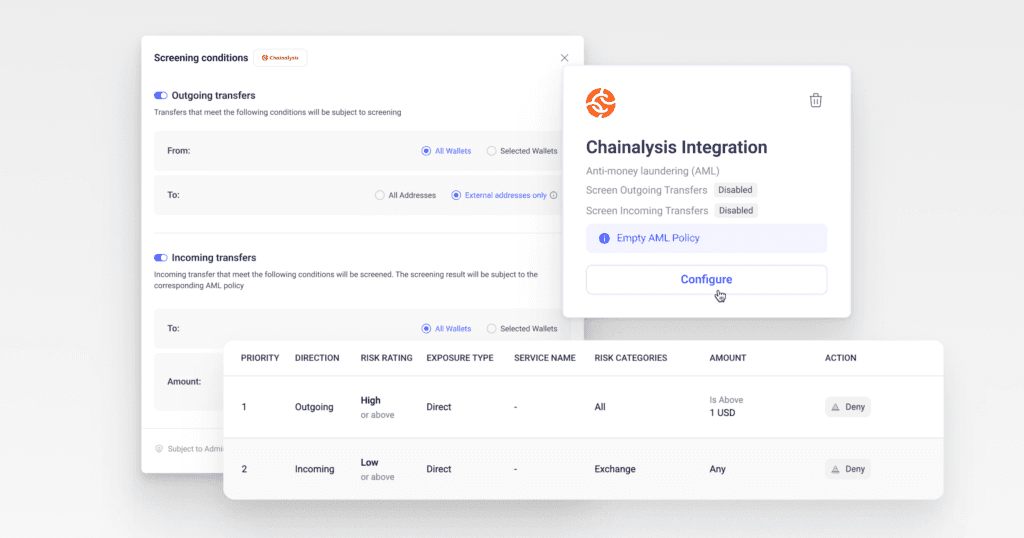
Chainalysis Integration
In practice, this lets you define a policy that automatically freezes or rejects a deposit if the counterparty is flagged by the AML provider. These AML rules run in-app, with one click you can drill down into the relevant investigator report for any address. All screenings and compliance events are recorded in Utila’s logs.
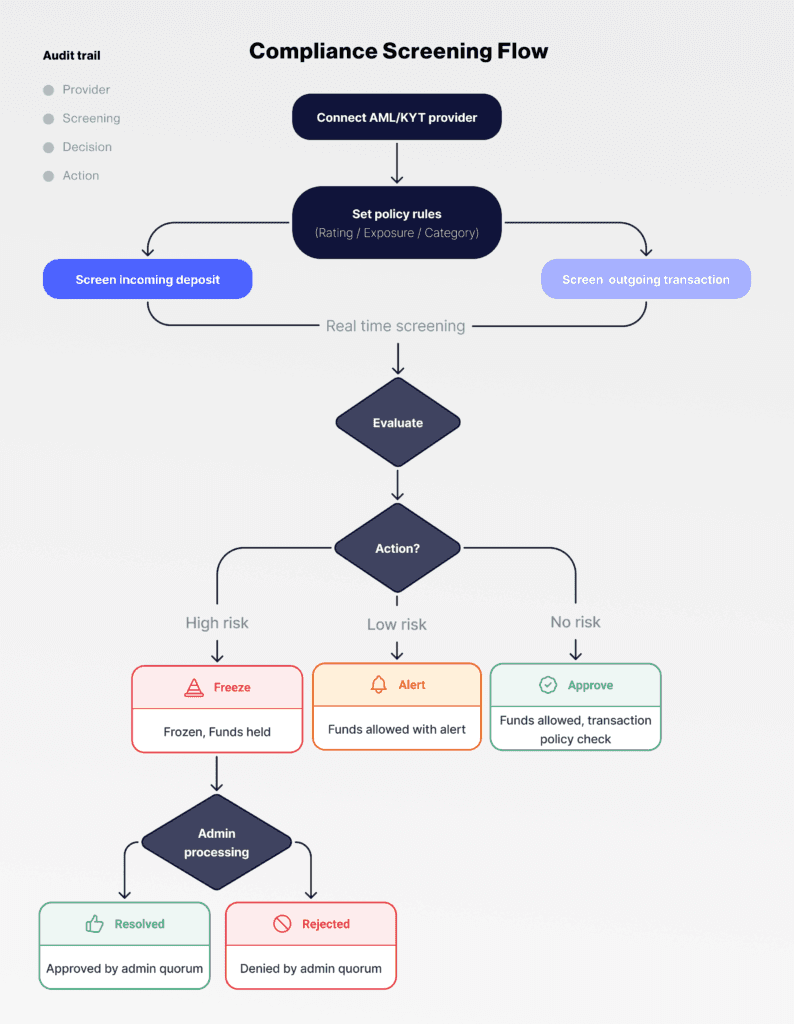
AML Policy Engine Flow
How it works:
Connect compliance provider (Chainalysis/TRM Labs) in Vault Settings
Set policy rules – auto-deny or alert on high-risk transactions
Automatic screening – incoming deposits checked instantly, suspicious funds frozen
Admin resolution – review alerts and approve/reject with quorum
Programmable Co-Signers & API Workflows
Our MPC architecture allows you to embed signing logic into your workflows. Utila’s InitiateTransaction API lets your system build and schedule a transfer automatically. The API co-signer mode allows you to set up a dedicated “service account” (gas wallet) to auto-sign routine transfers via API.
For example, instead of manually clicking “approve” in the UI for a daily settlement, your back-end can programmatically gather signatures (via secure co-signer credentials) and execute the transaction. This is powerful for high-frequency or automated flows, such as payroll disbursements or payroll en masse.
Sponsored (Gas-Relayed) Transfers
On networks like Ethereum or Tron, paying gas can be a hurdle for some users. Utila’s sponsored transfer feature solves this by delegating gas costs. By assigning a dedicated gas wallet (which will cover network fees on behalf of the actual sending wallet), users can initiate stablecoin transfers without holding native tokens.
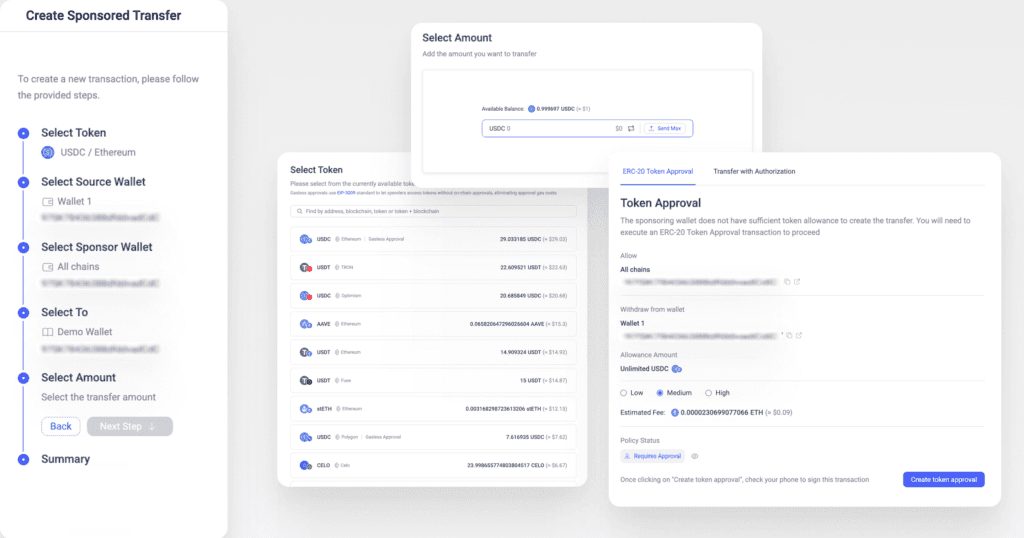
Sponsored Transfer Workflow
This means recipients or payers don’t need to hold ETH/BNB/Tron in their wallets – Utila’s sponsored transfers abstract away gas fees on ERC-20 and TRC-20 tokens (Solana support via API) and simplifies user experience.
How it works:
Setup wallets – Deposit wallet holds stablecoins, gas wallet holds ETH/native tokens
Create approval policy – Allow gas wallet to move tokens from deposit wallet
One-time approval – Authorize gas wallet to spend tokens on-chain
Execute transfer – Gas wallet pays fees automatically, deposit wallet sends without holding ETH
Cross-Chain Swaps and Bridges
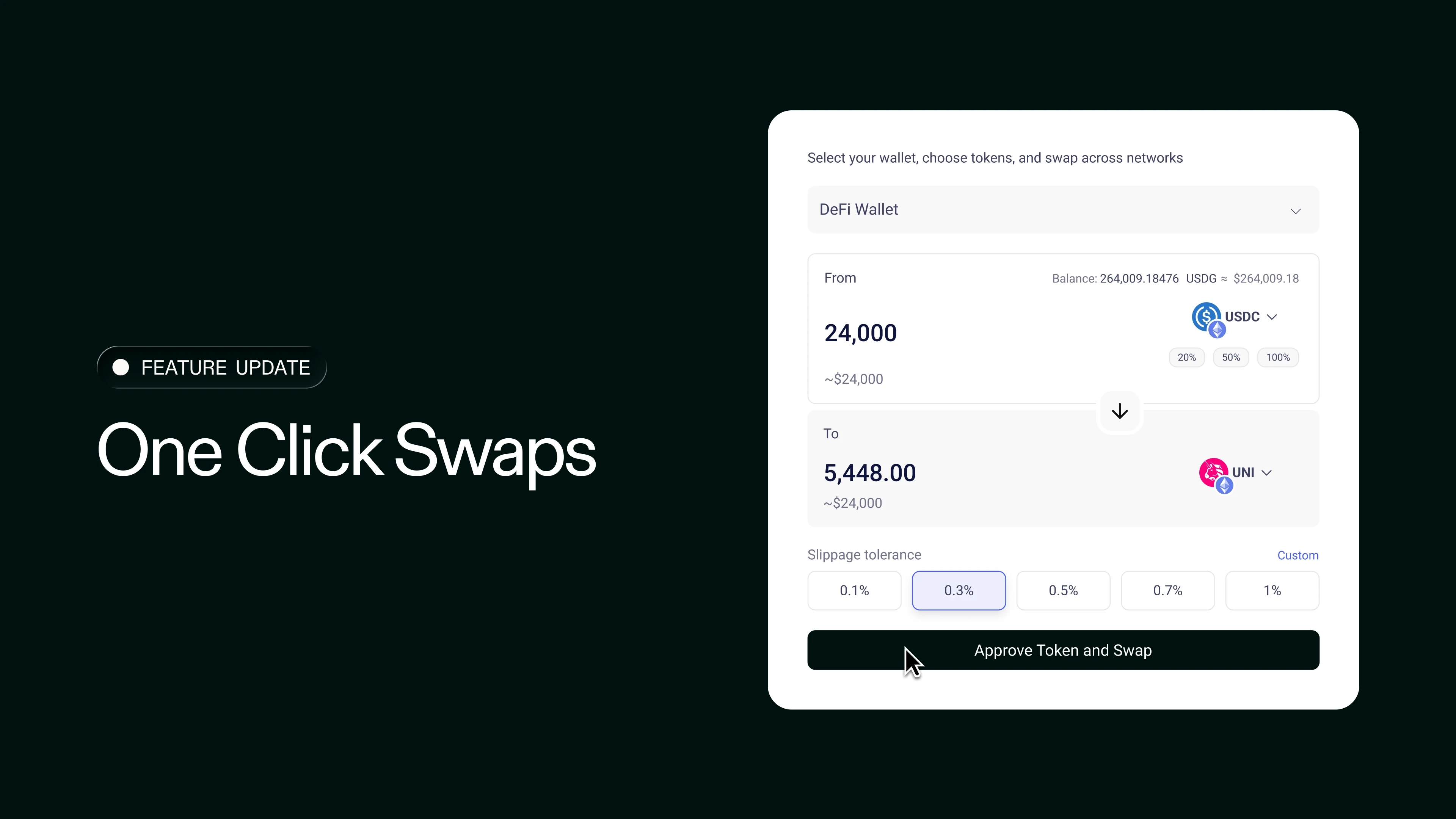
Because Utila supports a wide range of networks, automated workflows can include on-chain swaps or cross-chain bridges. For example, after receiving USDC on Ethereum, an automated flow can trigger a swap to USDT or bridge to Polygon – executed entirely via API.
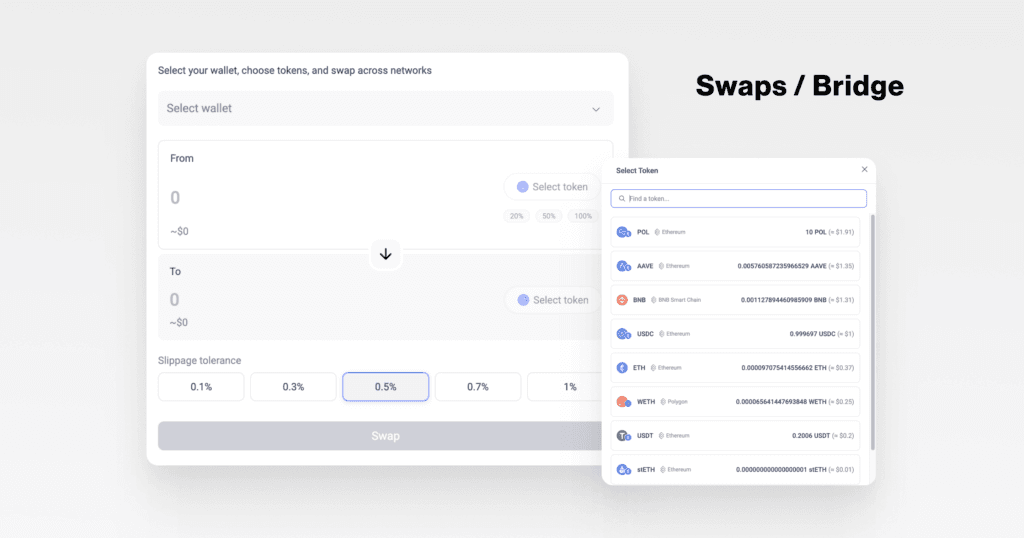
Swapping and bridging assets in Utila
With Utila’s extensive multi-chain support, you aren’t locked into one network when designing a payment flow.
End-to-End Fiat Integration
Utila connects crypto workflows to fiat rails. Through its on/off-ramp integrations, your application can push funds to traditional systems. For example, after collecting stablecoins for overseas payments, your workflow can call Utila’s on-ramp to Bridge (as shown in the image below) to convert any leftover crypto back into USD and remit to a global bank account.
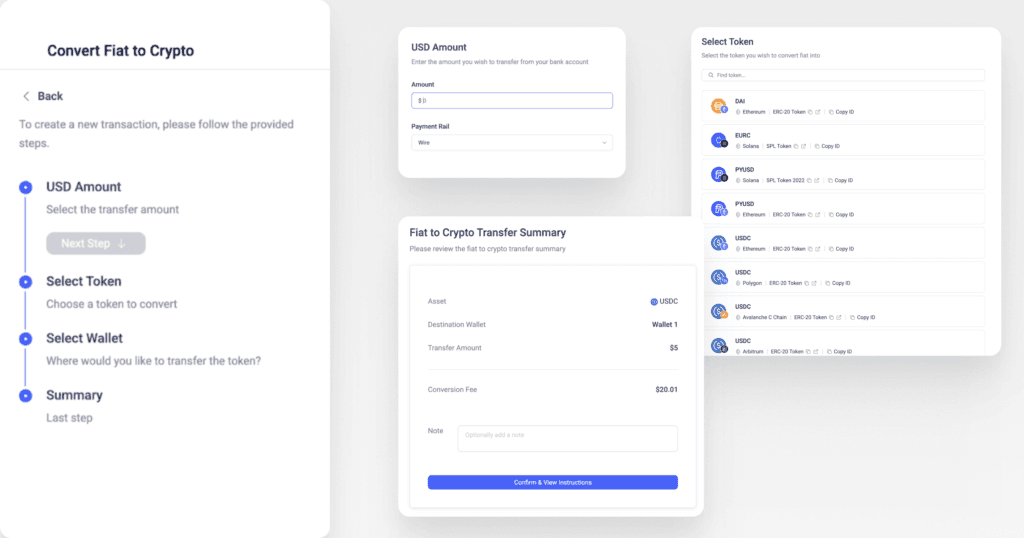
On/off ramping workflow
This closes the loop: a customer can pay you fiat (on-ramped to stablecoin), you process payment logic with Utila, then you off-ramp funds to your bank seamlessly, all via API.
We’ve been empowering multiple Neobanks, PSPs and stablecoin platforms like MS Pay, Austospend, Unblock, Stable Mint and others – all of whom are leveraging our entire set of features at scale to utilize stablecoins in their core offering.
The Infrastructure Modern Businesses Actually Need
Workflow automation with stablecoins represents a fundamental shift from batch processing to event-driven finance. When a customer payment triggers instant service activation, when vendor invoices self-execute based on delivery confirmation, when payroll runs continuously rather than biweekly – that’s when businesses realize the true potential of programmable money.
The companies using Utila for workflow automation aren’t running experiments or pilots. Payments firms like MS Pay automate client settlements and withdrawals. Payout platforms such as Autospend use batch disbursements and real-time webhooks to minimize manual reconciliation. And stablecoin EMIs like Stable Mint run policy-driven compliance checks and treasury sweeps – all on the kind of API-driven workflow infrastructure described in this article.
The question for modern finance teams isn’t whether to automate payment workflows, but how quickly they can implement before competitors gain the efficiency advantage. With Utila’s modular approach, companies can start with a single automated flow – perhaps vendor payments or customer refunds – and expand as they see results. The APIs are documented, the webhooks are tested at scale, and the compliance framework is battle-tested by institutions processing millions daily.
Start Automating Your Payment Workflows with Utila
Ready to eliminate manual payment processes? Our integration team has helped dozens of companies implement automated workflows. Contact our team to discuss your automation requirements.
This article is Part 2 of our 4-part series on how Utila’s modular infrastructure is helping transform institutional operations with stablecoin adoption:
Part 1: Treasury Management: Modernize cash operations and eliminate settlement delays
Part 2: Workflow Automation (this article): Eliminate manual processes and scale operations
Part 3: OTC Desk Operations: Scale trading capabilities with institutional-grade infrastructure
Part 4: Stablecoin Issuance: Launch and manage your own digital currency

Content Marketing Lead
Marcin Miłosierny is Content Marketing Lead at Utila, with experience creating content for regulated finance at Sygnum and technical analytics products at Glassnode.