In 2025, stablecoins showed they can move value globally with lower friction: faster settlement, streamlined payouts, and more efficient treasury operations. For anyone still doubting whether these use cases are proven, the strongest signal is who is building: Stripe, Mastercard, and a growing set of major fintechs are investing heavily in stablecoin rails.
In 2026, we don’t expect the pace of this adoption to slow down – more fintechs, payment companies, and banks will start using stablecoins as their payments and treasury infrastructure. We will also see high-volume money movers like financial institutions, marketplaces, payroll platforms, and gig-economy operators adopting them as well.
However, as stablecoin settlement becomes standard, the competitive edge will lie not in the simple fact of adoption but in how it is executed. For companies managing complex global pay-ins, payouts, and settlement operations, the critical question will become building a digital asset operation in a way that lets them control the technology stack underneath. This is the evolution from Stablecoin 1.0 to Stablecoin 2.0, and understanding it is essential for any financial institution planning its strategic roadmap in 2026.
Stablecoin 1.0: The Black Box and its Limitations
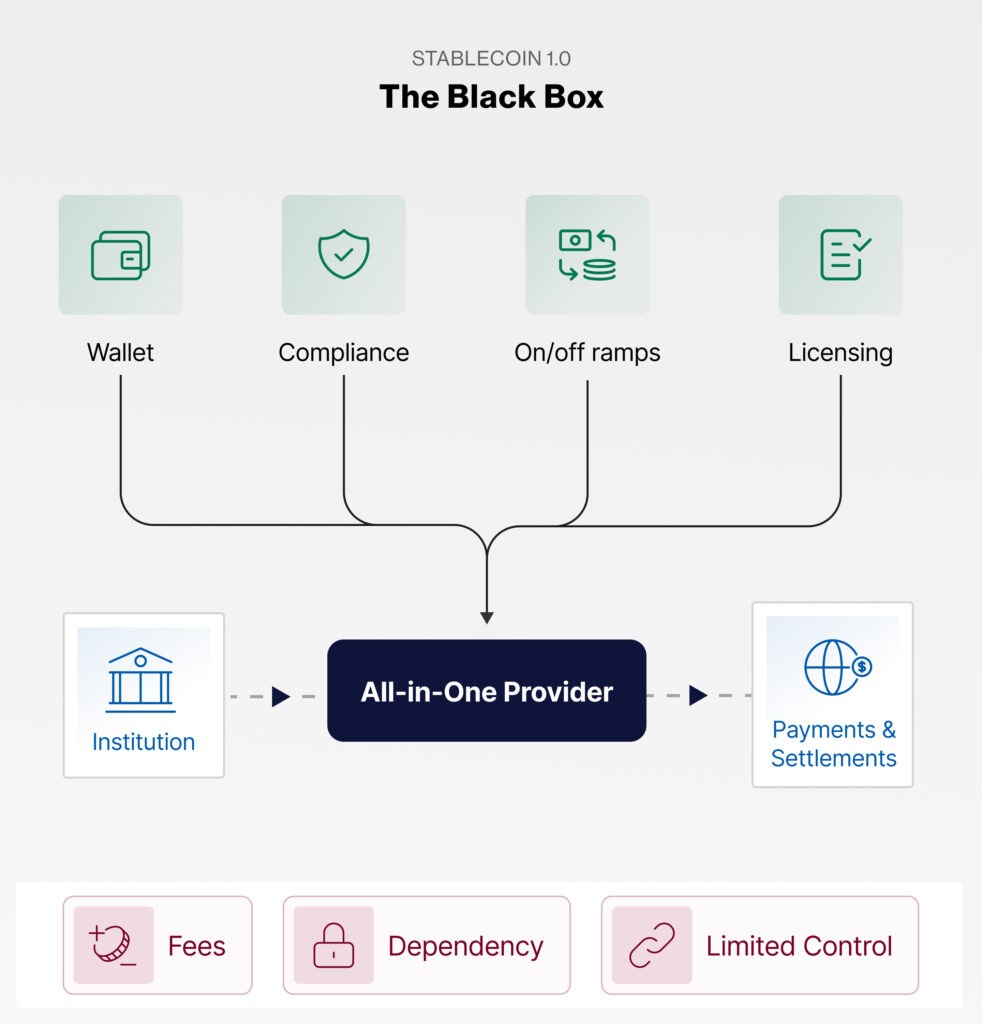
Today, most institutions access stablecoin liquidity and payment capabilities through external platform providers offering an all-in-one bundle – wallets, compliance, on/off-ramps, and licensing under a single umbrella. We characterize this as Stablecoin 1.0: a model that has proven the use case and enabled rapid market entry, especially for teams that want to test the waters without the infrastructure investment.
The trade-off is that the stack is largely pre-packaged and opaque – essentially, a black box. The platform provider brings the relationships across the underlying components, and the institution plugs in quickly – but with limited visibility into how each layer works, who powers it, and how flexible it is as requirements evolve. The initial convenience becomes increasingly limiting as operations scale, leading to:
Margin erosion: Each transaction carries a third-party fee, and even if the provider secures low underlying costs, they can retain a meaningful share – at scale, that becomes a material drag on profitability.
Dependency risk: When stablecoin operations run on external infrastructure, workflows become coupled to a third party’s uptime, tooling, and release cadence, limiting the ability to tailor flows, iterate on products, or respond to market-specific requirements.
Loss of control: The black box makes it difficult to negotiate directly with liquidity providers, optimize compliance workflows, or retain direct control of private keys.
The Black Box Solution
Before volumes show up, starting with a black-box solution makes sense. But when volumes start growing – and stablecoins become a strategic priority rather than an experiment – these limitations surface quickly.
Stablecoin 2.0: Taking Control of the Stack and the Margins
In conversations with leading payment companies, we note that many are already experiencing the limitations of the black box model and looking for an alternative. To reduce dependency, these organizations often start by choosing a solution that gives them more control over wallet operations and transaction workflows – approvals, roles, and limits – instrumental for running payments and treasury at scale.
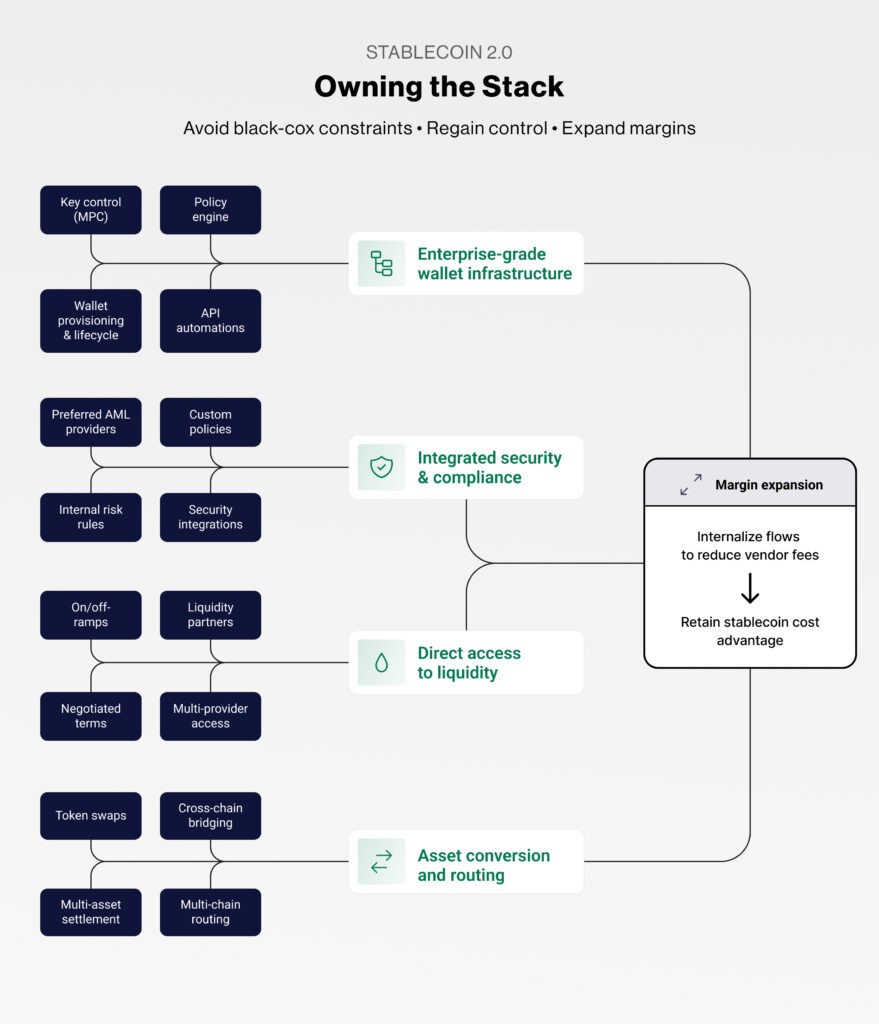
However, to truly avoid black-box constraints requires owning at least four elements of the infrastructure stack:
Enterprise-grade wallet infrastructure: Integrated wallet systems that govern assets, policies, and transaction flows – starting with control of private keys.
Integrated compliance: Direct integrations with preferred AML partners, with internal ownership of policies and risk parameters.
Direct access to liquidity: Direct connectivity to on/off-ramps and liquidity providers, negotiated terms, and multi-provider coverage across jurisdictions.
Asset conversion and routing: The ability to swap and bridge across assets and networks to meet counterparty requirements (e.g., receiving USDT but settling in USDC because that is what an off-ramp supports)
Stablecoins 2.0: Control the Stack, Control the Margins
The biggest advantage and rationale for owning the full stack is margin expansion. By internalizing transaction flows, companies capture value that would otherwise be ceded to vendors. In a world where stablecoin volumes are measured in billions, recapturing even a fraction of intermediary margin can translate into significant revenue.
This is particularly critical in payments, where margin optimization is an existential concern. Stablecoins are attractive precisely because they can reduce costs compared to traditional rails. But when excessive fees are paid to a black-box provider, much of that advantage is surrendered. Owning the stack means retaining the full benefit.
Flexible Licensing and Full Autonomy
For many organizations, the transition to Stablecoin 2.0 runs into an obstacle: licensing. Traditional payments licenses are often insufficient for stablecoin activity. In Europe, for example, even firms operating under EMI or Payment Institution frameworks typically need additional MiCA authorization to offer stablecoin services to clients. Obtaining that approval can take a year or more and demands meaningful regulatory effort.
That creates a practical dilemma. The strategic case for owning the stack is clear, but waiting 12+ months to start operating is rarely acceptable. Teams want to begin building and validating volumes now, while licensing applications move through the regulatory process.
One practical idea to solve this would be a transition model that pairs proprietary technology with flexible regulatory coverage: starting operations under an established licensed framework while building the permanent technology stack from day one. When a company secures its own authorization, it transitions to full autonomy without migrating infrastructure or re-integrating workflows. The result is immediate market entry with a clean path to independence.
How Utila Enables Stablecoin 2.0
Utila is built for institutions that want the Stablecoin 2.0 outcome: control over the stack, control over counterparties, and control over unit economics – without inheriting the constraints of a black-box provider.
Enterprise-grade MPC wallets: A highly secure, enterprise-grade, non-custodial wallet foundation with MPC-based key control and granular policy enforcement over assets and transaction flows.
Compliance by design: Native integrations with leading AML/KYT providers (Chainalysis, TRM, Elliptic etc.), enabling institutions to choose a preferred vendor and operationalize monitoring as part of standard workflows.
Direct liquidity and connectivity via Utila Link: Utila Link expands beyond on/off-ramps. It is a connectivity layer for liquidity – enabling direct access to multiple on/off-ramp and liquidity providers, with the ability to negotiate terms directly and diversify execution across partners and jurisdictions.
Native conversion and multi-chain execution: Built-in cross-chain swap and bridging, multi-chain support, and BYO EVM, so settlement can be routed in the asset and network counterparties require without re-platforming.
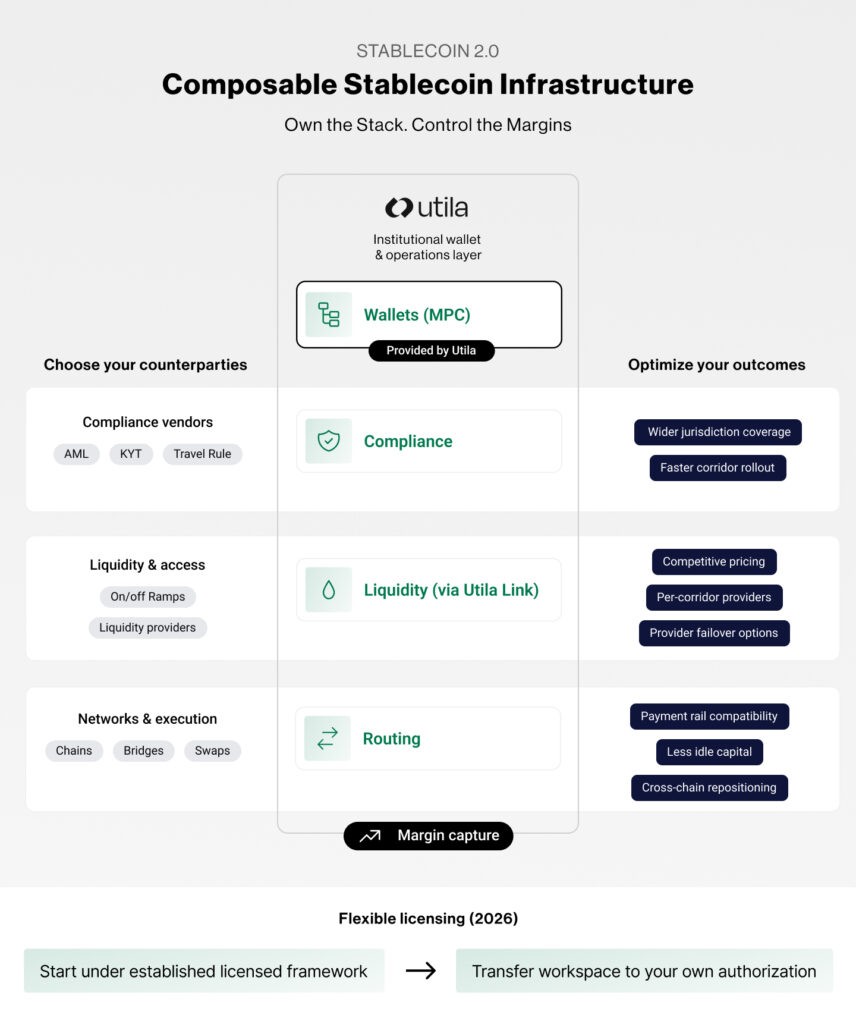
Utila’s Composable Stablecoin Stack
Solving licensing without forcing a black-box stack is Utila’s key frontier for 2026. Utila is building a flexible licensing model that lets institutions start operating under an established licensed framework while building the permanent stack on Utila from day one. When an institution secures its own authorization, workspace ownership can be transferred so operations continue on the same infrastructure.
This is the practical path from Stablecoin 1.0 to Stablecoin 2.0: start fast, build on infrastructure that remains owned and flexible, and transition to full autonomy the moment licensing catches up. Stablecoin 2.0 is an execution advantage. Utila provides the infrastructure to build it – owned, composable, and designed to scale.
Is your organization ready to move past the black box? Speak with us about building a composable, owned stack that supports multi-provider execution, enables corridor-specific routing, and adapts as your requirements change.