Executive Summary
Agentic payments move authorization from the individual transaction to a signed mandate, which lets autonomous agents execute transactions inside rules a person or an institution approved once. For payment service providers, financial institutions, and enterprise treasuries, the practical questions are narrow: how agentic payment systems verify who the agent is, how policy stops a transaction that falls outside its mandate, how regulatory compliance and risk management work when the transactor is software, and where in the payments value chain the margin ends up. This guide answers those questions in order, from the definition through the mechanics, the competing protocols, the risk surface, and the wallet infrastructure that has to sit underneath before any of it reaches production.
What Agentic Payments Change for Payments Providers
Agentic payments are financial transactions initiated, authorized, and executed by autonomous AI agents within predefined mandates, without a human approving each step. What changes is where authorization lives. A person or an institution signs off on a set of rules once, and software then decides what to pay, when, and to whom inside those rules.
If you run payments at a fintech, a PSP, or a bank, the questions that follow are operational. Who carries liability when an agent pays the wrong counterparty. How an agent proves it holds valid authority at the moment it spends. Which rails settle fast enough for software that transacts hundreds of times an hour. What your infrastructure has to enforce so that an agent with standing authority does not become an attacker with a working credential. Published projections put spending routed through agentic AI at roughly $155 billion by 2030 and place about $250 billion of existing payment volume within reach of agent-initiated flows, which is enough money for those questions to arrive before the category settles.
This guide covers the definition, the four-stage mechanics, the difference between agentic payments and scheduled automation, the use cases running today, the competing standards from Visa, Mastercard, Google, OpenAI, Anthropic, Coinbase, and Stripe, why stablecoins carry most agent-to-service settlement, the risk surface, and the infrastructure requirements underneath all of it.
What Is an Agentic Payment?
A payment becomes agentic when a reasoning layer stands between the instruction and the execution. Conventional automation replays a fixed instruction: pay $4,200 to this supplier on the 15th. An agent evaluates conditions at the moment of payment, decides whether a transaction should happen at all, and selects the counterparty, the amount, and sometimes the rail.
That discretion is bounded by a mandate, the signed set of rules the agent operates under: approved merchants, spending caps, categories, timeframes, and the conditions that force escalation to a human. A procurement mandate might allow up to $5,000 a week across eleven named suppliers and nothing else. Inside those limits the agent acts on its own, and outside them the credential does not work. Most implementations pair the mandate with a scoped credential, a payment token bound to specific parameters such as merchant, amount ceiling, and time window, so a credential lifted from an agent's runtime cannot be reused anywhere else.
Two conditions make that arrangement workable in a regulated setting. The mandate captures explicit consent from the person or the institution granting it, which is what allows autonomous agents to act on a user's behalf and produce evidence of their authority afterward. The mandate is also machine-readable, so when the agent determines that a purchase fits the rules, it can execute transactions without human approval on each item and without human intervention in the run itself, while anything falling outside the rules stops and waits for a person. Decision making is delegated; authority is not.
Four attributes separate agentic payments from the automation your systems already run:
Autonomous execution. The agent completes the transaction without a human approving that specific payment.
Mandate-bounded authority. Permissions are explicit, enumerated, and revocable rather than open-ended.
Real-time context. The agent reads current prices, inventory, balances, or compliance status before it acts.
Delegated authorization. A human authorizes the parameters once; the agent then authorizes each transaction against them.
Deployments fall along a spectrum. Agent-assisted flows leave a person approving each transaction and use the agent for selection and preparation, which is where most enterprise pilots have started through 2026. Fully autonomous flows hand execution to the agent and bring a human back only when a rule trips.
How do Agentic Payments Work?
Four stages carry an agentic payment from human intent to settled funds: mandate setup, credential issuance, autonomous execution, and audit. The sequence matters, because each stage constrains the next.
Mandate setup. You define what the agent may do: which merchants or wallet addresses it can pay, per-transaction and cumulative caps, approved categories, valid timeframes, and the conditions that route a decision back to a human. These rules are signed, which is what makes them enforceable rather than advisory, and they live in a policy engine, the programmable rule layer that decides which transactions execute and which escalate.
Credential issuance. The agent receives a scoped credential rather than your payment details. In card flows this is tokenization, where raw credentials are replaced with tokens that only function inside the mandate's boundaries, issued through network tokens or agent-specific cards such as Ramp Agent Cards. In on-chain flows it is a signing permission scoped to a wallet, a set of destinations, and a value ceiling. Either way, the agent never holds the underlying instrument.
Autonomous execution. The agent evaluates live conditions, checks the proposed transaction against the mandate, selects a rail, and settles. A purchasing agent comparing three suppliers at 2am does this without waking anyone; a treasury agent rebalancing across chains does it when a threshold breaks rather than when a schedule fires.
Audit. Every intent, constraint check, and action writes to an append-only record. Compliance teams need this to answer what authority the agent held at execution time, and merchants need it to defend disputes months later.
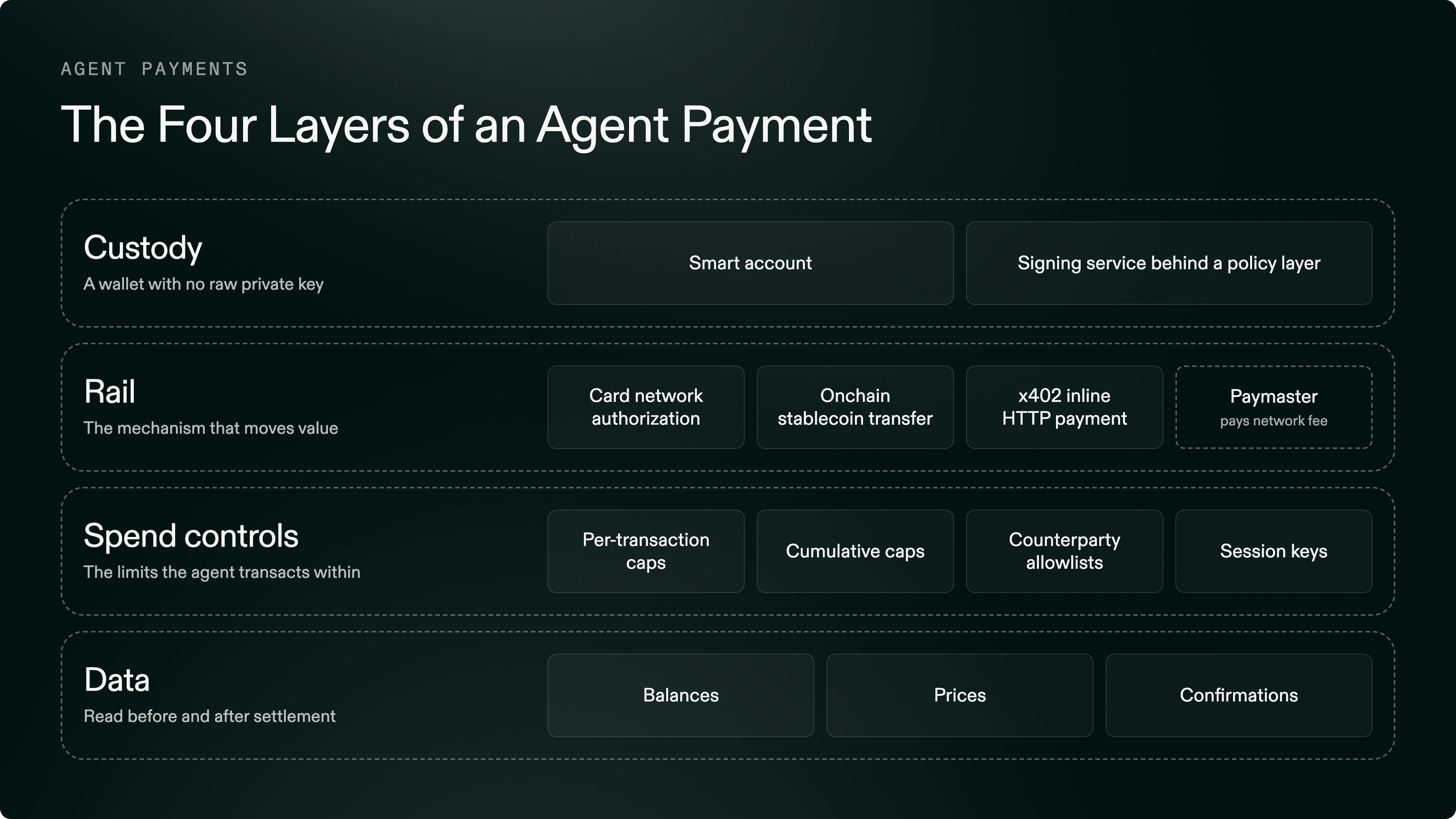
Agentic payment systems reuse most of what you already run: the business logic your risk and finance teams maintain, payment credentials that stay inside the token vault or the signing layer, and transaction data written back to the ledgers your team already reconciles. What is new is the layer that turns those rules into something an agent can read and a policy engine can enforce at the moment of signing.
A $49 subscription charge on a stored card fires on the same date every month, carries no evaluation of whether the service is still in use, and enforces nothing beyond the amount agreed at signup. An agentic version of the same payment checks the mandate, verifies the counterparty, and can decline on conditions the original authorization never had to expect.
Agentic Payments vs. Traditional and Automated Payments
Most payment operations already run two of the three models below. Placing the third against them is usually enough to see which workflows it belongs in.
Manual payments | Automated payments | Agentic payments | |
|---|---|---|---|
Control model | Human decides and approves each transaction | Human sets a rule; system executes it literally | Human sets a mandate; agent decides within it |
Timing | On demand | Fixed schedule or fixed trigger | Whenever conditions are met |
Reasoning | Human judgment per transaction | None | Model evaluation against live context |
Boundary enforcement | Approval workflow | Amount and date parameters | Signed mandate, scoped credential, policy engine |
Two comparisons come up repeatedly. The first is robotic process automation, which executes deterministic steps and fails when an input falls outside its script, where an agent selects among options and adapts to conditions it was never explicitly shown. Programmable money is the second, describing properties of the asset, such as conditional transfer logic written into a smart contract, where agentic describes a capability of the payer. The two compose well: an agent instructed to pay the cheapest compliant supplier under $500 can settle from a policy-governed USDC wallet and use both at once.
There is a structural point behind the table. Existing payment systems were designed around human behavior, which is why card transactions carry signals such as device fingerprints, session patterns, and a cardholder available to confirm a purchase. Agent traffic produces none of those, so the checks have to move to the mandate, the credential scope, and the contract terms agreed with the counterparty before the transaction runs.
Agentic payments handle the unpredictable but bounded middle. When the decision rule is clear but the timing, amount, or counterparty is not known in advance, neither a scheduled ACH run nor a manual approval queue fits well, and that is the space agents occupy.
Where Agentic Payments are Used Today
Seven patterns account for most production and pilot activity across fintech, treasury, and infrastructure teams.
Autonomous service payments. Agents pay for API calls, data, inference, and compute as they consume them, settling in stablecoins through protocols such as x402, an open protocol from Coinbase that uses the HTTP 402 status code to let machines pay for resources mid-request. Pricing moves from monthly seats to per-call settlement.
Agent-to-merchant settlement. The agent acts as a payer wallet, signing transactions inside its mandate while policy controls block destinations and amounts that fall outside it. Merchants receive a payment carrying verifiable authorization data rather than a card number and a hope.
Cross-chain treasury rebalancing. Treasury agents move stablecoin balances between chains when spreads or balance thresholds justify it, routing through swap aggregators. The trigger is a live condition rather than a fixed hour, which is what separates this from a standing transfer instruction. The same pattern extends to desks that let agents execute trades against approved venues under a treasury policy the operator sets.
Yield optimization. Agents deploy idle stablecoin balances into approved yield positions and unwind them when conditions change. The venue list and the exposure ceilings stay fixed in policy rather than in the agent's judgment.
Automated disbursements. High-frequency payouts to merchants, drivers, creators, or suppliers run with pre-execution validation, sanctions screening, and transaction monitoring on every item, so human review is reserved for the exceptions that break a rule. Payment companies already run this volume through stablecoin payout rails, which is why disbursements tend to be the first flow handed to an agent.
B2B invoice settlement. An agent pulls matching invoices, confirms delivery or milestone data against the source system, and routes vendor payouts. Approval authority stays with finance, exercised over the mandate and the exception queue rather than over each individual invoice.
AI-to-AI micropayments. One software agent pays another for a completed task, a dataset, or a model call. Amounts are often fractions of a cent. Card interchange rules those out on economics alone, which pushes settlement on-chain.
Online Shopping and Automated Procurement
Two of these patterns attract most of the public attention, and they sit at opposite ends of the same stack. In online shopping, an assistant reads user preferences, compares products, and carries the buying process through checkout, which changes what merchants can see about purchasing decisions: the shopper is present in the mandate rather than in the session. In automated procurement, an agent checks stock levels and market conditions, reads contract terms against a preferred supplier list, and releases a purchase order that one agent on the buyer side can settle with other agents on the seller side without a call.
The common thread is that the person moved upstream. They now set the rules, the limits, and the escalation points, then review exceptions instead of line items.
Agentic Payment Protocols and Standards
Seven frameworks now compete to standardize how an agent proves authority and moves money, and they solve overlapping pieces of the same problem. None of them has won.
Visa Intelligent Commerce (Visa). Launched in 2025, it lets AI agents transact on tokenized Visa credentials with consumer-set limits. Visa confirmed hundreds of live AI-only transactions by December 2025. The companion Visa Trusted Agent Protocol, also introduced in 2025, gives merchants a method for recognizing legitimate agent traffic.
Mastercard Agent Pay (Mastercard). Launched in April 2025, it extends tokenized card credentials to agent-initiated purchases and supports wallet integrations including PayPal.
Agent Payments Protocol, or AP2 (Google). An open standard built on signed user intent tokens, which prove that a human authorized a given scope of spending and travel with the transaction across environments. The design goal is verifiable intent: a merchant or a bank can check what the person approved before agentic transactions settle.
Agentic Commerce Protocol, or ACP (OpenAI with Stripe). A standard for how consumer shopping agents discover merchant catalogs, place orders, and check out, aimed at the assistant-to-merchant path.
Model Context Protocol, or MCP (Anthropic). An open standard for connecting AI models to external systems, including payment tools. It is not a payment rail, but it defines how an agent reaches one.
x402 (Coinbase). Uses the dormant HTTP 402 status code for machine-to-machine stablecoin payments, with the payment happening inside the request rather than through a separate checkout. On Solana it had processed more than 35 million transactions and over $10 million in volume as of mid-2026. [VERIFY: Coinbase has also reported 100 million-plus x402 payments network-wide; confirm whether the per-chain or the network-wide figure should publish.]
Machine Payments Protocol, or MPP (Stripe with Tempo). Applies bounded spending limits to agent accounts and clears batched micro-settlements, aimed at the agent-to-service side rather than consumer checkout.
Universal Commerce Protocol, or UCP (Google with Shopify and retail partners). Covers the full commerce lifecycle from product discovery through checkout.
Read across the list and one question connects all of it: how AI agents interact with systems that were built for people. Card networks are answering it by extending payment credentials and identity checks to agent traffic, the model vendors by defining how digital agents reach tools and rails, and the on-chain protocols by making settlement cheap enough for machine frequency. Enabling agents to pay is therefore less a new rail than a new set of checks layered onto existing ones.
Treat these as overlapping layers rather than as a contest with one survivor. Visa and Mastercard are standardizing agent identity and tokenized credentials, Google, OpenAI, and Anthropic are standardizing intent and tool access, and Coinbase and Stripe are standardizing settlement for amounts that card economics cannot carry. Infrastructure that will still be usable in three years supports several at once.
Why Stablecoins Power Agentic Payments
Stablecoins are digital assets pegged to a fiat currency, most often the US dollar, and they are the natural settlement rail for agent-initiated payments because they combine instant global settlement, sub-cent transaction cost, programmatic auditability, and price stability inside one asset. Card rails and bank transfers were designed around human transaction frequency and human working hours. Agents match neither.
Settlement in seconds, continuously. An agent transacting at 3am on a Sunday does not wait for a banking window or a batch cycle.
Cost per transaction measured in fractions of a cent. Micropayments for an API call or a dataset are economically impossible on card interchange.
Verifiable on-chain records. Every transfer produces a record your reconciliation and compliance processes can check independently.
Access without a local banking relationship. Cross-border agent payouts clear without correspondent banking chains.
Value stability across the transaction window. Unlike volatile digital assets, a dollar-pegged stablecoin holds its value between the decision and the settlement.
Processing costs decide more of this than speed does. Card transactions carry a fixed fee floor that makes a $0.002 payment impossible to price, and banking infrastructure built on batch files adds a per-item cost before anything clears. Agent to agent transactions in USDC or another dollar-pegged stablecoin clear for a fraction of a cent, which is what lets a service charge per API call instead of per month.
Cards and real-time payment rails will keep handling consumer shopping, where dispute rights and existing merchant relationships matter more than settlement speed. Dollar-pegged stablecoins such as USDC are taking the agent-to-service and agent-to-agent flows, where transaction size is small, frequency is high, and both counterparties are software. Running that settlement on self-custody infrastructure, meaning your organization holds the keys rather than a third party holding them for you, keeps the policy decisions and the funds under your own authority.
What Are the Risks of Agentic Payments?
Every serious failure mode traces back to one fact: an agent holding standing authority is a credential that acts on its own.
Agent identity. You need to verify that an agent is what it claims to be and that its mandate is still valid. The verification pattern emerging for this is KYA, or Know Your Agent: confirming an AI agent's identity, authorization scope, and provenance, much as KYC does for human customers. Standards here are early, so the burden falls on your own infrastructure.
Compromised agents holding standing authority. The highest-severity case. An attacker who controls an agent inherits a working credential and a mandate that permits spending, so containment depends on how fast authority can be withdrawn. The credential itself will check out.
Mandate revocation. Revocation has to take effect at the signing layer within seconds, across every chain and rail the agent touches. Kill the mandate first, unwind exposure second.
Fraudulent counterparties. Storefronts and service endpoints built specifically to exploit agent selection logic, offering the lowest advertised price to win the agent's decision. Allowlists and reputation checks do more work here than anomaly detection.
Chargeback and dispute exposure. To defend a disputed agent-initiated transaction, a merchant has to produce the mandate, evidence of the agent's identity, and a tamper-resistant record of the authorization chain. Missing any of the three usually means losing the dispute.
Regulatory ambiguity. KYC and AML frameworks were written for human transactors, and liability allocation between the user, the agent operator, and the merchant is unsettled in most jurisdictions.
The mitigations are specific enough to test against a vendor: private keys stay isolated from the agent runtime, and policy enforcement happens at the infrastructure layer, where a compromised application cannot bypass it. Transaction monitoring, known as KYT, and Travel Rule checks on qualifying transfers run before execution rather than in a nightly report. Revocation is immediate, and the audit record is full enough to reconstruct what the agent was permitted to do at any past moment.
Risk Management for Agent-Initiated Flows
Treat the list above as a risk management program rather than a launch checklist. Four functions carry most of the weight: the ability to verify agent identity before a transfer executes, fraud prevention tuned to agent interactions instead of to shopping sessions, dispute management that can produce the mandate and the authorization chain on request, and liability management written into merchant and vendor agreements before volume arrives.
Fraud detection is where the retooling shows first. Most machine learning scoring in production reads session behavior, device fingerprints, and typing cadence, and an agent generates none of them. AI powered scoring that can evaluate risk from mandate scope, agent provenance, counterparty history, and velocity replaces those signals. Dispute resolution frameworks are moving more slowly than the technology, so build your evidence trail now, keep regulatory compliance teams in the design conversation, and expect the rules to firm up as agentic payments mature.
Infrastructure Requirements for Enterprise-Scale Agentic Payments
Before evaluating any vendor, write down what the infrastructure itself has to do. These seven capabilities decide whether agentic payments can run inside a regulated production environment, and each one is worth confirming against a live demo rather than a feature page.
Key management that isolates private keys from the agent runtime. MPC, or multi-party computation, splits a private key into shares held separately so no single party, including the agent, can move funds alone. Signing happens outside the agent's process.
Programmable transaction policy controls. Approved destinations, transfer limits, permitted smart contract interactions, and escalation rules, all enforced at signing rather than reviewed afterward.
Pre-execution compliance checks. KYT, Travel Rule, and sanctions screening at the infrastructure layer, so an application bug cannot skip them.
Permission delegation. One access control model covering human-initiated and agent-initiated flows, so agent permissions are managed with the same rigor as employee permissions.
Structured audit and settlement records. Records built for reconciliation and regulatory reporting rather than log files someone parses under deadline.
Multi-chain and multi-asset access. Coverage across the networks and assets your agents will touch, without a separate integration and key ceremony for each.
Self-custody as the default. Bundled custody puts a third party between your organization and your own agents, which limits what your policies can enforce and what your balance sheet can claim.
Most of what you need to enable agentic payments already exists somewhere in your stack, and the work is connecting it under one policy model. Legacy infrastructure built on nightly batch files and email approval chains will not carry agent traffic, because the decision has to be made and enforced in the same second the agent acts. Transaction data is the other half: complete, structured records give finance and compliance teams valuable insights into what agents are buying and where the policies are too loose or too tight, which is what you tune on in the second quarter of a rollout.
Read that list against whatever you run today, then against the implementation described below.
How Utila Supports Agentic Payment Infrastructure
Utila gives fintechs, PSPs, banks, and enterprises self-custody wallet infrastructure for building agentic payment products, with MPC-secured keys, programmable policy controls, pre-execution compliance, and multi-chain coverage across more than 100 blockchains. Six capabilities map to the requirements above.
MPC key management. Agents never hold raw private keys. Signing is distributed across key shares with policy logic embedded in the signing process itself, and Utila Cosigner enforces approval logic on transactions that call for it.
Transaction policy controls. Operators define approved destinations, transfer limits, smart contract interactions, and escalation rules that apply to agent-initiated transactions the same way they apply to human ones.
Pre-transfer compliance checks. KYT and Travel Rule screening run before a transfer executes, at standards built for regulated environments. Utila is SOC 2 Type II certified and audited by Halborn.
Permission delegation. Granular access controls stay consistent across human and agent flows, so an agent's authority is visible and revocable in the same place as everyone else's.
Audit trail and settlement data. Structured records of every action and approval, formatted for reconciliation and compliance reporting.
Multi-chain, multi-asset access. More than 100 blockchains and over 30 integration partners, with Sponsored Transfers covering gas so agents can transact without holding native tokens on every chain.
Payment service providers and financial institutions already apply these controls to human-initiated flows, which is what makes agent-initiated flows an extension of an existing model rather than a second stack to run. The same platform carries stablecoin payments for a PSP, digital asset services for a bank, and embedded wallets for a fintech building on top of the API.
On Utila, the keys stay with your organization, the policies are yours to set, and the customer relationship remains yours, instead of renting a payment surface from a custodian whose terms and margins you do not control.
Agentic payments are moving from pilots into production, and the infrastructure decision you make now determines whether your institution owns that payment surface or rents it. Our Stablecoin Builder sessions cover how payment teams are putting these controls in place.
Book a demo to discuss architecture fit for your agentic payment workflows.
Frequently Asked Questions About Agentic Payments
Is ChatGPT an agentic AI?
By default it is a general-purpose language model. It becomes agentic when equipped with tools, a mandate, and the ability to act without approval at each step. Payment execution additionally needs wallet or credential infrastructure that the model itself does not supply.
Do agentic payments depend on large language models?
Most agents are built on large language models, which supply the reasoning and the tool use. The payment path does not depend on the model: authorization, policy enforcement, and settlement run in infrastructure the model calls into, so changing the model does not change how the money moves.
How do banks use agentic AI?
Deployments concentrate in treasury automation, invoice reconciliation, disbursement processing, credit analysis support, and compliance triage. Payment-executing agents lag well behind the analytical ones, mainly because authorization, liability, and audit requirements remain unsettled.
What are the four major payment processors used by agents?
For cards, the major networks are Visa, Mastercard, American Express, and Discover. Agentic payments intersect with them through frameworks such as Visa Intelligent Commerce and Mastercard Agent Pay, which extend tokenized credentials to agent-initiated purchases.
Which digital payment method is safest?
Safety depends on architecture rather than method. An agentic payment with MPC-secured keys, a scoped credential, enforced policy limits, and immediate revocation carries less exposure than a stored card number with no spending boundary attached to it.
When should you use agentic payments?
Use them when the decision rule is bounded but the timing or the counterparty is not known in advance. Rebalancing treasury across chains when spreads move qualifies. Paying a fixed office lease on the first of the month does not.
Are agentic payments secure?
Security is a property of the infrastructure rather than of the agent. What decides it: whether keys stay isolated from the agent runtime, whether policy is enforced at signing, whether compliance checks run before execution, and how fast a mandate can be revoked.

Content Marketing Lead
Marcin Miłosierny is Content Marketing Lead at Utila, with experience creating content for regulated finance at Sygnum and technical analytics products at Glassnode.