Executive Summary
The Optimism Foundation needed a way to generate onchain treasury yield without leaving critical DeFi risks unmanaged or adding manual insurance workflows around each allocation. Working with OpenCover, Morpho, Nexus Mutual, Gauntlet, and Utila, the Foundation used Covered Vaults to embed protection directly into a Morpho vault position, allowing cover to move with the allocation itself.
Utila provided the institutional wallet infrastructure, governance workflows, and policy controls used to execute and monitor the covered position. The result was a 7-figure covered stablecoin allocation on OP Mainnet that generated 4.62% net covered APY over its first 24 days, while transferring defined technical and economic risks to specialist underwriters.
Read on to see how the workflow was structured, why it mattered during one of DeFi’s most severe stress-test periods, and what it means for institutional onchain treasuries.
The DeFi Risk Transfer and What It Means for Onchain Treasuries
April 2026 showed how difficult it is to manage treasury risk in an interconnected DeFi environment. The month saw nearly one exploit per day and more than $600 million in losses. In several cases, the impact extended beyond the protocol that was directly attacked, because vaults, lending markets, collateral assets, and liquidity venues often depend on one another.
For onchain treasury teams, that creates a practical problem. Diligence, diversification, monitoring, and wallet-level controls can reduce exposure, but they cannot remove every technical or economic failure mode inside a live DeFi position. An active treasury strategy needs a way to keep capital deployed while transferring defined tail risks, such as smart contract exploits, oracle failures, governance attacks, or bad debt, to specialist underwriters.
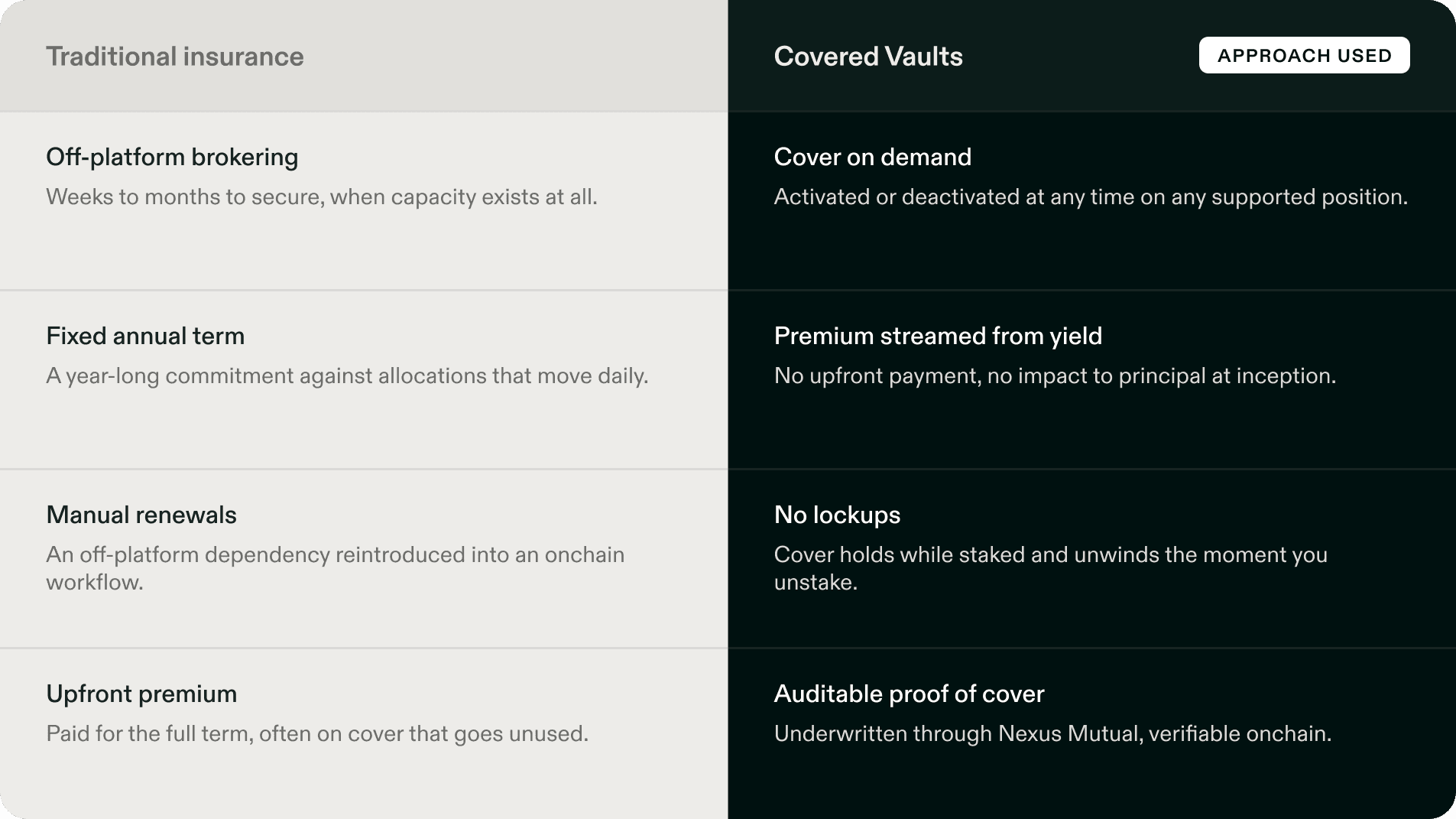
Historically, that risk transfer has been difficult to use in day-to-day onchain treasury operations. Cover has often been arranged through separate off-platform processes, committed for fixed terms, paid upfront, and managed manually. That structure does not fit allocations that may be adjusted, increased, reduced, or unwound as market conditions change.
This is the gap Covered Vaults were designed to address: placing cover inside the vault allocation itself, so protection can move with the position rather than being managed as a separate insurance workflow. For the Optimism Foundation, the key question was whether that model could run inside its existing Utila treasury infrastructure, with the same wallet controls, governance workflows, and policy framework already used for onchain execution.
The Optimism Foundation’s Requirements for Covered Treasury Yield
The Optimism Foundation stewards the Optimism Collective, the governance body of the OP Stack. That stack powers more than 50 chains, including OP Mainnet, Base, and World Chain, accounting for over 40% of the Layer 2 market with roughly 17 million daily transactions and combined TVL above $5 billion.
Managing the Collective’s onchain treasury under an active mandate is one of the Foundation’s core responsibilities, with Utila providing the wallet infrastructure, governance workflows, and policy controls used to execute and monitor that activity.
Three requirements shaped how the Foundation approached covered onchain allocations:
Tail-risk transfer: The active mandate required a way to put capital to work while transferring defined catastrophic risks to specialist underwriters.
Position-level visibility: The team needed to see what was covered, what each position was worth, and whether protection remained active.
Operational fit: Cover had to work inside the same Utila infrastructure used for treasury execution, approvals, policy enforcement, and monitoring.
Together, these requirements made operational design as important as yield or coverage terms. The right solution had to protect the position while preserving the treasury controls the Foundation already used.
What Covered Vaults Are and How They Work
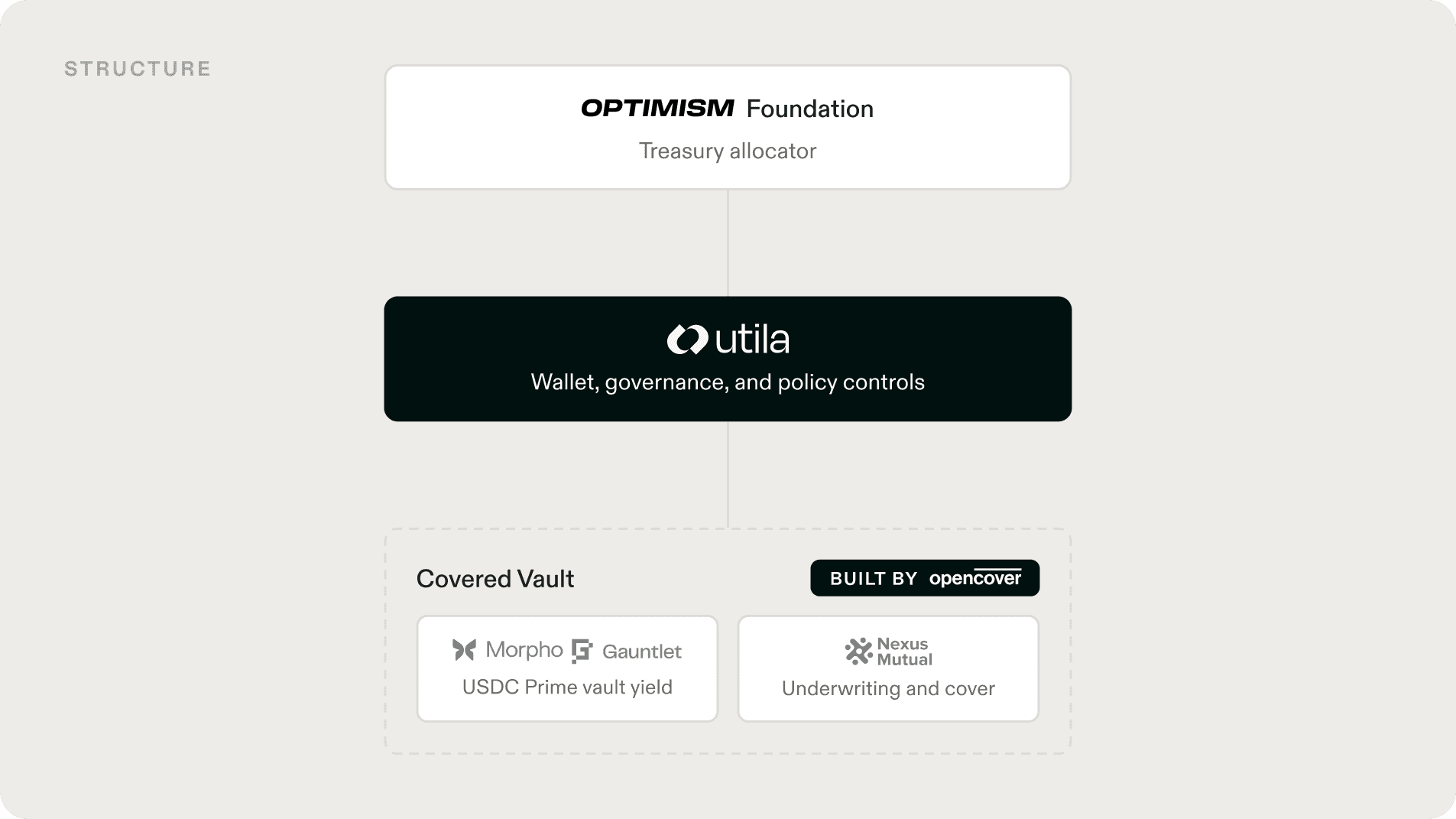
Covered Vaults is an onchain coverage primitive built by OpenCover with Morpho, Nexus Mutual, Utila, Kiln, and 15 further design partners. It embeds cover directly into tokenized vault strategies, so protection stays attached to the vault position rather than being purchased and managed separately.
The model covers major technical and economic risks that have affected DeFi since 2019, including smart contract exploits, oracle manipulation or failure, governance attacks, and bad debt caused by collateral failures in upstream protocols.
Four features make the structure better suited to institutional onchain treasury workflows:
Cover on demand: Protection can be activated or deactivated at any time on any supported vault position.
No upfront payment: Premium streams continuously from the underlying vault's yield rather than reducing principal at inception.
No lockups: Cover holds only while the position is staked and unwinds the moment it is unstaked.
Auditable proof of cover: Underwriting runs through Nexus Mutual, with proof of cover verifiable onchain and underwriting capital locked onchain to back payouts.
Covered Vaults use ERC-4626, a common Ethereum standard for tokenized vaults. That compatibility allowed the covered position to be managed through the same Utila infrastructure the Foundation already used for wallet operations, approvals, policy enforcement, and monitoring.
How Utila Enables Covered Vault Operations for Optimism
Utila provides the Optimism Foundation with the institutional wallet infrastructure, governance workflows, and policy controls required to manage all treasury activity. Because the Covered Vault position lived in Utila, the team did not adopt a parallel process to use it. Activating cover, adjusting the allocation, and unwinding the position all happened within the wallet, governance, and policy controls the team already enforced.
That placement also answered the visibility requirement. The covered position stayed trackable directly in Utila, alongside DeFi portfolio trackers such as DeBank, so the team could see what was covered and whether protection remained in force without leaving its system of record.
Utila’s role as a design partner helped shape that operational fit. Covered Vaults were built to work through institutional treasury infrastructure, allowing cover to be managed within the same controls used for execution, approvals, policy enforcement, and monitoring.
Treasury Management
Securely manage your company’s day-to-day digital asset treasury operations.
The 7-Figure Covered Morpho Vault Allocation on OP Mainnet
OpenCover worked with Nexus Mutual, Utila, and Gauntlet, a yield curator with $1.5 billion in assets across vaults and more than 150 live fintech and institutional integrations, to deliver a high-capacity Covered Vault on Morpho's OP Mainnet deployment. The Optimism Foundation made an initial 7-figure allocation to the Covered Morpho × Gauntlet USDC Prime vault.
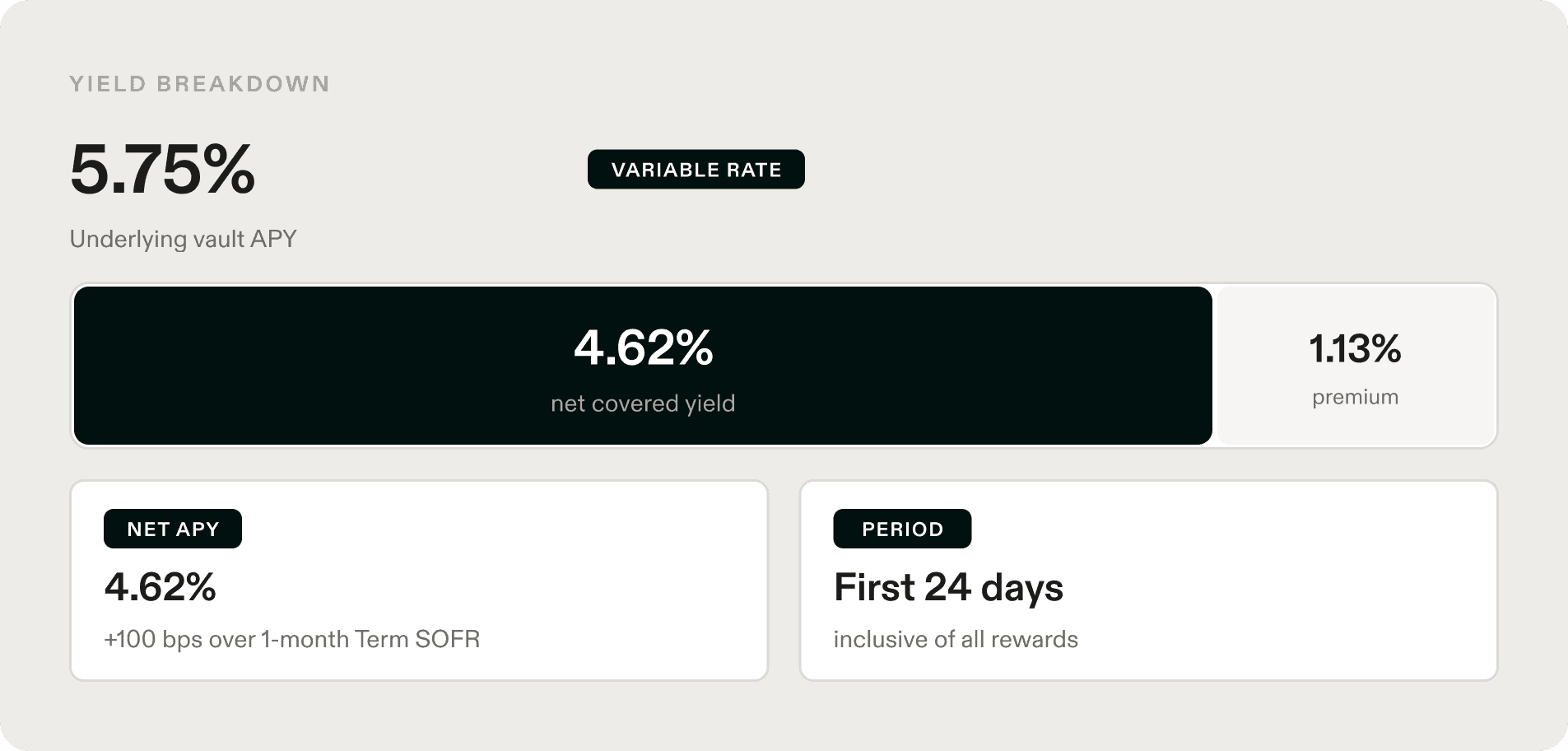
Over the first 24 days, the position returned an average net covered yield of 4.62% APY inclusive of rewards: a variable underlying vault APY of 5.75%, less a fixed cover premium of 1.13%. That placed the Foundation roughly 100 basis points over one-month Term SOFR on a covered stablecoin position, with near-zero incremental operational overhead. The full set of covered technical and economic risks moved to specialist underwriters in a single onchain action, and the position stayed legible to the team throughout.
Why Covered Vaults Matter for Institutional Onchain Treasury Management
For companies managing treasury assets onchain, the Optimism Foundation’s allocation shows a broader operational point: yield, cover, and treasury controls need to work together. A covered vault position only becomes practical for institutions when it can be approved, executed, monitored, and unwound through the same infrastructure that governs the rest of their digital asset operations.
That operating layer is what Utila provides: wallet infrastructure, governance workflows, policy controls, and monitoring for onchain treasury activity. In the context of Covered Vaults, this allows treasury teams to access covered yield opportunities without creating a separate process for cover, tracking, approvals, or position management.
For other foundations, fintechs, PSPs, exchanges, and digital asset businesses, the Optimism Foundation’s allocation points to a broader operating model: risk transfer works best when it sits inside the same workflow used to allocate, approve, monitor, and unwind treasury positions.
If your team is exploring onchain treasury yield, stablecoin allocations, or covered DeFi strategies, Utila can help you manage those workflows with the wallet infrastructure, policy controls, governance processes, and monitoring required for institutional operations.
Speak with our team to see how Utila can support covered treasury yield inside your existing digital asset operating model.

Content Marketing Lead
Marcin Miłosierny is Content Marketing Lead at Utila, with experience creating content for regulated finance at Sygnum and technical analytics products at Glassnode.