

•
3 min read time
View Transcript
Stablecoin settlement runs 24/7 and can complete in seconds. Bank operations are often built around approval windows, batch reconciliation, and support processes tied to banking hours. Putting the two together creates a clear operational problem: the payment rail can move faster, and for longer, than the systems and teams responsible for controlling it.
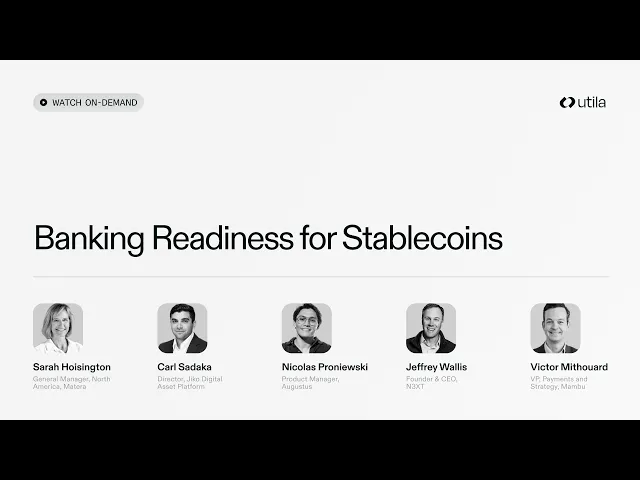
That operational gap is the focus of Episode 13 of the Stablecoin Builder Series. Shahar Friedman, Head of Payments at Utila, is joined by Sarah Hoisington of Matera, Jeffrey Wallis of N3XT, Victor Mithouard of Mambu, Carl Sadaka of Jiko Digital Asset Platform, and Nicolas Proniewski of Augustus. They explain how banks are adapting controls, reconciliation, and operating processes so stablecoin and tokenized-deposit services can run in production.
Key Takeaways
Stablecoin readiness is primarily an operating challenge
Moving assets onchain is only one part of a bank deployment. Production requires the organization to support real-time settlement, transaction exceptions, customer inquiries, reconciliation, approvals, and incident response around the clock. Carl Sadaka described stablecoin implementation as an operational project with a strong technology component, while Victor Mithouard highlighted the shift from batch-based banking processes to real-time operations.
Stablecoins and tokenized deposits solve different problems
Stablecoins are emerging as an additional payment rail that banks can use for client-facing flows, including cross-border payments. Tokenized deposits have attracted interest for intrabank settlement and treasury operations, particularly among large banks that can capture value by moving liquidity between internal entities more efficiently. Banks need to decide which model fits the specific flow they are trying to improve.
Start with one problem and build around it
Several panelists warned against trying to launch an entire digital asset strategy at once. Sarah Hoisington recommended choosing one customer, one problem, and one flow of money, then bringing together the relevant teams to map how digital assets could improve it. That gives a bank a defined production problem to solve and exposes the operational dependencies before the scope expands.
Build-versus-buy decisions shape long-term capabilities
The panel offered different views on how much infrastructure banks should own. Nicolas Proniewski emphasized that custody and wallet architecture are foundational decisions that can be difficult to reverse. Victor Mithouard argued for composability and specialist partners while the market is still developing. The common point is that banks need to decide deliberately which capabilities they consider strategic and which can be supplied by external infrastructure.
Cross-border payments offer a clear production use case
Victor Mithouard identified cross-border payments as a likely early production use case because settlement friction is high and banks already face competition from fintech providers. Stablecoins can address an existing customer need while giving banks a defined flow against which to measure speed, cost, liquidity, and operational performance.
Key Speaker Insights
“We go from what is still currently a batch world to a real-time world.”
Victor Mithouard, VP, Payments and Strategy, Mambu
Explaining why stablecoin adoption changes processes and operating models alongside the underlying technology.
“I really think it’s an operational project with a strong technology component to it.”
Carl Sadaka, Director, Jiko Digital Asset Platform
Describing why stablecoin deployment has to involve teams across the bank rather than sit solely within technology.
“Banks are less talking about, ‘Should I use the blockchain?’ And now they’re really talking about, ‘Which one should I use and for what purpose?’”
Sarah Hoisington, General Manager, North America, Matera
Explaining how the conversation inside banks has shifted toward selecting infrastructure for specific production use cases.
“Traditional rails have a lot of latency baked in and stablecoins are a real unlock on that front.”
Nicolas Proniewski, Product Manager, Augustus
Connecting stablecoin adoption to faster settlement and more efficient use of liquidity.
“Find who’s the best, partner, compose, and go fast to see if you can create value.”
Victor Mithouard, VP, Payments and Strategy, Mambu
Making the case for specialist partners and modular infrastructure while banks test new digital asset services.
“Pick a use case, a customer, a problem, a flow of money.”
Sarah Hoisington, General Manager, North America, Matera
Giving banks a practical starting point for moving a stablecoin initiative toward production.
Explore our complete webinar library


Subscribe
Subscribe for Utila news and insights
Thought leadership, product updates, and partnerships - delivered only when we have something interesting to share.