


•
5 min read time
View Transcript
APAC is one of the most active regions for stablecoins, where adoption is driven by high-volume cross-border flows, fragmented currencies, evolving regulatory regimes, strong crypto adoption, and real demand for faster settlement. However, the opportunity is not uniform across the region. Japan, Indonesia, Singapore, Hong Kong, and other markets are each developing different paths for stablecoin issuance, licensing, local currency rails, off-ramping, and institutional adoption.
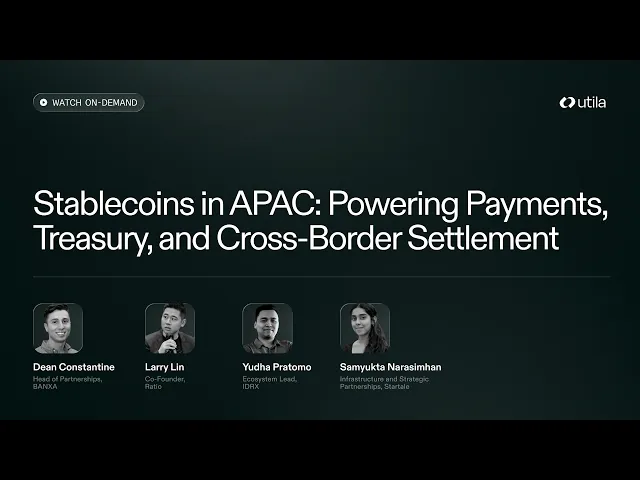
In Episode 11 of the Stablecoin Builder Series, Yan Shan Tan of Utila is joined by Dean Constantine of BANXA, Larry Lin of Ratio, Samyukta Narasimhan of Startale, and Yudha Pratomo of IDRX to discuss where stablecoin adoption is happening across APAC today, what it takes to build regulated products in the region, and how payment firms, fintechs, banks, and stablecoin issuers are approaching cross-border settlement, treasury, on-chain FX, and local currency stablecoins.
Key Takeaways
APAC stablecoin adoption is happening market by market
APAC cannot be treated as one stablecoin market. Each jurisdiction has its own regulatory posture, banking environment, currency dynamics, local payment methods, and institutional adoption curve. The panel discussed Hong Kong, Singapore, Japan, and Indonesia as examples of markets moving at different speeds and through different legal structures. For builders, regional opportunity depends on local execution.
Regulation is becoming part of the adoption story
The panel discussed how regulators across the region are becoming more active, specific, and constructive around stablecoins. More markets are creating pathways for licensed issuers, regulated counterparties, and compliant use cases. For institutional stablecoin products, regulatory clarity can increase trust and make adoption easier for banks, enterprises, and payment firms.
Local currency stablecoins are opening new rails
The discussion moved beyond USD stablecoins to local currency stablecoins such as Indonesian rupiah and Japanese yen stablecoins. The panelists noted that these assets are not necessarily designed to replace existing USD stablecoin volume. They can create new rails for local payments, cross-border settlement, remittances, treasury workflows, and eventually tokenized asset settlement in markets where users and businesses want exposure to their own currency.
B2B payments and treasury are leading practical adoption
The strongest near-term use cases discussed by the panel were B2B cross-border settlement, trade settlement, remittances, treasury movement, and emerging market corridors. Retail stablecoin access is growing, but the clearest repeat usage often comes from businesses trying to move value faster, reduce settlement friction, manage FX exposure, or connect local payout rails with stablecoin liquidity.
Production stablecoin products require more than technical integration
Several speakers emphasized that smart contracts, minting, redemption, and blockchain integrations are only part of the work. The more demanding operational requirements include reserve structure, redemption mechanics, compliance processes, regulated counterparties, banking relationships, local rails, and regulator engagement. A product can be technically functional and still fail if the surrounding operating model is not ready.
Redemption and off-ramping remain critical constraints
Stablecoin adoption depends on the ability to move reliably between fiat and stablecoins. The panel discussed the difficulty of building local payout and off-ramp coverage across APAC, especially when each market requires different banking partners, payment methods, licensing approaches, and compliance workflows. Builders need to solve access and exit paths, not only on-chain transfer.
On-chain FX depends on trusted counterparties
On-chain FX can improve stablecoin settlement across regional currencies, but it requires trusted stablecoins and regulated counterparties on both sides of the flow. The panel discussed the Singapore–Indonesia corridor as an example where demand exists, but regulated local stablecoin options still need to mature before flows can shift away from dominant unregulated or less locally aligned instruments.
Banks are engaging, but fintechs still push much of the adoption
The panel gave a nuanced view of bank adoption. Some banks in APAC are actively working with stablecoin and Web3 companies, especially in markets like Japan. At the same time, much of the current adoption still appears to be driven by fintechs, payment companies, exchanges, issuers, and infrastructure providers. Banks are becoming more open, but implementation often depends on partnerships with companies already operating in the market.
Stablecoins and tokenized assets are converging
The discussion also connected stablecoins with RWAs and tokenized assets. As tokenized products grow, stablecoins can become part of the settlement, subscription, redemption, yield distribution, and secondary transfer flow. Local currency stablecoins may play an important role when tokenized asset activity needs to connect with domestic investors, local banking relationships, and regional settlement workflows.
Key Speaker Insights
Dean Constantine, Head of Partnerships, BANXA
“APAC is moving fast because the pain points here are structurally worse than anywhere else.”
Explaining why cross-border settlement, local currency volatility, and fragmented financial rails make stablecoins especially relevant across the region.
Yudha Pratomo, Ecosystem Lead, IDRX
“This is a good opportunity for us to build stablecoins around cross-border settlements, around remittances, around treasury movement globally.”
Describing how IDRX sees regulated rupiah stablecoin use cases developing inside Indonesia’s regulatory framework.
Samyukta Narasimhan, Infrastructure and Strategic Partnerships, Startale
“Once the product is live and you have all your licenses in place, it gives you a good freeway to start building up the adoption of your stablecoin in Japan.”
Discussing why Japan’s stricter, bank-anchored approach can support long-term stablecoin adoption.
“Every major economy in the APAC region will have its own regulated stablecoin.”
Explaining Ratio’s view that regulated local currency stablecoins will become a major part of the regional financial infrastructure.
Yudha Pratomo, Ecosystem Lead, IDRX
“The tech part, like smart contracts, minting, redeeming, all the integration, is the easiest part.”
Explaining why production stablecoin products depend heavily on compliance, banking, payment gateways, and ecosystem integration.
Samyukta Narasimhan, Infrastructure and Strategic Partnerships, Startale
“Solve the redemption and structure before you actually just focus on features.”
Highlighting the importance of reserves, redemption, and regulated structure before adding product features.
Samyukta Narasimhan, Infrastructure and Strategic Partnerships, Startale
“Banks do understand that it is actually advantageous for the traditional banking customer to be able to operate outside of banking hours.”
Explaining why banks are becoming more open to stablecoins as they recognize the value of always-on settlement.
Explore our complete webinar library

Stablecoin Builder Series
Stablecoin Builder Series

Stablecoin Builder Series
Subscribe
Subscribe for Utila news and insights
Thought leadership, product updates, and partnerships - delivered only when we have something interesting to share.