Executive Summary
Sponsored EVM Transactions and EVM Delegated Calls are now available on the Utila API, enabling multi-step flows to execute as one atomic transaction with gas paid by a sponsor wallet.
Payments, treasury, and product teams can consolidate collections and DeFi actions while retaining existing policy controls and removing the need to maintain native gas balances on source wallets.
Simplifying Multi-Step EVM Flows
Making an onchain payment or completing a treasury flow is usually multi-step. A swap is actually an approve and a swap. A bridge is actually an approve and a burn. Entering yield is actually an approve and a deposit. Pulling payments from a set of payer wallets means one transferFrom per payer. Each step has historically been its own transaction, its own signature, and its own gas, on wallets that often hold only stablecoins.
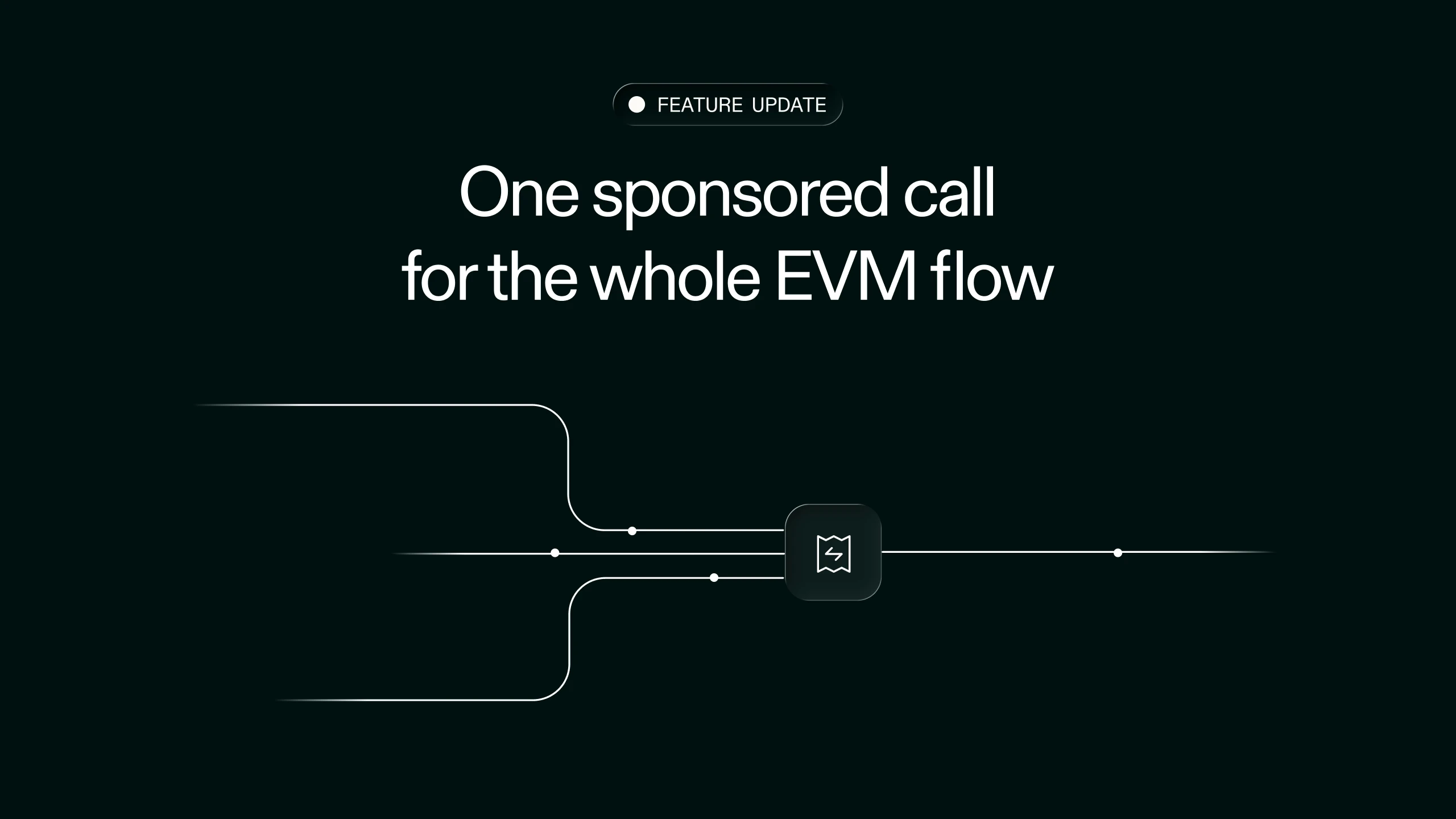
Now the process is easier. Sponsored EVM Transactions and EVM Delegated Calls are available on the Utila API. Together they let a whole flow execute as one governed transaction, sponsored by a single wallet, with no native asset required on the source wallet. Both surfaces route through EIP-7702, executed from a delegated account.
Two New API Surfaces
Sponsored EVM Transactions. A sponsor field on the standard EVMTransaction object. Set a sponsor and the call routes through the sponsored EIP-7702 path, so a wallet holding only stablecoins can make the call. Leave it empty and self-paid behavior is unchanged.
EVM Delegated Calls. A new object that takes an ordered list of calls, each with destination, value, and calldata, and executes them as one atomic multicall from the delegated account. This results in one signature and one sponsor covering the whole bundle, with all-or-none execution.
Example Use Cases
Pull Payments Across Many Wallets. Payer wallets that have granted an allowance can be swept into a single destination through one bundled call. A subscription collection, a set of merchant settlements, or a batch of recurring transfers becomes one transaction with a single signature, gas fee, and policy decision.
One-Click DeFi Actions. A swap that would otherwise require an approve and then a swap lives inside one atomic transaction. The same holds for bridging (approve, then burn) and entering yield (approve, then deposit). If any step in the bundle would fail, the whole bundle reverts.
Policy Governance Stays the Same
Approval rules, contract call rules with CEL conditions, and mint or burn rules evaluate on the two new paths the same way they evaluate self-paid transactions. Multi-step onchain payments become a single business action, governed as a single business action.
Who This Is For
This helps payments and treasury teams running scheduled or recurring collections to consolidate them into one governed bundle. Product teams building consumer flows on Utila can offer users one-tap DeFi actions without asking them to hold native gas. Operations teams can stop maintaining a native balance across every operational wallet.
How to Get Started
Both surfaces are live on the Utila API today. Any Utila-managed wallet or address in the same vault, funded with native asset, can act as the sponsor. Both paths use EIP-7702, so the target chain must support it. Delegations are added by Utila on first use to our audited Utila7702Delegate contract, and can be reviewed anytime through the QueryEvmAccountDelegations endpoint.
Consolidate your next payment or treasury flow into one sponsored transaction. Contact our team to implement it through the Utila API, or request a demo to see how sponsored execution and policy controls work together.

Technical Product Marketing
Kimron Flicker works in product marketing at Utila, bringing content and marketing experience at Polygon Labs and Zengo to institutional digital asset infrastructure.