Executive Summary
Banks implementing tokenized deposits and stablecoin payments need to connect customer account records with controlled blockchain execution. Current bank pilots and interbank development initiatives make ledger ownership and participant access central to that design. The choice of instrument also determines who owes the customer money and how redemption works.
This guide explains how our wallet infrastructure and transaction controls support bank payment, treasury and issuance workflows. Payments, technology and risk teams can use it to assess signing responsibilities and the integration work required to operate digital money alongside existing banking systems.
How Stablecoins, Tokenized Deposits, and Digital Money Are Becoming The Next Frontier for Banks
Digital money is moving into the core architecture agenda for banks. In KPMG’s 2026 Banking Technology Survey, 71% of leaders at institutions with more than $100 billion in assets said they prioritize designing interoperable systems for tokenized deposits and stablecoins.
For banks, putting these products into production creates a demanding infrastructure problem. Stablecoin payments, tokenized deposits, and tokenized assets introduce 24/7 onchain execution into operating models built around strict custody requirements, segregation of duties, pre-transaction controls, compliance oversight, auditability, and integration with core banking and treasury systems. Each additional network, asset, or counterparty increases that operational surface area.
Utila provides the digital asset infrastructure banks need to operate these flows under one institutional control framework. This article shows how that infrastructure works in practice. It looks at how banks can use Utila across custody, payments, treasury, and tokenization, while maintaining the governance, compliance, connectivity, and integration standards required for institutional operations.
Tokenized Deposits in Bank Operations
A tokenized deposit represents a commercial bank deposit on a blockchain or distributed ledger. The bank remains responsible for the deposit liability; the implementation determines how balances are transferred and redeemed. In Canada, OSFI confirmed on 10 September 2026 that tokenized deposits are not legally distinct from traditional deposits and that existing obligations continue to apply.
A bank can use an existing payment stablecoin, develop a tokenized deposit product or pursue payment-stablecoin issuance. These choices carry different responsibilities for the customer’s claim and redemption process. Our comparison of stablecoins and tokenized deposits explains the instrument decision; the sections below focus on the infrastructure needed to operate the chosen model.
U.S. Bank’s USBDC pilot illustrates the integration requirement: its Stellar payment connected with internal finance, risk, compliance and operations systems. The pilot also evaluated minting, redemption and intervention controls. Deutsche Bank’s September 2026 analysis similarly identifies integration with existing treasury and payment processes as a requirement for broader stablecoin adoption.
Developing Stablecoin and Tokenized Deposit Infrastructure for Banking
A blockchain wallet alone does not give a bank the controls required to run digital asset operations. The institution must govern who can create wallets, initiate transfers, approve transactions, add counterparties, change policies, interact with smart contracts, and access funds across different legal entities or business units.
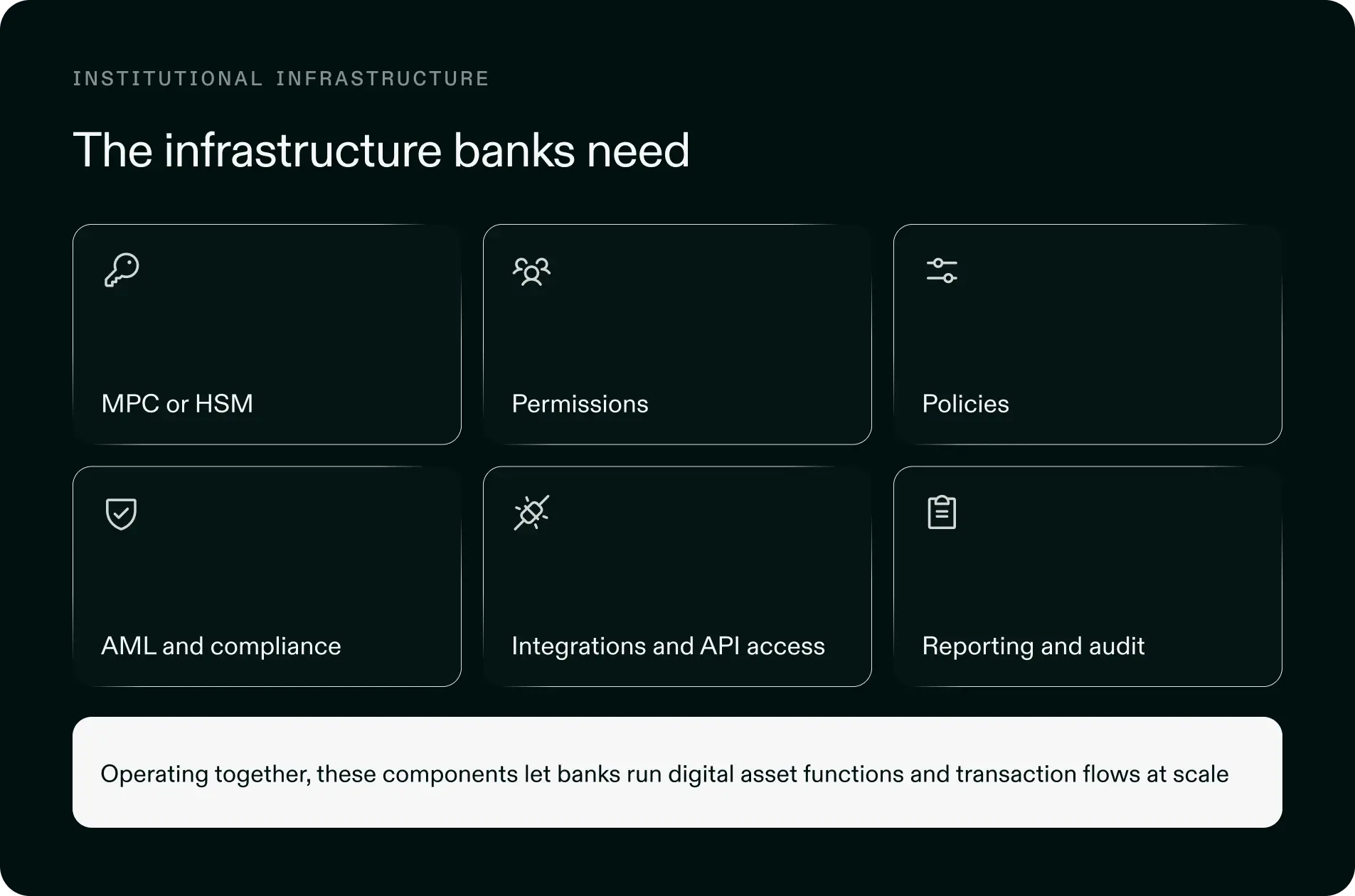
Utila brings these functions into a single operating environment:
Key management: Non-custodial MPC wallets or an HSM-backed architecture for institutions that need wallet keys to remain inside their own hardware environment
Governance controls: Role-based permissions, transaction policies, multi-party approvals, address controls, and segregation of duties
Compliance: AML and KYT integrations with Chainalysis, TRM Labs, and Elliptic
Multi-chain support: Support for EVM-compatible networks, Solana, Tron, and other blockchains through one platform
APIs and automation: APIs and webhooks for wallet creation, transaction initiation, approval orchestration, event tracking, and integration with internal systems
Audit and reporting: Audit logs, wallet labels, transaction records, and reporting data for operations, compliance, finance, and internal audit teams
Ecosystem connectivity: Connectivity to exchanges, liquidity providers, payment partners, and institutional counterparties through Utila Link
These capabilities apply consistently across payment, treasury, custody, and tokenization workflows. A bank can therefore introduce a new product without building a separate wallet, policy, and reporting stack for every implementation.
Digital Asset Custody Supporting MPC or Institution-Controlled HSMs
Key custody is often the first architectural decision a bank must make. Utila supports two operating models, allowing the institution to align signing with its internal security requirements.
MPC-based wallet infrastructure
Utila’s enterprise-grade MPC architecture distributes signing authority across separate key shares. A complete private key is not assembled in one location during transaction signing, reducing reliance on a single device, person, or system.
Banks can combine MPC signing with role-based access, approval quorums, transaction limits, address restrictions, and policy controls. The result is a non-custodial operating model in which the institution governs access to assets while Utila coordinates the transaction workflow.
Connecting an existing HSM to Utila
Some banks require wallet keys to remain within an HSM that they operate. An HSM can protect non-extractable keys inside a certified hardware boundary and produce a blockchain signature without releasing the underlying key material.
The HSM does not provide the full operating workflow around that signature. Wallet administration, transaction construction, approvals, AML screening, blockchain connectivity, broadcasting, confirmation tracking, and audit evidence still need to be managed elsewhere.
Utila’s HSM-backed architecture connects institution-controlled signing to the broader digital asset operation. Under this model:
The bank generates or stores the wallet keys inside its HSM. Utila does not receive the wallet key material.
An authorized user or internal system initiates a transaction through the Utila console or API.
Utila evaluates the transaction against the institution’s policies, approval requirements, and compliance controls.
A Utila-provided connector inside the bank’s environment passes the approved signing request to the HSM. HSM credentials remain local.
The HSM produces the signature. Where supported, an HSM-resident validation module can verify defined transaction attributes before signing.
Utila broadcasts the signed transaction and records the approvals, policy decision, transaction status, and audit data.
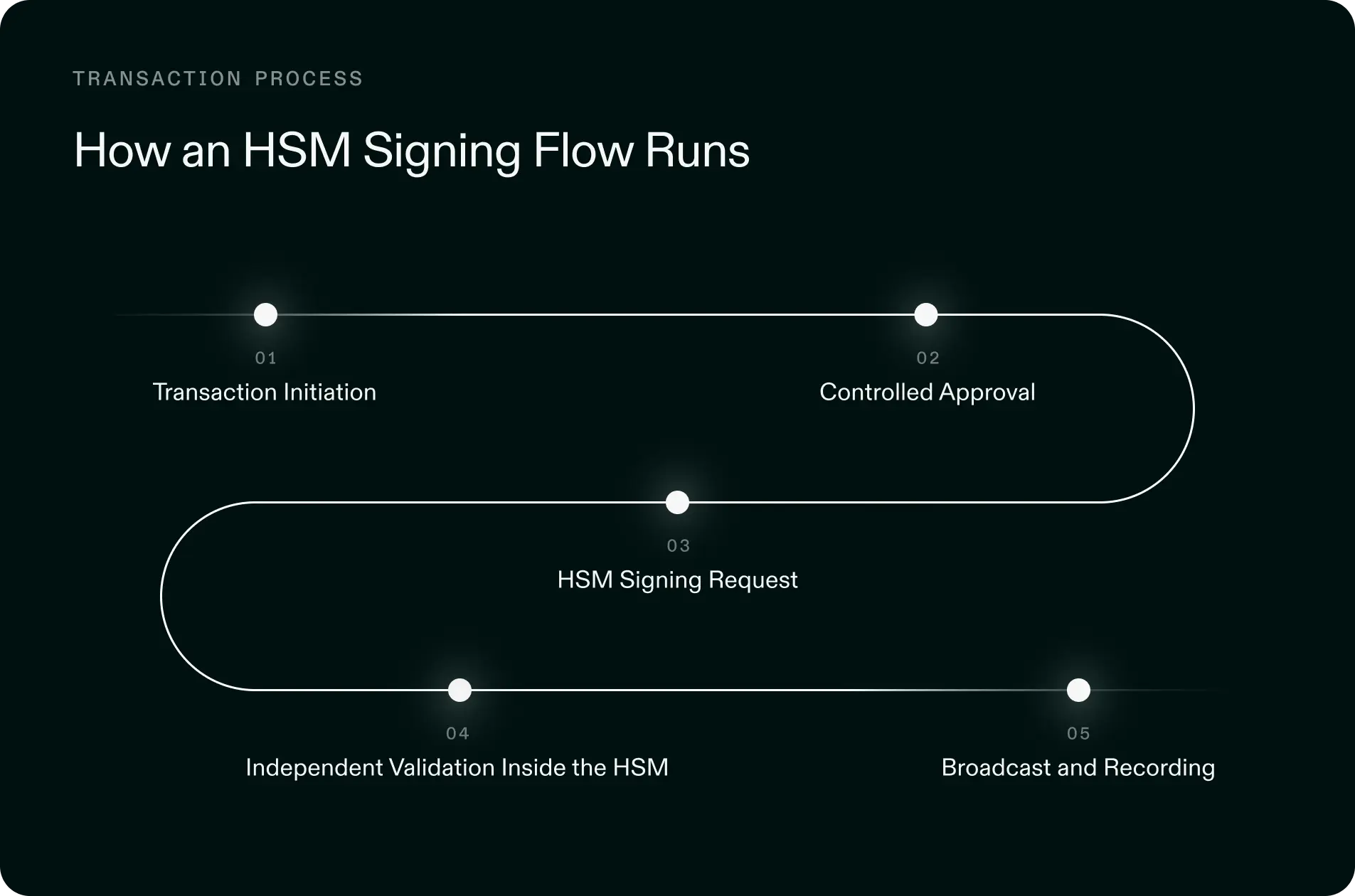
The bank preserves its approved hardware boundary while using Utila for the operational controls surrounding each transaction. A more detailed explanation is available in Digital Asset Custody for Banks and Financial Institutions: Why You Need More Than an HSM to Operate at Scale.
Once the custody architecture is established, the next requirement is controlling what can be signed and under which conditions.
Policy-Based Governance for Stablecoin Payments and Transactions
Utila’s policy engine allows banks to translate internal governance rules into controls that are applied before a transaction reaches the blockchain.
Policies can define:
Which users or systems may initiate and approve transactions
Which wallets, assets, networks, destinations, and transaction types are permitted
Transfer limits and approval thresholds
Multi-party sign-off requirements for higher-value or higher-risk activity
Address allowlists and restrictions on unapproved counterparties
Role separation between initiators, approvers, administrators, and policy managers
Rules that vary by business unit, jurisdiction, client program, or legal entity
For smart contract activity, contract call policies provide more granular control than a standard transfer policy. A bank can approve specific contract functions and define permitted parameter ranges, automatically blocking calls that fall outside the approved configuration.
This matters for token issuance and onchain financial products. An unauthorized contract interaction may change token supply, alter an allowlist, modify a compliance module, pause a contract, or transfer administrative control. Function-level policies allow the institution to govern those actions individually rather than treating every smart contract call as equivalent.
Compliance checks can operate within the same transaction workflow. Integrations with Chainalysis, TRM Labs, and Elliptic support wallet and transaction screening before execution, with risk thresholds and escalation processes configured around the institution’s requirements.
The policy, approval, compliance, and signing decisions are retained with the transaction record. This gives operations and audit teams evidence of how a movement was authorized, rather than only a blockchain hash showing that it occurred.
How Utila Enables Stablecoin Settlement and Payment Processing for Banks
Stablecoin settlement introduces several blockchain-specific requirements: wallet creation, network selection, fee management, transaction screening, approvals, confirmation tracking, and integration with fiat conversion or payout partners.
Utila allows banks to manage these requirements as part of one controlled workflow rather than as separate point integrations.
How Can Banks Integrate Stablecoin Payments?
Banks need a defined handoff between customer instructions, account authorization and blockchain execution. Consider a corporate customer asking its bank to send USDC to an approved external wallet. The implementation should specify the following sequence and assign responsibility for each step.
Capture the instruction. The banking channel records the amount, destination and supported network against the customer’s account.
Authorize the account movement. The bank’s authorization and ledger systems check the customer’s entitlement and available balance, with defined rules for reserving or debiting funds.
Approve and execute the transfer. The wallet workflow applies the configured transaction policies, required approvals and screening before signing and broadcasting on the selected network.
Confirm the result. The integration uses transaction status information to determine when the bank’s confirmation requirements have been met and update the customer-facing payment status.
Reconcile and resolve exceptions. Operations match the account movement to the blockchain transaction and resolve pending or failed payments under documented procedures.
Our partnership with Matera connects digital asset services with existing core banking systems. Matera’s Digital Twin provides the authorization and ledger layer, while we provide wallet infrastructure, transaction policies and onchain execution. Banks can use this division of responsibilities to specify how each payment is authorized, recorded and completed.
Wallet infrastructure integrated into bank products
Programmatic wallet creation allows banks to generate and administer wallets through API. Stablecoin functionality can be embedded into existing client portals, payment applications, account structures, and internal operations tools without requiring the end user to interact directly with blockchain infrastructure.
Banks can create dedicated wallets for customers, entities, payment programs, settlement accounts, or individual workflows. Role-based permissions and policy controls determine how each wallet can be used.
Transaction fees handled at the infrastructure layer
Native blockchain tokens create unnecessary complexity for clients that only need to send or receive stablecoins. Utila’s gas management capabilities and Sponsored Transfers allow transaction fees to be managed at the infrastructure level, so a bank can shield corporate clients from acquiring and maintaining separate gas balances.
Controlled high-volume payments
Batch transaction capabilities support high-volume supplier payments, merchant settlement, or other payout workflows. Each transaction remains subject to the bank’s policy and compliance controls, rather than bypassing governance because it is part of a bulk operation.
Multi-chain operations through one platform
Stablecoin liquidity and counterparties are distributed across several blockchain networks. Utila lets institutions manage supported EVM chains, Solana, Tron, and other networks through a common operating environment, with consistent approval, compliance, and reporting controls.
The bank can therefore support the network required by a specific corridor or client without building an independent operating stack for every chain.
Settlement often requires more than the blockchain transfer itself. Fiat conversion, liquidity, swaps, bridging, and payout connectivity must also be coordinated around the transaction.
Stablecoin Infrastructure
Work with stablecoins on top of our institutional-grade wallet infrastructure.
Utila Link and Connectivity Across Fiat, Liquidity, and Blockchain Networks
Utila Link gives banks access to a network of exchanges, liquidity providers, payment companies, and institutional counterparties directly through the platform.
For stablecoin payment and settlement operations, this can support:
Fiat on-ramp and off-ramp routes across different jurisdictions
Connections to payment and payout partners
Access to liquidity providers and exchanges
Movement between assets when a corridor requires a different stablecoin
Cross-network movement when liquidity or counterparties operate on another chain
More than one route for critical workflows, reducing dependence on a single provider
Compliance and governance remain part of the wider workflow. The institution can apply its own approval rules and risk controls while selecting the conversion, routing, and settlement partners appropriate for each product.
This connectivity also supports treasury operations, where incoming balances must be consolidated, reallocated, or converted into fiat across entities and bank accounts.
How Utila Supports Stablecoin Treasury Operations
Utila allows treasury teams to create dedicated wallets for each legal entity, business unit, client program, or bank account and manage movements between them through policy-controlled approvals.
Automated wallet sweeping can consolidate incoming stablecoin balances into designated treasury wallets. This reduces the need for operators to prepare repetitive transfers and helps maintain a defined wallet structure across customer and operating accounts.
Treasury teams can use Utila for:
Balance visibility: Real-time visibility into balances across supported wallets and networks
Inter-entity transfers: Policy-controlled transfers between entities and operating accounts
Automated sweeps: Automated consolidation of incoming balances
Fiat off-ramping: Fiat conversion through connected off-ramp partners when funds need to return to bank accounts
Wallet organization: Wallet labels and tags that map onchain activity to entities, accounts, or business purposes
Reconciliation: Exportable transaction and audit data for reconciliation with accounting and treasury systems
APIs and webhooks allow these workflows to connect with internal treasury platforms. A bank can initiate or prepare transactions based on events in its own systems while preserving approval, compliance, and signing controls within Utila.
Our stablecoin treasury management guide examines how these capabilities support day-to-day liquidity and payment operations.
The same infrastructure can support tokenized money issued by the bank itself. Utila does not issue the deposit or determine its legal structure; it provides the wallet, governance, contract, and operational layer required to manage it onchain.
Treasury Management
Securely manage your company’s day-to-day digital asset treasury operations.
How Utila Supports Tokenized Deposits and Tokenized Asset Issuance
Launching a tokenization program requires governed and auditable onchain infrastructure. Banks and token issuers need to control minting, burning, contract administration, distribution, supply reporting, and settlement while connecting these operations to existing systems and internal approvals.
Utila supports stablecoins, tokenized deposits, and real-world assets through one institutional operating environment.
Secure minting and burning
Banks can mint and burn tokens across supported EVM networks and Solana using MPC-powered wallets or an approved HSM-backed signing architecture.
Dedicated administrative wallets can be assigned to issuance activity. Policies define who may initiate, approve, or execute mint and burn operations, preventing one individual from unilaterally changing supply.
Function-level control over token contracts
Utila’s contract call policies allow the institution to specify which smart contract functions may be used and which parameter ranges are acceptable. Calls outside the defined policy are blocked before signing.
This gives banks granular control over supply changes, contract administration, allowlist updates, token transfers, and other privileged actions.
Contract management and compliance modules
Utila supports ERC-20 and ERC-3643 token contracts. Institutions can read and call contract functions through the platform and configure ERC-3643 compliance components, including allowlists, blocklists, and compliance identities.
Role-based controls determine who can issue, approve, administer, or distribute tokens. AML and KYT screening can run within transfer workflows through the bank’s selected compliance integration.
APIs and automation
Minting, burning, wallet management, transfers, and policy enforcement are available through REST APIs, with webhook support for real-time event notifications.
A bank can connect tokenization workflows directly to internal issuance, servicing, treasury, or customer systems. Large-scale operations can be automated without removing the approval and policy controls applied to the underlying transaction.
Ledger Controls for Deposit Tokens
A bank operating a deposit token needs a documented relationship between its deposit records and token supply. Before connecting minting and burning to internal systems, define these handoffs:
Record ownership. Identify the authoritative record of the customer’s deposit claim and the system responsible for each balance update.
Supply reconciliation. Specify how token supply and deposit records are compared, including how discrepancies are investigated.
Administrative approval. Assign authority for minting, burning and changing token controls, with approvals appropriate to each action.
Exception handling. Define what happens when a ledger update succeeds but the blockchain transaction remains pending or fails.
Redemption completion. Establish when tokens are removed from circulation and when the customer receives usable account funds.
These decisions give operations and finance teams a common basis for reviewing each supply change and completing a redemption.
Supply tracking, audit logs, and reporting
Token supply can be tracked across wallets and supported networks through one dashboard. Audit logs record mint, burn, transfer, approval, and policy activity for internal review and regulatory reporting.
This gives the institution a consistent operating record across the full token lifecycle rather than relying on disconnected blockchain explorers, spreadsheets, and contract administration tools.
Distribution and settlement through Utila Link
After issuance, the token may need to reach approved exchanges, investors, liquidity providers, payment partners, or institutional counterparties. Utila Link supports access to that ecosystem from within the same platform used to govern issuance.
Operating balances can also be deployed into supported onchain venues under the same wallet and policy framework, subject to the institution’s product design and approved counterparties.
For tokenized deposits, the bank remains the issuer and retains responsibility for the deposit liability, redemption model, regulatory treatment, and client relationship. Utila supplies the blockchain infrastructure used to administer balances, govern mint and burn activity, execute transfers, and connect the token to payment or settlement workflows.
For a specific bank-issued instrument, read how our N3XT partnership supports institutions operating N3XT Digital Dollar within their own transaction policies and operational controls.
Tokenization
Securely mint, custody, and transfer tokenized assets with our tokenization platform.
Stablecoin and Tokenized Deposit Infrastructure Tailored for Your Bank’s Requirements
A bank’s digital asset architecture should reflect its approved custody model, internal control framework, target products, required networks, and existing technology stack. Utila can support an MPC-based deployment or connect institution-controlled HSM signing to the wider transaction workflow.
The same platform can then govern stablecoin settlement, treasury operations, payment processing, tokenized deposits, and token issuance without requiring separate infrastructure for every product. Utila supports more than 300 companies, processes over $25 billion in monthly volume, and is SOC 2 Type II compliant.
Request a demo to map one proposed bank payment or deposit-token workflow against its ledger responsibilities, signing model and approval requirements. We can help you identify the wallet infrastructure and integration points your team needs to evaluate before implementation.
Utila for Banks
Digital asset & stablecoin infrastructure for financial institutions.
FAQs About Utila’s Infrastructure for Banks
What does Utila provide for banks?
Utila provides non-custodial digital asset infrastructure for wallet administration, transaction signing, policy controls, approvals, compliance workflows, blockchain connectivity, APIs, tokenization, transaction execution, and audit records. Banks can use it to support stablecoin payments, treasury operations, tokenized deposits, and tokenized asset issuance.
Is Utila a digital asset custodian?
Utila provides non-custodial wallet and transaction infrastructure. The institution retains control over its signing architecture and assets. Banks can use Utila’s MPC wallet model or keep wallet keys inside an institution-controlled HSM while using Utila for the operating workflow around each transaction.
Can a bank connect its existing HSM to Utila?
Yes. Utila’s HSM-backed architecture allows the bank’s wallet keys to remain inside its own HSM. A local connector passes approved signing requests to the HSM, while Utila manages wallet administration, policy evaluation, approvals, AML workflows, blockchain connectivity, broadcasting, and transaction records.
What is the difference between using an HSM and Utila’s MPC wallets?
An HSM protects a complete key inside a hardware boundary and produces signatures when an approved request is received. MPC distributes signing authority across separate key shares and creates a valid signature without assembling the full private key in one place. Utila can support either architecture, depending on the bank’s custody requirements and existing security environment.
How does Utila help banks manage stablecoin payments?
Utila supports programmatic wallet creation, policy-controlled transaction approvals, compliance screening, sponsored transaction fees, batch payments, multi-chain execution, APIs, and integration with liquidity, fiat conversion, and payout partners through Utila Link.
Can Utila support tokenized deposits issued by a bank?
Yes. The bank remains the deposit issuer and is responsible for the liability, regulatory structure, redemption process, and customer relationship. Utila provides the wallet, signing, policy, compliance, smart contract, API, reporting, and transaction infrastructure used to operate the tokenized deposit onchain.
How does Utila control token minting and burning?
Banks can assign dedicated administrative wallets and use policy rules to define who may initiate, approve, and execute mint or burn operations. Multi-party approval can be required, and contract call policies can restrict permitted functions and parameter ranges before signing.
Does Utila support ERC-20 and ERC-3643 tokenization?
Yes. Utila supports interaction with ERC-20 and ERC-3643 token contracts. Institutions can manage contract functions and ERC-3643 compliance components, including allowlists, blocklists, and compliance identities, through a policy-controlled operating environment.
How does Utila integrate with a bank’s existing systems?
Utila provides REST APIs and webhooks for wallet creation, transaction initiation, approvals, minting, burning, policy enforcement, and real-time event notifications. Banks can embed digital asset operations into existing payment, treasury, issuance, and customer systems.

Content Marketing Lead
Marcin Miłosierny is Content Marketing Lead at Utila, with experience creating content for regulated finance at Sygnum and technical analytics products at Glassnode.