Executive Summary
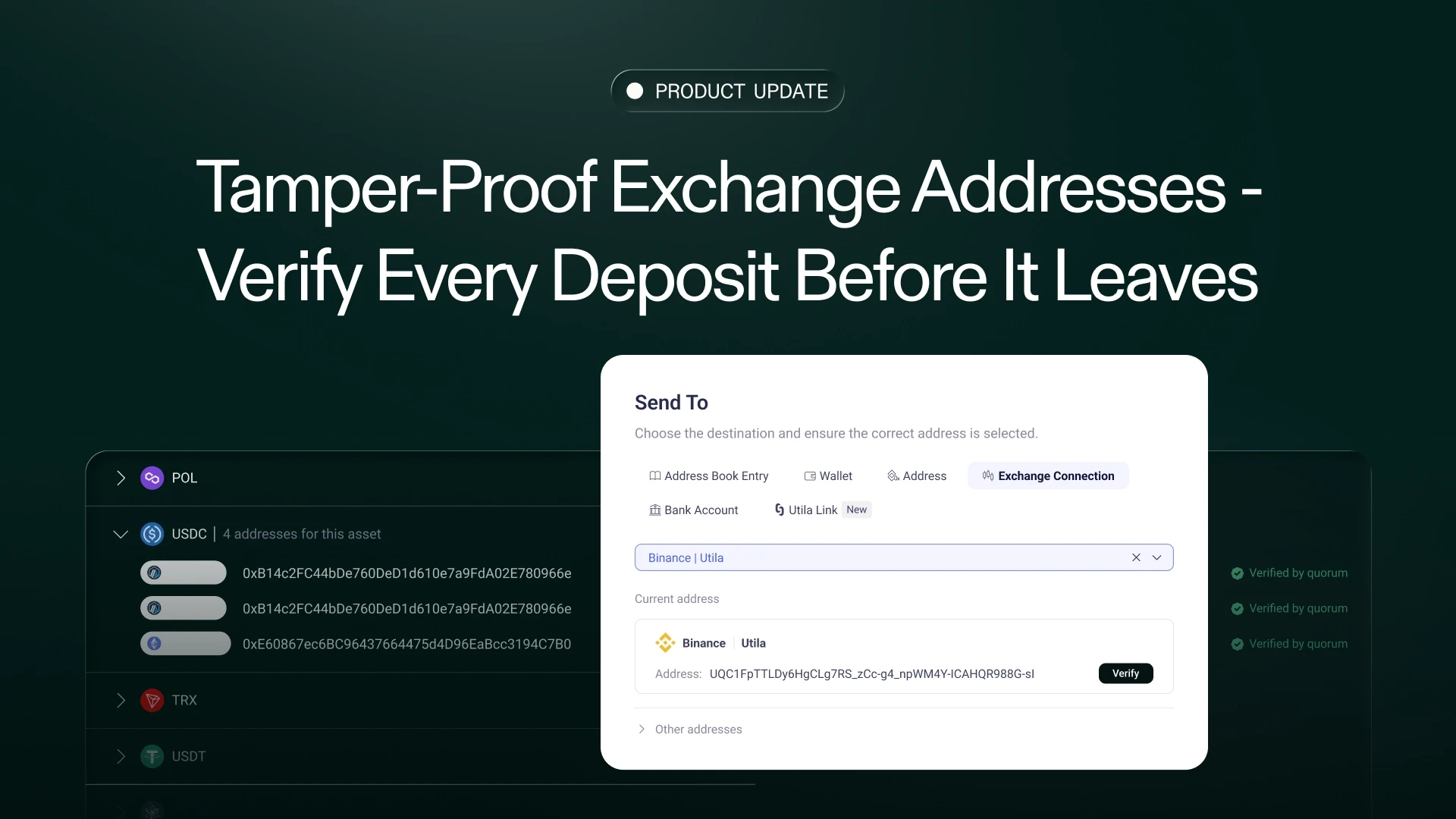
Utila now supports cryptographic verification of exchange deposit addresses. When depositing funds to a connected exchange, the deposit address can be submitted to the vault's admin quorum for approval and signing using their security keys. Once signed, the address becomes tamper-proof: any modification is immediately flagged across the Utila console and mobile app.
The feature extends the same cryptographic protections that Utila already applies to address book entries into exchange workflows.
Exchange Deposit Addresses Are a High-Value Target
Exchange deposits introduce a weak point in the transaction flow. The destination address is generated by an exchange, then copied, imported, or retrieved through an API before funds are sent. If that address is substituted at any point - through address poisoning, clipboard hijacking, a compromised API response, a man-in-the-middle attack, or operator error - the transaction can look routine until the funds leave the vault.
Importantly, address poisoning has become one of the most visible forms of address-tampering risk. One large-scale study identified more than 270M attack attempts across Ethereum and BSC, targeting over 17M victims and causing at least $83.8M in losses. Chainalysis has also found that address poisoning campaigns often target experienced users with high balances and frequent on-chain activity, which makes the risk especially relevant to treasury, trading, settlement, and exchange operations.
As a result, teams often fall back on manual verification before sending funds to an exchange: cross-checking the address against prior transactions, checking it in the exchange dashboard, or sending a test transfer. These checks can reduce risk, but they depend on human diligence and are difficult to enforce consistently across multiple operators, exchanges, and recurring deposit workflows.
The Solution: Quorum-Signed Exchange Addresses
Utila's new exchange address verification feature brings the same cryptographic signing model used for a client’s own vault address book entries to exchange deposit workflows. After depositing to a connected exchange, the operator submits the deposit address for verification from the transaction page. The request goes to the vault's admin quorum, and on approval, the address is cryptographically signed using the quorum's security keys.
Utila recommends performing a penny check before submitting the address for verification. This confirms the address actually credits the organization's exchange account before the quorum signs it. Once verified, subsequent deposits to that address carry a green check mark indicator in the console's destination selector, in the transaction list, and as a "Verified by quorum" card on the mobile app's transaction details screen. Operators no longer need to manually re-verify the address each time.
The feature works with any connected exchange and is not limited to specific integrations.
How Teams Benefit
Exchange address verification is built for organizations that regularly move funds between self-custody wallets and exchanges for trading, settlement, OTC activity, or treasury management. In these workflows, teams need to confirm that the destination address is correct before funds leave the vault, while still keeping recurring deposits fast and auditable.
Quorum-signed exchange addresses help teams do this in four ways:
Tamper detection before funds leave the vault. Once cryptographically signed, any modification to the address is immediately flagged. Address poisoning, clipboard hijacking, and fraudulent address substitution become detectable, not just preventable through vigilance.
No more manual re-verification. A verified address carries its proof with it, visible across console and mobile. Operators stop cross-checking exchange dashboards before every deposit.
Auditable address integrity. Compliance teams gain a cryptographic record that the deposit address was reviewed and approved by the admin quorum, providing a clear audit trail for exchange-bound transactions.
Consistent security model across self-custody and exchange flows. Address book entries are already quorum-signed. Exchange address verification extends that standard to deposit addresses, so the security posture does not weaken at the boundary between self-custody and exchange operations.
Utila for Trading Firms
Digital asset & stablecoin infrastructure for DeFi & trading firms.
Start Using Exchange Address Verification
Exchange address verification is available now in the Utila web console and mobile app. For a detailed walkthrough of the verification process, see the Create a verified exchange deposit address article in the Utila Help Center.
To discuss how this fits into your exchange operations,book a demo with the Utila team or reach out to your account manager.

Content Marketing Lead
Marcin Miłosierny is Content Marketing Lead at Utila, with experience creating content for regulated finance at Sygnum and technical analytics products at Glassnode.