
•
4 min read time
View Transcript
Overview
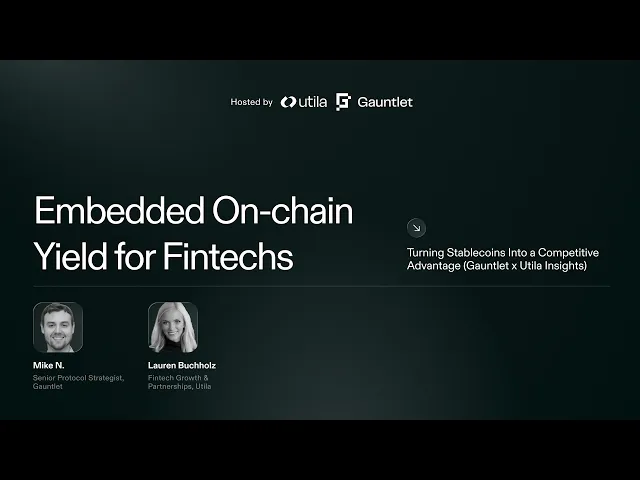
Fintech yield products used to be easier to frame when the main option was staking. Stablecoin yield now sits across lending markets, curated vaults, looping strategies, RWA collateral, and multi-strategy products. The product question for fintechs is how to make those opportunities accessible without asking users to understand collateral risk, liquidation mechanics, liquidity depth, or vault allocation.
That is why Utila and Gauntlet hosted this session on embedded onchain yield for fintechs. Lauren Buchholz of Utila is joined by Mike N. of Gauntlet to discuss how risk-managed DeFi yield can be integrated into fintech products, why curated vaults are becoming an important access layer, and what teams need across custody, governance, execution, and risk management before yield can become part of the user experience.
Key Takeaways
Stablecoin yield has moved beyond staking
The session framed staking as only one part of the yield conversation. Today’s stablecoin yield products can draw from lending markets, curated vaults, basis strategies, tokenized assets, RWA-backed collateral, and automated allocation models. For fintechs, the opportunity is not just offering yield, but deciding which strategies are understandable, liquid, risk-managed, and suitable for their users.
Curated vaults help fintechs offer yield without building a DeFi risk team
Mike explained how vault curation removes much of the strategy-selection burden from fintech teams. Instead of evaluating every collateral asset, liquidation path, market parameter, and borrower segment internally, fintechs can work with a curator that designs vaults around specific risk profiles. That matters because onchain lending markets move quickly, and managing them properly requires risk infrastructure, not occasional manual review.
Yield products need clear risk tiers
The session broke down how vaults can be structured for different audiences. Prime vaults focus on highly liquid blue-chip collateral and lower insolvency risk. Balanced vaults add measured exposure to additional collateral types. Frontier strategies can pursue higher yield through less liquid or newer assets. For fintechs, these tiers matter because user experience, disclosures, liquidity expectations, and product positioning should match the underlying risk.
Liquidity and liquidation paths matter as much as APY
Gauntlet’s approach starts with whether the market can remain healthy under pressure. A lending strategy may look attractive on headline yield, but lenders need to know whether collateral can be liquidated cleanly, whether markets are deep enough, how much slippage could appear, and whether funds can exit when conditions change. APY is only useful when the operating and liquidity assumptions behind it hold.
Embedded yield can make fintech products stickier
Yield becomes more powerful when it is built into an existing financial product rather than presented as a separate DeFi workflow. Mike discussed how users with idle stablecoin balances can earn inside a wallet, card, savings-style product, or fintech account without managing protocols directly. For fintechs, this can improve engagement and retention because users see balances working without leaving the product environment.
Wallet infrastructure is the entry point to the yield stack
The session tied yield access back to custody and wallet operations. Before a fintech can embed onchain yield, it needs secure wallet infrastructure, governance, approval policies, and operational controls for moving capital into and out of vaults. Utila’s role in the stack is to provide the wallet and operations layer that lets fintechs connect to these yield opportunities with the controls institutions expect.
Bespoke vaults can support specific fintech and institutional needs
Beyond off-the-shelf vaults, Mike discussed custom vaults for teams with specific assets, user segments, risk profiles, or product requirements. A fintech may want a vault for KYC’d users, a stablecoin issuer may want to support supply growth, or an institution may want exposure to a specific lending or RWA strategy. The vault layer gives teams more flexibility than a single generic yield product.
Key Speaker Insights
Mike N., Senior Protocol Strategist, Gauntlet
“The number one thing is we want to make sure as a lender, your money is safe and you have liquidity.”
Describing the core risk question behind onchain lending and vault curation.
“Fintechs don’t need their own quant risk team.”
Explaining why curated vaults can help fintechs access risk-managed DeFi yield without building the full risk function internally.
“If you have stablecoins, you have idle funds sitting in a wallet. If they’re not doing anything, let’s utilize them.”
Framing embedded yield as a way for fintechs to make stablecoin balances more capital-efficient.
“The wallet is just the infrastructure. It’s the lens and it’s your portal to access the onchain economy.”
Explaining why wallet infrastructure sits at the beginning of the embedded yield stack.
Explore our complete webinar library
Stablecoin Builder Series

Stablecoin Builder Series

Stablecoin Builder Series
Subscribe
Subscribe for Utila news and insights
Thought leadership, product updates, and partnerships - delivered only when we have something interesting to share.