•
5 min read time
View Transcript
Overview
Stablecoin startups can grow quickly when they find a pricing edge, a regulatory opening, or an underserved corridor. The harder question is whether that early motion can become a durable company once take rates compress, incumbents respond, and customers start comparing providers on reliability, liquidity, compliance, and distribution.
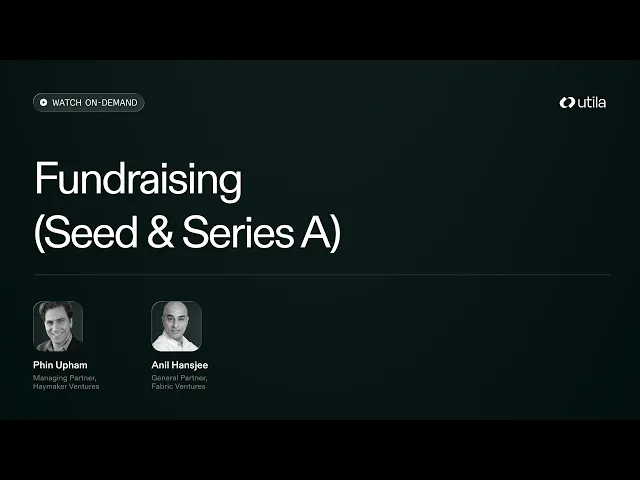
That is why Utila hosted this fundraising session for early-stage founders and builders in the stablecoin ecosystem. Josh Weiss of Utila is joined by Phin Upham of Haymaker Ventures and Anil Hansjee of Fabric Ventures to discuss how investors evaluate stablecoin companies, what they expect at seed and Series A, and how founders should think about go-to-market, differentiation, geography, investor selection, and long-term strategy.
Key Takeaways
Stablecoin startups need more than category momentum
Investors are no longer giving companies a free pass because stablecoins are in the pitch. The panel made clear that stablecoin adoption has accelerated, but fundraising still depends on the quality of the business: customer access, revenue durability, margin structure, regulatory path, and proof that the company owns a specific problem in the value chain.
Founders need both a short-term wedge and a long-term business
The strongest fundraising story connects the immediate reason customers are adopting with the larger company that can be built over time. A short-term wedge might come from pricing, speed, a corridor, a regulatory gap, or a specific customer pain point. But investors want to understand how that wedge turns into a defensible business once the first advantage becomes easier to copy.
Series A requires stronger evidence than it did two years ago
The panel discussed how the fundraising bar has moved up, especially for companies raising a Series A. Fast growth still matters, but investors are looking more closely at revenue scale, repeatability, retention, customer concentration, unit economics, and whether growth is sustainable. A spike in transaction volume is not enough if it depends on temporary pricing or a narrow market opening.
Differentiation depends on knowing what you are replacing
Stablecoin founders need a detailed understanding of the payment, banking, treasury, or capital markets workflow they are trying to improve. Investors will test whether the team understands existing systems, customer behavior, regulatory constraints, banking relationships, liquidity access, and operational dependencies. “Stablecoins make this faster and cheaper” is too thin without a clear explanation of the legacy process and why the new approach wins.
Competitive positioning needs to be honest
The panel warned against selective competitor slides. In a crowded market, investors are likely to know the missing names. Founders should be clear about who they compete with, where they overlap, what they do differently, and why that difference matters to customers. A narrow but credible differentiation point is stronger than a broad claim that ignores the rest of the market.
Geography changes the business model
Stablecoin adoption does not mean the same thing in every region. The panel discussed US dollar dominance, Latin America, Africa, local stablecoins, FX revenue, capital controls, and the role stablecoins can play in markets underserved by traditional banks. Founders need to understand corridor-level economics, local regulation, liquidity, banking access, and whether the use case depends on payments, FX, yield, capital markets, or dollar access.
Partnerships and consolidation will shape the market
The panel expects stablecoin infrastructure to involve both collaboration and competition. Banks, fintechs, card networks, and payment companies may partner with or acquire point solutions that solve specific on-chain problems. At the same time, parts of the market may commoditize, including on-ramps, off-ramps, swaps, and some wallet infrastructure. Founders need to decide whether they are building a deep point solution, a broader packaged product, or an infrastructure layer that larger players will rely on.
Investor selection should match the company’s path
The panel emphasized partner fit over investor label. A crypto-native investor may help if the company is building deeply on-chain infrastructure. A fintech investor may add more value if the company sells into banks, payment companies, neobanks, or regulated financial institutions. Corporate investors can help, but founders need to understand whether they are investing for strategic access, financial return, or business development.
B2B models may be better protected from commoditization
When money movement becomes cheaper and more standardized, value may shift toward workflow, software, compliance, orchestration, and customer relationships around the payment. The panel pointed to B2B models as more resistant to pure price competition, especially when the product solves a complex operating problem rather than simply moving funds from one place to another.
Key Speaker Insights
Anil Hansjee, General Partner, Fabric Ventures
“The bar has gone up considerably. Whether it’s $4 million ARR or whatever the magic number is, it’s a lot higher than it was a couple of years ago.”
Discussing what investors now expect from stablecoin companies raising beyond the seed stage.
Phin Upham, Managing Partner, Haymaker Ventures
“I think you need a long-term strategy. You need a ten-year strategy, and then you need a six-month strategy or a one-month strategy.”
Explaining why founders need to connect the immediate wedge with a durable company-building plan.
Anil Hansjee, General Partner, Fabric Ventures
“I prefer people to be crystal clear around what it is that they’re doing that’s different.”
Describing how founders should approach competitive positioning in a crowded stablecoin market.
Phin Upham, Managing Partner, Haymaker Ventures
“I do not think this is a money game. I do not think this is a game where if you raise more money at a higher valuation, you win.”
Warning founders against treating fundraising size and valuation as proof of long-term advantage.
Anil Hansjee, General Partner, Fabric Ventures
“What is the growth hack initially? And how does that growth hack mature into a sustainable business?”
Framing the core fundraising question for startups that have found early traction.
Phin Upham, Managing Partner, Haymaker Ventures
“In fintech in particular, you need to integrate with existing legacy systems. There is a lot of regulation. There is a ton of infrastructure already there.”
Explaining why stablecoin founders need deep knowledge of the systems they want to replace or improve.
Explore our complete webinar library
Stablecoin Builder Series

Stablecoin Builder Series

Stablecoin Builder Series
Subscribe
Subscribe for Utila news and insights
Thought leadership, product updates, and partnerships - delivered only when we have something interesting to share.