


•
4 min read time
View Transcript
Overview
USD stablecoins still carry most on-chain liquidity, but regional payment flows, corporate treasury operations, and local FX needs do not always fit a dollar-denominated model. Non-USD stablecoins can reduce currency hops and support local settlement, but adoption still depends on market depth, bank access, on-ramps, orchestration, and regulatory treatment. For builders working on payments, treasury, or cross-border infrastructure, these constraints directly determine whether a product can scale in production.
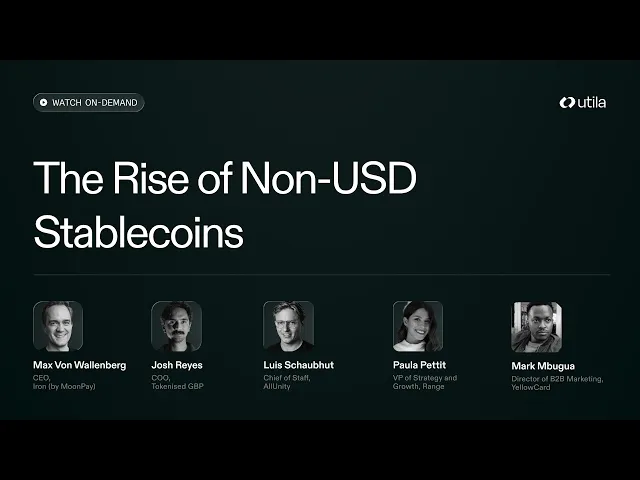
To unpack these challenges and highlight where real opportunities are emerging, Utila brought together operators building directly in these markets. In Episode 03 of the Stablecoin Builder Series, Adrielle Andrade is joined by Max von Wallenberg of Iron by MoonPay, Josh Reyes of Tokenised GBP, Luis Schaubhut of AllUnity, Paula Pettit of Range, and Mark Mbugua of Yellow Card. The panel goes beyond surface-level trends to explore where euro, GBP, and African local-currency stablecoins are actually being used today, what breaks first when systems go live, and what builders need to consider when designing for liquidity, routing, and real-world adoption.
Key Takeaways
Non-USD stablecoin liquidity remains the primary adoption bottleneck
The panel returned to liquidity as the first constraint for non-USD stablecoins. Market makers need volume before they provide depth, while users need reliable liquidity before they move meaningful flows. That creates a difficult starting point for fiat-backed issuers, especially when they cannot match the high token-incentive programs sometimes used by crypto-native projects.
Local stablecoin on-ramps are harder than global payout coverage
Global payouts are increasingly covered by existing vendors, but local collections and on-ramps remain difficult. The discussion pointed to capital controls, limited bank appetite for crypto-related businesses, blocked fiat rails, and the need for direct banking relationships. For institutional flows, the question is not only whether a provider supports a market, but whether the rail can handle enterprise-scale volume when transactions fail or counterparties need reconciliation.
Non-USD stablecoins need cash-equivalent treatment for treasury adoption
Regulation helps issuers speak to banks and large institutions, but the panel highlighted an unresolved treasury issue in Europe. If regulated stablecoins are still treated as crypto exposure rather than cash equivalents, corporate treasurers may struggle to use them for payments at scale. For large B2B treasury teams, adoption depends on legal clarity, accounting treatment, internal risk approval, and the ability for counterparties to send and receive the asset.
Regional stablecoins are strongest when they reduce FX hops and local settlement costs
The strongest near-term case for non-USD stablecoins is not generic retail usage. It is specific transaction flow where local-currency stablecoins reduce FX conversion, tax complexity, or settlement exposure. Examples discussed included Europe-to-Africa corridors, intra-Africa trade, local B2B settlement, and treasury operations where a recipient can hold or reuse the stablecoin directly.
Stablecoin orchestration matters as much as stablecoin issuance
Issuance alone does not create usable payment infrastructure. The panel separated fiat orchestration from on-chain orchestration: the first moves money between bank rails and stablecoins, while the second routes assets across chains, currencies, and compliance checks. As more issuers and chains enter the market, payment operators will need routing, liquidity access, KYT, and reliable conversion paths across many stablecoins.
Key Speaker Insights
Max von Wallenberg, CEO, Iron by MoonPay
“Global payouts are decently solved. If you want to go from stablecoin into global payouts, there are a lot of vendors to pick from. The hardest part is local on-ramps. Local collections are something I keep hearing need solving.”
Discussing where stablecoin payment infrastructure still struggles after payout coverage is in place.
Josh Reyes, COO, Tokenised GBP
“What breaks first, or probably the biggest challenge, is liquidity. One thing I’d like to see the space invest in more is liquidity operations.”
Asked what fails first when teams support multiple non-USD stablecoins in production.
Luis Schaubhut, Chief of Staff, AllUnity
“What we have to achieve with stablecoins is that they are cash equivalent. Otherwise, a big treasurer moving billions daily can’t use a stablecoin because, from a risk exposure perspective, it’s not possible.”
Explaining what treasury teams need before using stablecoins for high-volume corporate payments.
Paula Pettit, VP of Strategy and Growth, Range
“At the end of the day, they mostly shouldn’t see it. It just needs to be a payment to them: the easiest payment, with the best fee, that goes the quickest.”
Describing what end users should experience when stablecoin payments reach mainstream applications.
Mark Mbugua, Director of B2B Marketing, Yellow Card
“The rule of thumb, at least in Africa, is to use USD stablecoins for savings and hedging. Ideally, we’d want to use local stablecoins for transaction flows.”
Framing the difference between USD stablecoin demand and local-currency stablecoin use cases in African B2B corridors.
Explore our complete webinar library
Stablecoin Builder Series

Stablecoin Builder Series

Stablecoin Builder Series
Subscribe
Subscribe for Utila news and insights
Thought leadership, product updates, and partnerships - delivered only when we have something interesting to share.