Executive Summary
Utila has launched the Licensed Partner Network, an industry-first solution designed for fintechs and enterprises that want to offer stablecoin payments, payouts, custody, or related services but do not hold the required licenses themselves. Through the network, companies can work with licensed partners including Fipto, CoinGate, Balance, and Surus, while building their stablecoin operations on Utila’s wallet and payments infrastructure.
The model gives companies a way to launch under an appropriate partner framework, continue pursuing their own authorization if that is their long-term strategy, and transition to their own license without rebuilding the underlying infrastructure. It addresses the remaining piece of the Stablecoin 2.0 model we introduced earlier this year: making regulatory access modular alongside wallets, compliance, liquidity, and execution.
Licensing Is Becoming a Build-or-Partner Decision
Financial institutions increasingly expect partnerships to form part of their stablecoin strategy. EY-Parthenon found that 73% of financial institutions plan to use partner licenses in some form: 30% expect to rely entirely on a partner’s license, while another 43% plan to combine partner licenses with licenses they obtain themselves. Only 6% expect to secure all required licenses entirely in-house.
These statistics make more sense in the context of a broader shift in how financial institutions are approaching stablecoin infrastructure. A company building a stablecoin payment product needs several distinct capabilities, and there is little reason they must all come from the same provider. Wallet infrastructure, transaction governance, AML/KYT, liquidity, on/off-ramps, and settlement execution can increasingly be assembled around the company’s requirements.
But licensing has so far been harder to treat in the same way. For teams that need regulated coverage before they can launch, the choice of license provider can end up determining the rest of the technology stack.
That is particularly important for companies that see stablecoins becoming a meaningful part of their payments business and want greater control as volumes grow. This shift toward choosing and controlling the individual components of the stack is the basis of what we call Stablecoin 2.0.
Stablecoin 2.0: Own the Stack, Choose the Providers
Earlier this year, we introduced Stablecoin 2.0 to describe the shift we see among fintechs moving beyond all-in-one stablecoin providers.
Stablecoin 1.0 packages the components required to get started into a single service. That can work well for testing a new product or establishing initial volumes. As the operation grows, payments companies tend to care more about who controls each part of the flow, which providers they can use, and where transaction economics are being captured.
Stablecoin 2.0 gives the institution direct control over four core layers:
Wallet and policy governance. Control the wallets, keys, roles, approvals, limits, and transaction policies governing money movement.
Compliance integrations. Choose AML/KYT and other compliance providers according to the institution’s own requirements.
Liquidity and ramps. Connect directly with liquidity, banking, and on/off-ramp partners and negotiate commercial terms directly.
Conversion and routing. Move between assets, networks, and counterparties according to each payment or settlement requirement.
This modular approach lets institutions change providers and optimize individual components without replacing their entire stablecoin operation.
When we first introduced the Stablecoin 2.0 framework, we explicitly identified flexible licensing as the remaining layer: start under an established licensed framework, then transition to the institution’s own authorization when available.
Licensing Can Hold Back an Otherwise Ready Stablecoin Product
In our conversations with fintechs and payment companies, licensing has repeatedly surfaced as a constraint on customer-facing stablecoin products. A company may already have customer demand, an engineering team, established payment operations, and a clear use case for stablecoin payouts or settlement, while lacking the authorization required for that specific activity.
The requirements vary substantially by jurisdiction and business model. In Europe, for example, a payments company may require MiCA authorization for activities that its existing payments permissions do not cover. In the United States, the required structure can involve money transmitter or regulated custody coverage depending on what the company is offering.
The solution that many companies were forced to settle for is to choose an all-in-one stablecoin provider that supplies regulatory coverage together with the wallet, compliance, and liquidity infrastructure. That solves the immediate licensing requirement, but it can make regulatory access inseparable from the rest of the operating model.
For a fintech already planning to secure its own licenses, that can create a repeatable infrastructure migration problem: build on one stack to launch, obtain the license, then migrate technology and counterparties to reach the operating model they wanted in the first place.
Meanwhile, other companies may prefer to operate permanently through a licensed partner, but still want control over the infrastructure, counterparties, and workflows around that regulatory relationship.
The Stablecoin 2.0 framework described precisely this problem and proposed a model in which companies could start under partner coverage while building their permanent infrastructure from day one.
Introducing the Utila Licensed Partner Network
The Utila Licensed Partner Network puts that model into practice. It connects companies that need regulatory coverage with licensed partners that can serve as the regulated counterparty for supported activities and jurisdictions, while Utila provides the underlying wallet and operational infrastructure.
The model supports different licensing strategies. A fintech can build its wallets, transaction policies, integrations, and payment workflows on Utila while operating through a licensed partner on an ongoing basis. If it later secures its own authorization, workspace ownership can transition without replacing the infrastructure underneath the product.
We believe this combination represents an industry-first approach to unbundling licensed regulatory coverage from the permanent stablecoin infrastructure stack.
The license therefore becomes another provider relationship within a modular architecture rather than the reason the company has to accept an all-in-one stack.
Start Under Partner Coverage, Keep the Stack
The network is designed for companies that need licensed coverage while retaining control over the infrastructure supporting their stablecoin product.
Build while pursuing authorization. Product and engineering teams can establish their stablecoin infrastructure while their own licensing process continues.
Keep the same operating foundation. Wallet architecture, transaction policies, integrations, and workflows do not need to be rebuilt simply because the regulatory model changes.
Preserve provider choice. The institution can build direct relationships across compliance, liquidity, on/off-ramps, and other components instead of receiving them through one bundled intermediary.
Choose the long-term licensing model. Continue operating through a licensed partner or transition to your own authorization when that fits the business.
This makes the model relevant both to companies entering stablecoins for the first time and to established payments businesses that already know they want greater control over how their stablecoin product is built.
Who the Licensed Partner Network Is For
The Licensed Partner Network supports different regulatory strategies. Some companies want a partner to cover the period before their own license is ready. Others may decide that working through a licensed partner is the right long-term operating model.
The main use cases include:
Launch while pursuing your own license. Build and operate the product through an appropriate licensed partner while your own authorization process continues, then transition to your own license without rebuilding the underlying infrastructure.
Operate permanently through a licensed partner. Companies that do not plan to become licensed themselves can use a partner as the regulated counterparty while retaining control over their wallet infrastructure, integrations, liquidity relationships, and product experience.
Expand into a new jurisdiction. A company may already hold licenses in its core markets but need additional regulatory coverage before offering stablecoin services elsewhere. The network can provide access to partners with the relevant local permissions.
Add a regulated stablecoin product to an existing payments business. Fintechs and payment companies can introduce customer-facing stablecoin pay-ins, payouts, custody, or related services where the required authorization sits outside their existing regulatory scope.
The appropriate structure depends on the jurisdiction, regulated activity, customer model, and partner requirements. The common thread is that the licensing model should not dictate the rest of the stablecoin stack.
Licensed Partners Across Europe and North America
The first group of partners brings different regulatory permissions and geographic coverage to the network. Through Utila, companies can work with the partner appropriate to their intended activity and market.
Fipto (France and EU): Fipto is a MiCA-authorized Crypto-Asset Service Provider and licensed Payment Institution in France, providing regulatory coverage across supported crypto-asset and payment activities.
CoinGate (EU): CoinGate is a MiCA-authorized CASP covering services including custody, transfer, and crypto/fiat exchange.
Balance (United States and Canada): Balance operates regulated entities supporting institutional custody and money movement across North America.
Surus (United States): Surus is a North Carolina-chartered trust company providing regulated custody infrastructure for institutional digital asset and stablecoin holdings.
Additional partners and jurisdictions are planned as the network expands.
Completing the Stablecoin 2.0 Stack
When we published our first Stablecoin 2.0 article, we described licensing as the major piece still missing from the modular model. Utila already provided the wallet and operational layer, integrations gave institutions control over compliance and tech stack providers, and Utila Link connected them directly with liquidity and payment partners. Flexible regulatory coverage was the remaining part we were working to solve.
The Licensed Partner Network turns that idea into an operating model.
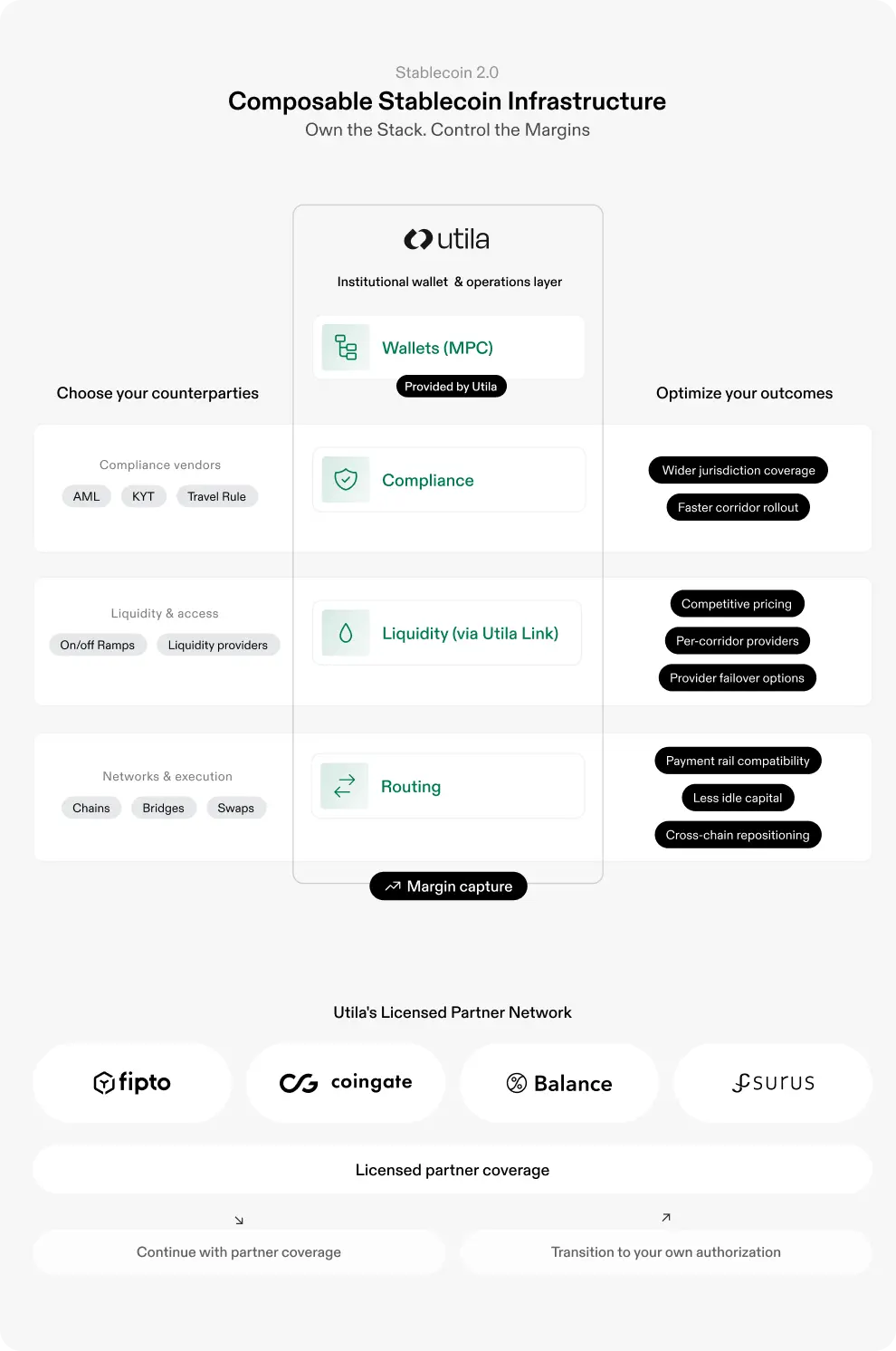
A fintech can choose the infrastructure it wants to keep, access appropriate licensed coverage for the markets and activities it serves, and decide whether partner coverage or its own authorization is the right long-term model. If that model changes, the underlying infrastructure does not have to change with it.
If licensing is delaying your stablecoin roadmap, contact Utila to explore the Licensed Partner Network and the options available for your market, use case, and licensing strategy.

Co-Founder & CEO
Bentzi Rabi is Co-founder and CEO of Utila, with experience building cybersecurity technology at Perception Point and investing in early-stage companies as Principal at i3 Equity Partners.