Choosing digital asset infrastructure is one of the more consequential decisions an institution makes when it begins moving money on-chain.
Once adopted, the platform becomes the operating layer for digital asset operations, shaping the controls around transactions, the way counterparties are managed, the role compliance plays in daily execution, and the reliability of those workflows as volume grows.
For organizations weighing that decision, Utila and Fireblocks are two of the platforms that appear most often on the shortlist.
This article compares Utila and Fireblocks: where each platform is strongest, which workflows each is best suited for, and what institutions should consider when evaluating digital asset infrastructure for stablecoin payments, treasury operations, and broader onchain financial products.
Utila vs Fireblocks at a Glance: Diverging Starting Points
At first glance, Fireblocks and Utila may appear more alike than different. Both support MPC key management, multi-chain wallet operations, transaction governance, compliance workflows, and APIs for teams moving digital assets at scale.
The differences become apparent when we look at each company’s origins and the market they were originally built for. That initial context continues to shape Fireblocks’ and Utila’s respective architecture, product priorities, and assumptions about how institutions would use digital assets.
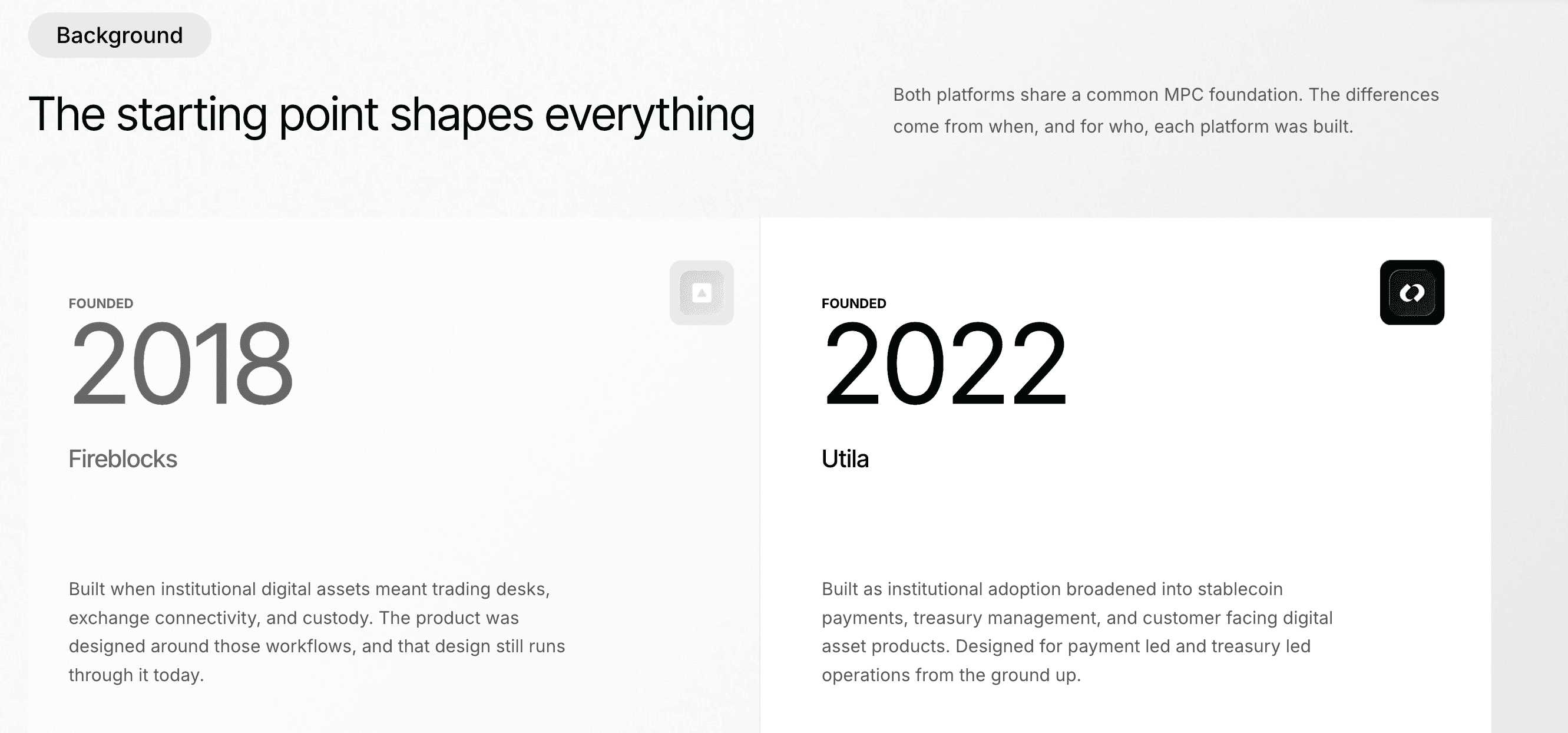
Fireblocks started in 2018, when the first major institutional digital asset workflows centered on trading, custody, and exchange connectivity. Utila, on the other hand, launched in 2022, when the context started to shift: institutional adoption started widening across more use cases, with fintechs, enterprises, PSPs, and banks exploring digital assets and stablecoins for payments, cross-border money movement, treasury management, and customer-facing financial products.
Utila vs Fireblocks: Feature Comparison
Capability | Fireblocks | Utila |
Security foundation | MPC-CMP implementation using homomorphic encryption and cloud-hosted key-share infrastructure. | DKLS23 MPC implementation with independent key-share architecture. |
Transaction controls | Function-level contract-call controls, plus standard transfer approval/permit policies. | Function-parameter level controls for any EVM, enabling granular governance for tokenization, DeFi and stablecoin operations. |
Transaction fee management | Gasless Relays sponsor transaction fees, with sponsorship configured per vault. | Sponsor wallets can be selected per transaction across BTC, EVMs, Solana, Sui, Tron, and Aptos. |
Batch payouts | Batching is available on EVMs via API. | Native batching across EVM, Solana, Tron, and Bitcoin via both API and console. |
Wallet and address controls | Per-token, per-address whitelisting, each entry requiring admin-quorum approval. Once created, whitelist entries can’t be edited. | Token-agnostic whitelisting, address-level policy flexibility (addresses are not nested under specific wallets), bulk upload of up to 200 addresses, and batch approval. |
Console performance at scale | Missing pagination renders the console unusable when thousands of wallets need to be rendered in the UI. | Paginated from the ground up; works across large wallet estates |
APIs and automation | Rate limits unpublished; raising them requires CSM contact and may carry charges. | Public rate limits are documented in the Help Center, with wallets, transfers, sponsorship, batching, and policies automated through one API layer. Trial and production use the same platform experience. |
Blockchain network support | 125+ supported blockchains, with some additional networks available only to specific customers. | Payment-focused coverage across Tron, Stellar, XRPL, Solana, Sui, Aptos, and EVMs, plus Bring Your Own EVM. |
Counterparty connectivity | Network available across its customer base, although active usage and counterparty discoverability vary. | Utila Link connects 80+ payment and liquidity partners across stablecoin payment corridors. |
Exchange connectivity and deposit-address security | Broader native exchange connectivity and off-exchange settlement, but less visibility into the exact deposit address used in exchange-connected flows. | Fewer native exchange integrations, but offering verified deposit addresses that teams can view, verify, and lock before funds move. |
Yield and treasury | New offering (2026) with limited coverage and offerings outside the core payment workflow | Broad yield and staking access through Yield.xyz, Figment, Everstake, Meria, Osero Earn, and Morpho-based vaults, plus tokenized money market funds from Midas, Securitize, and Ondo. |
Business continuity | Cannot mirror an external provider's environment | Can fully replicate a Fireblocks environment for redundancy, DORA planning, or parallel evaluation |
Pricing model | $999/month entry (6 months), $1M volume, 0.20% overage, paid add-ons | $499/month entry (12 months), $3M volume/quarter, core features included |
Support model | Tiered; entry plan includes 8×5 support | Named CSM, dedicated Slack, engineer access; 24/7 chat from Starter |
How the Two Platforms Handle Payment Specific Workflows
Key takeaway: Stablecoin payments and trading operations place different demands on digital asset infrastructure, and the differences show up in the operating details payment companies deal with every day.
Trading led workflows revolve around moving assets between venues, managing custody, connecting to exchanges, and settling with institutional counterparties.
Payment led workflows revolve around repeated money movement across customers, payees, corridors, wallets, and blockchain networks.
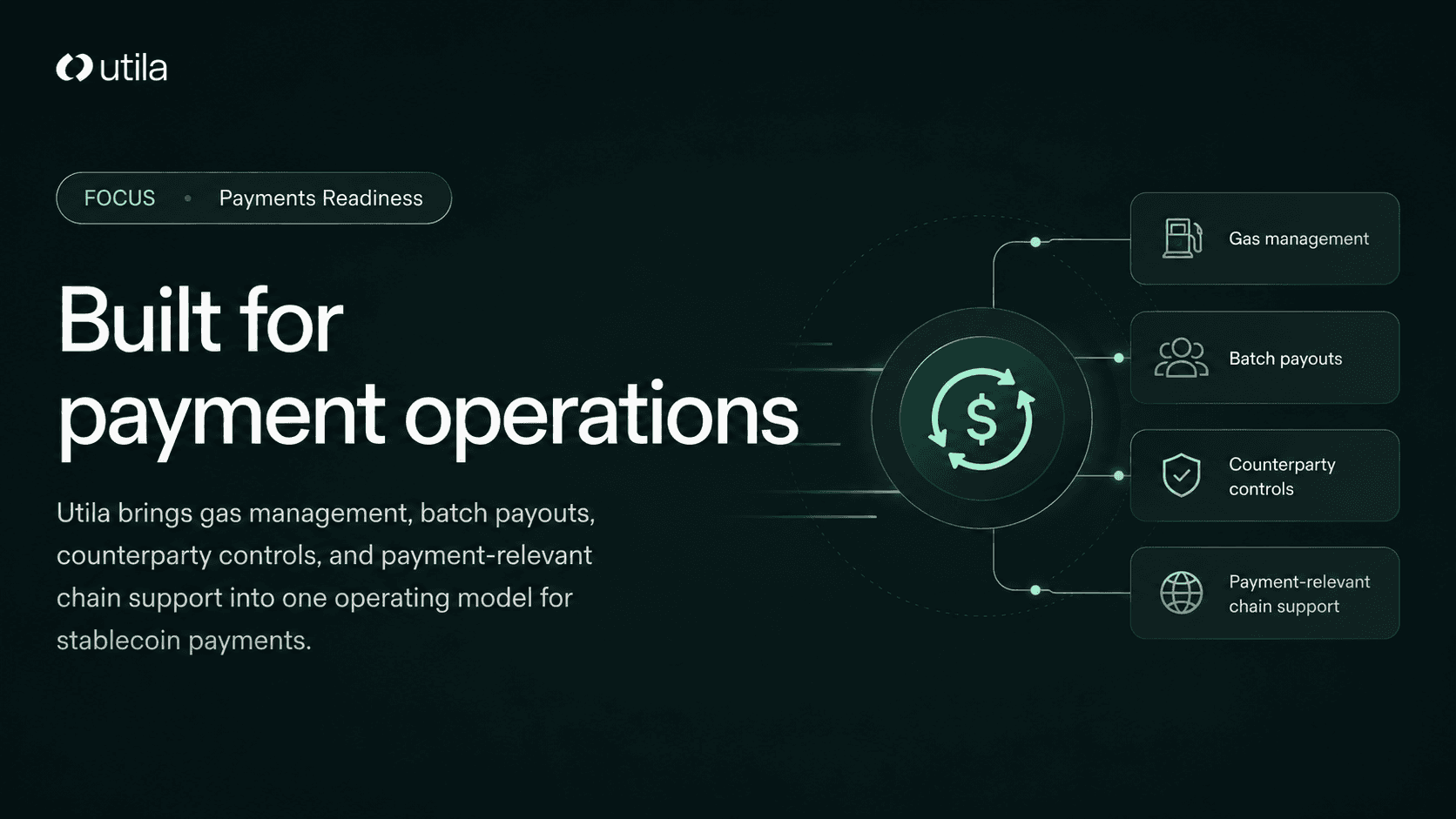
Below, we compare how Utila and Fireblocks handle the features that matter most for managing stablecoin payments at institutional scale.
Keeping transaction costs manageable (Gas Management)
Why it matters: High-volume payment operations may use thousands of wallets across several networks. Requiring every wallet to hold and replenish native gas tokens adds funding transactions, stranded balances, and failed sweeps. Gas management should abstract fee payment while also reducing the underlying transaction cost where network-specific mechanisms are available.
Fireblocks | Utila | |
Fee funding model | Gasless transfers use a designated relay vault or relay workspace to cover fees for supported transactions. | Teams can select the sponsor wallet for each transaction, with delegation, required approvals, and the transfer handled through one flow. |
Configuration and workflow | Teams configure a gasless relay and the policy rules governing relay transactions before dependent vaults can use it. | Sponsorship is part of the standard console, mobile, and API transfer flow, without requiring the source wallet to hold native tokens for fees. |
Network coverage | Universal Gasless is available on a limited set of EVM mainnets. Other networks require separate fee-management approaches. | Sponsored transactions extend across EVM networks, Solana, Sui, Aptos, and TRON under the same approval and policy framework. |
TRON cost control | TRON is outside Universal Gasless coverage and therefore relies on a separate fee-funding and resource-management approach. | Utila’s TRON Gas Station lets teams pay transaction fees in USDT and reduce costs by 50–70%. Teams can also use native TRX staking, resource delegation, or on-demand energy rental under the same policy and approval controls. |
The difference becomes particularly important on TRON, where fee management involves energy and bandwidth as well as the transaction’s native gas token. Utila brings fee payment, resource optimization, and transaction governance into the same operational flow used to manage wallets and transfers.
Explore case study: Mandioca Learn how Mandioca eliminated the need to fund gas fees for each wallet individually thanks to Utila's sponsored transfers. |
High volume payout execution (Batch Transactions)
Why it matters: Payroll, supplier payments, customer disbursements, treasury sweeps, and partner settlements may involve hundreds or thousands of transfers. Native batching reduces the number of transactions teams need to create, approve, track, and reconcile.
Fireblocks | Utila | |
Batch transaction coverage | Recently added EVM batching, with additional batching capabilities varying by network. | Native batching across EVM networks, Solana, Tron, and Bitcoin. |
Execution and operator workflow | Batching is currently API-based rather than available through a dedicated console workflow. Console-based sweeping can be configured through a separate, premium Automations feature. | Teams can create and execute batches through either the API or the console, including a dedicated console workflow for sweeping funds across wallets. |
Utila gives payment and operations teams broader network coverage and lets them manage batches directly from the console, while still supporting API-based automation for larger-scale workflows.
Explore case study: Mandioca. Learn how Mandioca handles high-volume cross-border payment flows thanks to Utila's batch payment capabilities. |
Streamlining payee, counterparty, and address approvals (Address Whitelisting)
Why it matters: The security of stablecoin payment operations at scale depends on approved destinations. As the number of payees, assets, and corridors grows, the approval model becomes a source of either control or administrative drag.
Fireblocks | Utila | |
Approval granularity | Whitelisting is configured per token and address, with each entry requiring admin-quorum approval. Entries cannot be edited; any change requires deleting and recreating the entry, followed by another approval. | Token agnostic whitelisting allows a counterparty address to be approved once for the tokens sent to it. |
Bulk administration | Administrative overhead grows with the matrix of addresses and tokens as payees, assets, and corridors expand. E.g.: adding 200 address entries requires 200 separate whitelisting and admin-quorum approval workflows. | Teams can upload up to 200 addresses in one operation and submit them through a single batch approval workflow. |
At scale, the approval model determines whether each new corridor remains a controlled operational update or creates additional administrative backlog.
Console performance and operational visibility (Payment UX/UI)
Why it matters: For teams running large wallet setups, the console is part of the daily operating environment. Operations teams need to be able to search, filter, approve, monitor, and resolve transactions without the interface becoming a bottleneck as wallet counts grow.
Fireblocks | Utila | |
Console performance at scale | Console performance can degrade across large wallet estates, requiring teams to hide inactive wallets to keep the interface responsive. | Native pagination keeps wallet search, filtering, transaction review, and monitoring responsive as wallet counts grow. |
Transaction visibility | Operational review can become harder as wallet and transaction counts grow. | Transaction lifecycle visibility gives teams a clearer view of where each payment stands, from submission through approval and execution. |
Mobile transaction workflow | The mobile app supports transaction review, approval, and signing, but transactions must be initiated through the console or API. | Teams can initiate, review, and approve transactions directly from the mobile app. |
Explore case study: 1Konto Learn how 1Konto accelerated client settlements thanks to Utila's intuitive console experience. |
Policy controls for payments, treasury, and digital asset products (Policy Engine)
Why it matters: As stablecoin payment operations expand to include treasury movement, customer-facing wallets, tokenized assets, or yield workflows, governance needs to cover the actions a wallet can perform as well as the approvals behind each transaction. Without that control, the same wallet permissioning model used for simple payments can allow higher-risk actions.
Fireblocks | Utila | |
Transaction authorization | Configurable policies for initiators, sources, destinations, assets, amounts, and approval requirements. | Granular policies for initiators, sources, destinations, assets, amounts, and approval requirements. |
Smart contract governance | Function-level controls can govern who may interact with an approved contract and which function they may call. | CEL-based policies can restrict both the function being called and the arguments passed to it, including value thresholds and per-initiator limits across EVM smart contracts. |
Explore case study: Vield Learn how Vield governs its digital asset lending operations thanks to Utila's policy and admin quorum features. |
Blockchain network support and corridor expansion (Bring Your Own EVM)
Why it matters: Stablecoin payment corridors often depend on specific blockchain networks because local partners, liquidity, fees, and settlement habits vary by market. The comparison is therefore about both published coverage and how quickly each provider can support the network a corridor requires.
Fireblocks | Utila | |
Published coverage | 125+ supported blockchains, with some additional networks available only to specific customers. | Coverage focused on payment-relevant networks, including Tron, XRPL, Stellar, Solana, Sui, Aptos, and EVMs. |
Adding new networks | Support for a new network depends on Fireblocks implementing it and may involve longer lead times and fees of $25,000 or more. | Bring Your Own EVM allows customers to add EVM compatible networks quickly, often the same week. |
Payment-relevant chains | Broad chain coverage, with feature depth varying by network. | Strong support for payment relevant networks, including Tron for stablecoin heavy corridors in APAC and LATAM, and Sui for emerging regional use cases such as Africa. |
Operational depth | Network support may not always include the same payment specific tooling across fee management, batching, policies, and automation. | Network support is paired with payment specific capabilities such as transaction fee management, batch payouts, policy controls, and wallet operations. |
Explore case study: Afriex Learn how Afriex runs stablecoin powered cross-border payments across 23 African corridors thanks to Utila's multi-chain, payment relevant network support. |
Automating payment operations end to end (APIs and Automation)
Why it matters: Once stablecoin payments run in production, most of the work does not happen in a console. Wallet creation, transaction execution, sponsored transfers, policy checks, and reconciliation run through APIs.
The API surface, then, becomes an important field of comparison as it determines how much of the operation a team can automate and how reliably it holds up when transaction volume spikes.
Fireblocks | Utila | |
API limits at scale | Actual rate limit values are not published, and raising limits requires contacting your CSM, with additional charges that may apply. | API infrastructure designed for payments grade throughput, built to handle the volume spikes that come with real world payment operations. |
Automation surface | Wallet creation, transaction execution, gasless sponsorship, batching, and policy operations are available through APIs, although some capabilities use separate services and configuration flows. | Wallet creation, transaction execution, sponsored transfers (through a unified gas sponsorship API), batch payouts, and policy-governed approvals can all be automated through the same API layer. |
Developer experience | Sandbox environments have limited rate limit configuration for scale testing. | Developer-friendly APIs, direct access to engineers, and self-serve trials running on mainnet. Teams can test real assets, exchange transfers, and smart contract interactions in the same environment they will use after launch. |
For payment companies, the API layer is where infrastructure either fits seamlessly into the product or becomes a recurring engineering issue. Utila is the stronger fit when wallet creation, transaction execution, sponsorship, policies, and operational workflows need to be automated through APIs.
Relevant case study: tGBP Learn how tGBP automated its stablecoin mint and burn operations at scale thanks to Utila's API-driven architecture, growing TVL from ~$2M to ~$30M with a team of under 20 people. |
Tokenization
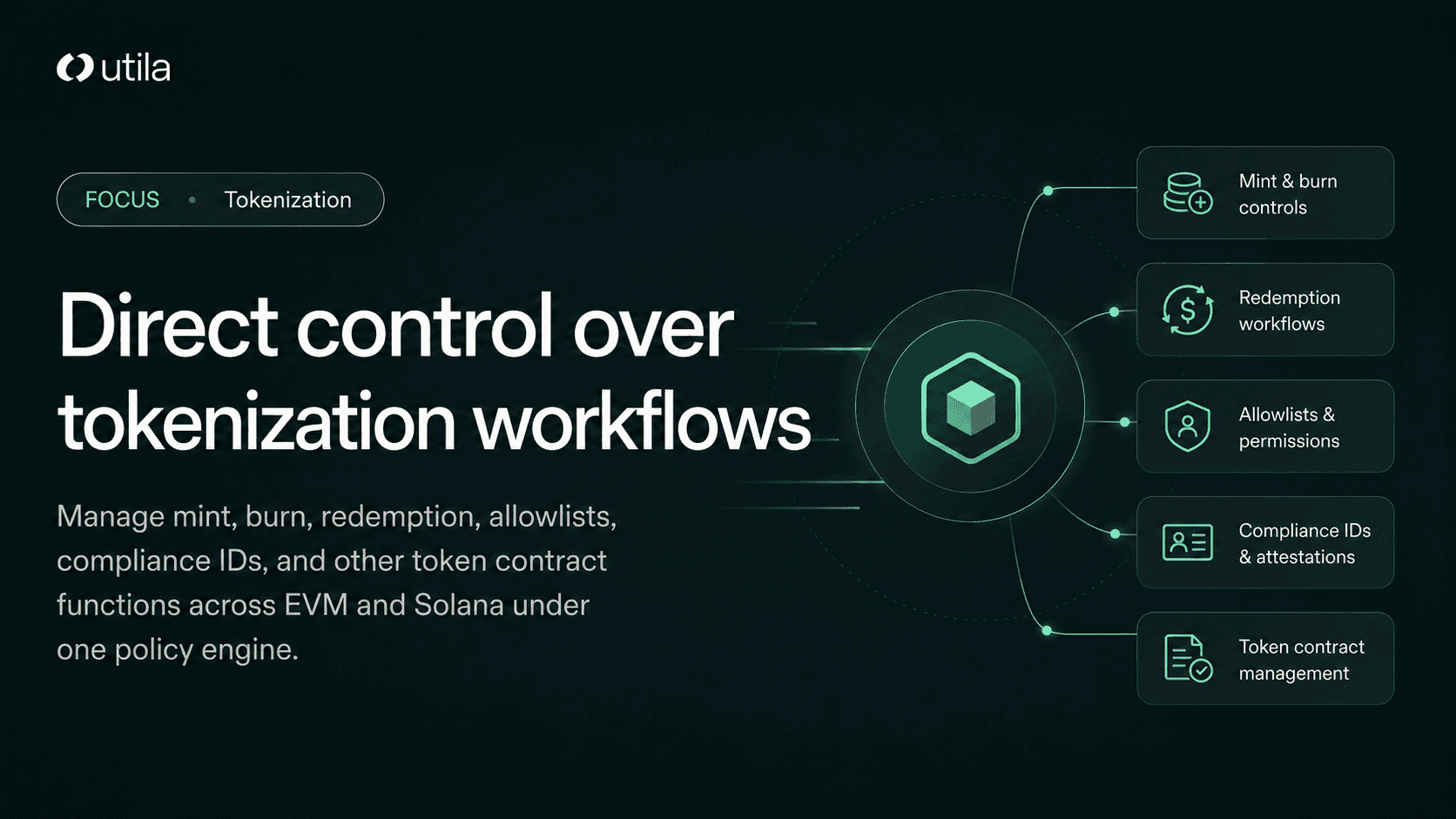
Key takeaway: Fireblocks provides a structured tokenization offering built around predefined issuance and lifecycle workflows. Utila gives banks and issuers direct control over tokenization smart contracts, including compliance functions, policy-governed minting and burning, and operations across EVM and Solana.
Tokenization workflows extend beyond issuing an asset. Banks and regulated institutions may need to manage investor eligibility, allowlists, blocklists, compliance identities, transfer restrictions, minting, burning, and redemption throughout the asset lifecycle. The infrastructure therefore needs to govern the full set of smart contract actions behind tokenized deposits, regulated securities, and RWAs.
Utila gives banks and regulated institutions direct control over the smart contract functions that govern tokenized assets, including minting, burning, redemption, allowlists, blocklists, compliance identities, and compliance modules.
These operations run under the same policies, approval flows, limits, and transaction visibility used across the rest of the platform, making Utila a stronger fit for tokenized deposits, regulated securities, and RWA products that require ongoing compliance and operational control.
Fireblocks | Utila | |
Tokenization model | Structured tokenization workflows covering issuance, transfer, minting, burning, and lifecycle management through the Fireblocks platform. | Direct smart contract management from the Utila console, allowing teams to read and execute any supported function on the tokenization contract. |
Smart contract operations | Governance centers on predefined tokenization actions and supported contract functions. | Teams can manage minting, burning, redemption, allowlists, blocklists, compliance IDs, and compliance-module functions directly from the wallet environment. |
Standards and network support | Supports EVM token standards and Solana SPL tokens, with Solana minting and burning handled through a generic program call. | Supports ERC-20 and ERC-3643 on EVM, together with SPL Token and Token-2022 on Solana. Solana minting and burning are treated as native token operations. |
Policy controls | Policies govern supported tokenization actions, approvals, and user permissions. | The same approval flows, limits, transaction policies, and lifecycle visibility apply across EVM and Solana tokenization operations. |
Fit for regulated institutions | Suitable for institutions seeking a more predefined tokenization product and lifecycle framework. | Suitable for banks and issuers that need direct control over regulated token contracts, compliance modules, tokenized deposits, and RWA operations. |
Pricing and Unit Economics
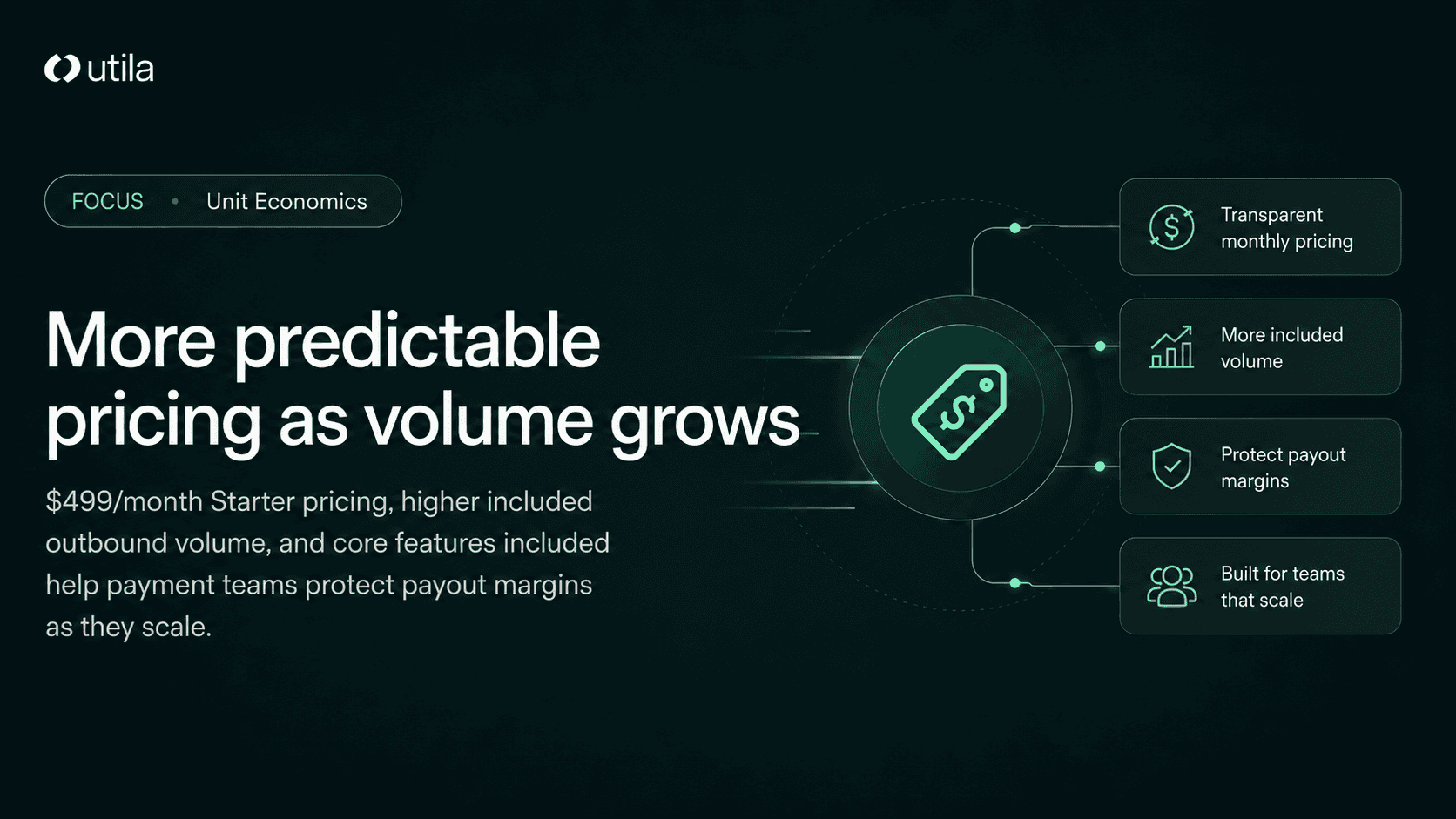
Key takeaway: Utila gives payment led teams more predictable pricing, with a lower published entry price, higher included outbound volume, and core infrastructure capabilities included from the start.
For stablecoin payment businesses, infrastructure pricing affects payout margins, corridor economics, and the cost of scaling new flows.
Fireblocks | Utila | |
Published entry price | Essentials starts at $999/month for up to 6 months. | Starter starts at $499/month for 12 months, billed quarterly. |
Included outbound volume | Essentials includes $1 million in outbound transaction volume per quarter. | Starter includes up to $3M outbound transaction volume per quarter. |
Wallet allowance | Essentials includes 1,000 embedded wallets. | Starter includes 1,000 active wallets. |
Support | Essentials includes basic 8×5 support. Custom plans can add Premium or Platinum 24/7 support. | Starter includes 24/7 chat support. Custom plans include dedicated onboarding and support, with priority SLA and account management. |
Blockchains | Essentials includes access to supported blockchains. | All Utila plans include all supported blockchains. |
Overages and add-ons | Essentials charges a 0.20% overage rate. Published add-ons include DRS, staking, automation, cold wallets, raw signing, KeyLink, Off Exchange, and tokenization; Off Exchange is priced from 3–30 basis points on assets under custody. | Utila's Custom plans are agreed around outbound volume, wallet limits, vaults, users, SLA, and account management, with core infrastructure features included. |
While Fireblocks has a clear public entry plan, Utila offers a lower starting price, more included outbound volume, 24/7 chat support on Starter, and a cleaner path to custom pricing as payment volume, wallet count, and corridor coverage grow.

Fireblocks Network(s) vs. Utila Link - Which Network Is Truly Payment Centric?
Key takeaway: Fireblocks has two distinct offerings: the broader Fireblocks Network for transfers between Fireblocks customers, and a separately branded Network for Payments built around third-party on/off-ramp integrations. Utila Link focuses on connecting Utila customers with payment, liquidity, and settlement partners.
Fireblocks often points to the scale of its broader Network, which is available across a customer base of more than 2,000 companies. However, that figure represents customers with access to the Network, not necessarily active users.
Every Fireblocks customer has Network access by default, but active usage and discoverability are more limited. Many major counterparties opt out of discovery, so connecting with them may still require an existing relationship and their Fireblocks Network ID.
Importantly, the broader Fireblocks Network does not represent a dedicated payment network of on/off-ramp providers, local settlement partners, liquidity providers, and corridor specific counterparties. While Fireblocks does have a dedicated payment network - Fireblocks Network for Payments - its current provider count appears much narrower, with only five payment focused providers.
On the other hand, Utila Link is a payment network built around the requirements of payment companies. It helps companies discover, connect with, and settle through counterparties that support stablecoin corridors, liquidity routes, on/off-ramp flows, and local settlement.
Fireblocks Network(s) | Utila Link | |
Network type and fit | Broader Fireblocks Network connects institutions inside the Fireblocks ecosystem; strongest for trading, OTC, exchange, custody, and treasury workflows. | Payment network built for stablecoin settlement and corridor-specific flows; strongest for pay-ins, payouts, liquidity routes, on/off-ramps, and local settlement. |
Payments-specific coverage | Fireblocks Network for Payments is separate from the broader client network. Current count: five dedicated payment entities currently live. | 80+ partners curated around real payment corridors. |
Discovery and onboarding | More fixed network model with standardized onboarding and network structure. | Open discovery model where either side can initiate, with the ability to onboard a specific counterparty a customer needs. |
For trading led institutions, the broader Fireblocks Network is valuable because many of the relevant counterparties already sit inside that ecosystem. For payments led businesses, the practical value comes from payment counterparty relevance, not from the size of a broader institutional client directory.
Operational Resilience: Utila's Business Continuity Feature and DORA Readiness
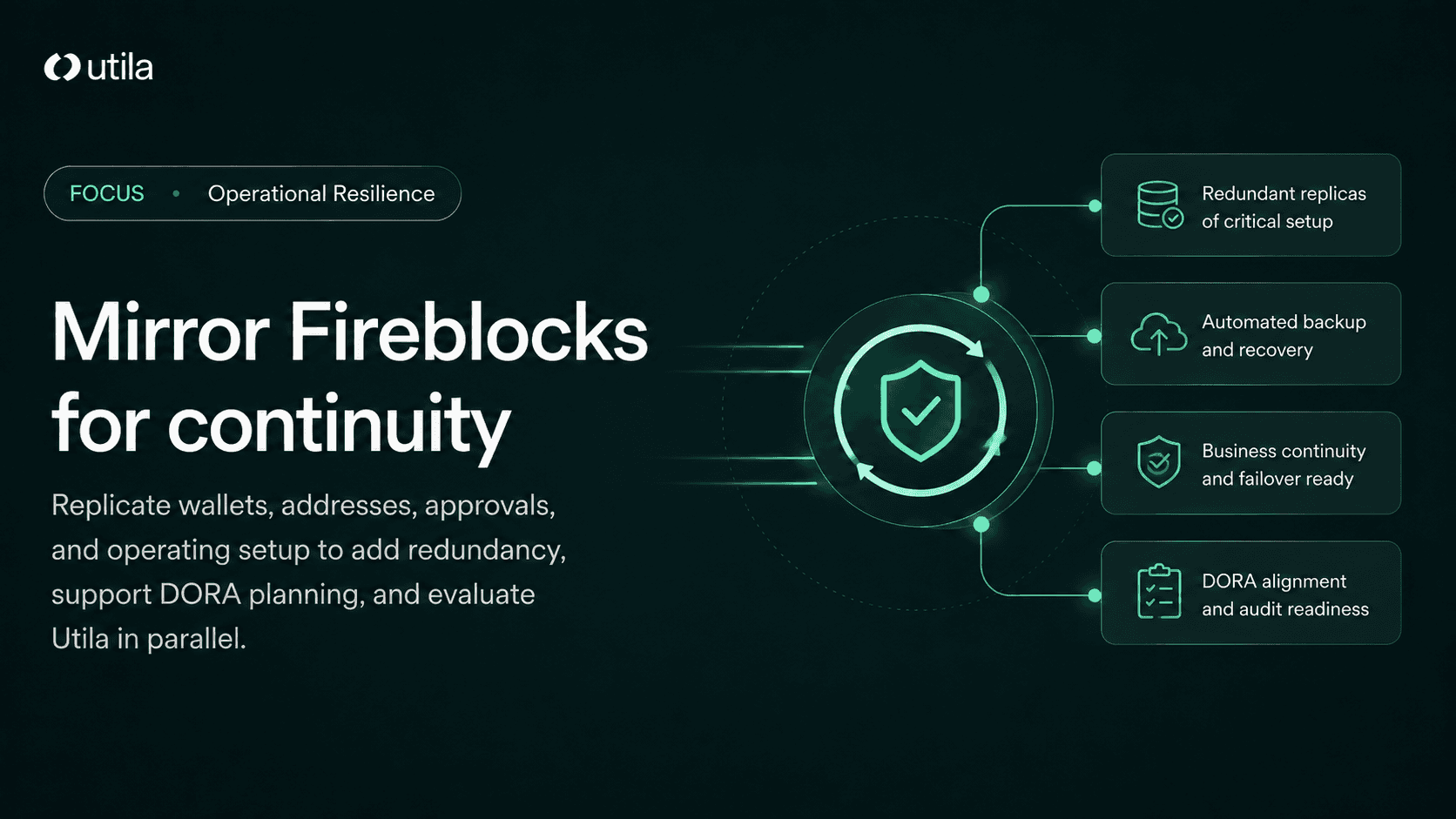
Key takeaway: Critical digital asset operations increasingly require provider redundancy. Utila can mirror an existing Fireblocks environment, giving institutions a practical path to add resilience, test a second provider, or prepare a future migration without an immediate platform switch.
For institutions running live payment flows, a single provider setup can create exposure related to incident response and continuity planning.
Additionally, under the DORA act, regulated financial entities need to show that critical technology dependencies are governed, monitored, and resilient - meaning infrastructure choices are assessed not only for day-to-day functionality, but also for continuity, substitutability, exit planning, and the ability to keep critical operations running if a provider becomes unavailable.
Utila supports that model by offering the unique ability to completely replicate an existing Fireblocks environment, including wallets, addresses, approval policies, and operational setup. This allows a team to run Utila as a backup provider while keeping its current Fireblocks infrastructure in place. In practice, that means:
Adding provider redundancy - mirror the existing wallet environment and approval setup so Utila can operate as a secondary provider.
Supporting DORA-aligned continuity planning - maintain an alternative operating environment for critical wallet and payment workflows.
Reducing third party concentration risk - avoid relying on a single wallet infrastructure provider for critical digital asset operations.
Evaluating in parallel - run Utila alongside Fireblocks before deciding whether to move specific workflows.
Preparing a migration path - shift wallets, policies, or payment operations over time instead of relying on a single cutover.
XEROF, a Swiss-regulated Virtual Asset Services Provider, followed this path by running Fireblocks and Utila side by side for several months before moving its segregated wallet infrastructure to Utila.
For teams already using Fireblocks, this makes Utila relevant before a full migration decision. It can start as a continuity layer, then expand into primary payment operations where Utila's workflow design, pricing model, and operational controls provide a stronger fit.
Where Fireblocks May Be the Better Fit: Trading-Led Digital Asset Operations
Key takeaway: Fireblocks remains a suitable fit when exchange connectivity, off exchange settlement, and custody for trading-led operations sit at the center of the workflow.
Fireblocks has advantages when the operating model centers on trading venues, OTC desks, custody, and exchange-based settlement.
Specifically, Fireblocks is appropriate when when:
Exchange connectivity is central to the operating model, and you need a large number of native exchange connections.
You need off exchange settlement, which Utila does not offer.
Your core workflows relate to asset management or trading across many venues.
Utila supports a smaller set of native exchange integrations because our product focus and the needs of our clients require connectivity to a smaller set of well-established, popular exchanges. Instead, payments teams typically rely more on address-book entries and direct withdrawals.
Decision Summary: Which Platform Fits Your Company's Operating Model?
The capability-by-capability comparison above points back to the original difference between the two platforms - and that difference still shows up in the workflows each platform makes easiest to run:
Fireblocks is strongest where the core workflow is trading led: exchange connectivity, off-exchange settlement, and access to centralized venues.
Utila is strongest where the core workflow is payment led: transaction fee (gas) management, payout batching, counterparty and address approvals, transaction controls, fast new blockchain support, and predictable pricing as volume grows.
Category | Winner | Why |
Security foundation | Tie | Different implementations - Fireblocks uses MPC-CMP, while Utila uses DKLS23. |
Core wallet operations | Tie | Both support institutional wallet creation, signing, approvals, and multi-user operations. Utila additionally supports restricted members, giving teams more granular control over what designated users can access. |
Broad blockchain coverage | Tie | Fireblocks has broader headline coverage, while Utila provides deeper support for payment-relevant networks and lets customers add EVM-compatible networks through Bring Your Own EVM. |
APIs and automation | Utila | Stronger fit for payments use cases that require wallet creation, transaction execution, sponsorship, policies, and operational workflows to be automated through APIs. |
Stablecoin payments | Utila | Utila has stronger payment-specific capabilities for recurring pay-ins, payouts, and treasury movement. |
Transaction throughput | Utila | Utila currently provides higher signing throughput for high-volume transaction operations. |
Transaction-fee management | Utila | Sponsored transfers and Tron gas workflows reduce the need to prefund wallets with native tokens. |
Batch payouts | Utila | Both support EVM batching, but Utila extends native batching across EVM networks, Solana, Tron, and Bitcoin, with execution available through both the API and console. |
Counterparty and address approvals | Utila | Token-agnostic whitelisting and bulk approvals reduce administrative work as payees and corridors grow. |
Policy controls for payment products | Utila | Utila provides a stronger workflow fit for payments, treasury, tokenization, and yield, with controls for function arguments and values across any EVM. |
Corridor-specific network support | Utila | Bring Your Own EVM and deeper support for payment-relevant chains help teams support new corridors faster. For Bitcoin operations, advanced UTXO selection and fee sponsorship reduce the manual work involved in selecting inputs and funding transaction fees. |
Payment counterparty network | Utila | Utila Link centers on payment counterparties, liquidity routes, on/off-ramps, and settlement partners. |
Business continuity | Utila | Existing Fireblocks environments can be mirrored for redundancy, parallel evaluation, or migration planning. |
Yield coverage | Utila | Utila provides broad yield and staking integration coverage, together with live access to tokenized money market funds from Midas, Ondo, and Securitize. |
Pricing for payment-led teams | Utila | Utila offers a lower published entry price, more included outbound volume, and a clearer software pricing model. |
Exchange connectivity | Fireblocks | Fireblocks has broader native exchange connectivity and a stronger fit for trading workflows. |
Off-exchange settlement | Fireblocks | Fireblocks supports off-exchange settlement; Utila does not. |
Institutional trading workflows | Fireblocks | Fireblocks has clear advantages for trading desks, OTC activity, exchange access, and custody-led operations. |
For teams whose infrastructure decision starts with trading, custody, and exchange access, Fireblocks may remain the better fit. For teams building stablecoin payments, treasury operations, or customer facing digital asset products, Utila offers the stronger operating model.
Find the Right Infrastructure Path for Your Stablecoin Operations
Whether you are new to stablecoin infrastructure, comparing Utila and Fireblocks, or already using Fireblocks and looking for a back up provider, Utila can help you evaluate the right setup for your business.
Where you are today | How Utila can help |
You are new to stablecoin payments | Map the wallet, policy, transaction fee, compliance, and counterparty requirements you need before choosing a platform. |
You are comparing Utila and Fireblocks | Compare both platforms against your expected flows, including payouts, treasury movement, network support, pricing, and operational controls. |
You already use Fireblocks | Assess Utila as a backup provider, mirror your existing wallet environment, and evaluate a parallel setup before making any migration decision. |
Book a Utila demo to understand which infrastructure path fits your payment operations, whether you are starting from scratch, evaluating providers, or adding redundancy to an existing Fireblocks setup.

Utila - Digital Asset Infrastructure
Managing digital assets at scale?
Schedule a 15-minute walkthrough of Utila’s wallet and stablecoin infrastructure.