Executive Summary
Wallet infrastructure for stablecoin payments brings key management, transaction signing, policy enforcement, blockchain connectivity, compliance, and treasury operations into the control layer behind stablecoin movement. Financial institutions need that layer to define signing authority, govern how funds move, reconcile activity, and connect stablecoin rails with existing payment systems without giving up operational control to a bundled provider. The infrastructure decision therefore affects both how the institution operates stablecoin flows and how much flexibility it retains as volumes, counterparties, and use cases expand.
This guide focuses on the infrastructure underneath those flows. It covers wallet and custody models, cross-border payments, treasury, merchant acceptance, MPC security, governance, compliance, multi-chain settlement, on/off-ramps, APIs, implementation, and provider evaluation. The intended reader manages payments, treasury, product, risk, or infrastructure at an institution that wants to use stablecoins without handing control of its entire operating model to a bundled provider.
How Institutions Control Stablecoin Money Movement
Visa's recent study puts stablecoin transaction volume at $10.2 trillion over the previous 12 months, up 63% year over year. A large portion of stablecoin transactions take place outside traditional banking hours, while embedded stablecoin wallet volumes are growing rapidly, with PSP and fintech customers accounting for the majority of that activity.
A stablecoin wallet gives an institution authority over blockchain addresses and the private-key material required to authorize stablecoin transactions. The surrounding wallet infrastructure turns that cryptographic capability into an operating system for money movement: policies determine who may initiate or approve a transfer, APIs connect wallets to internal systems, compliance providers screen activity, and liquidity partners convert stablecoin balances into fiat or other digital assets.
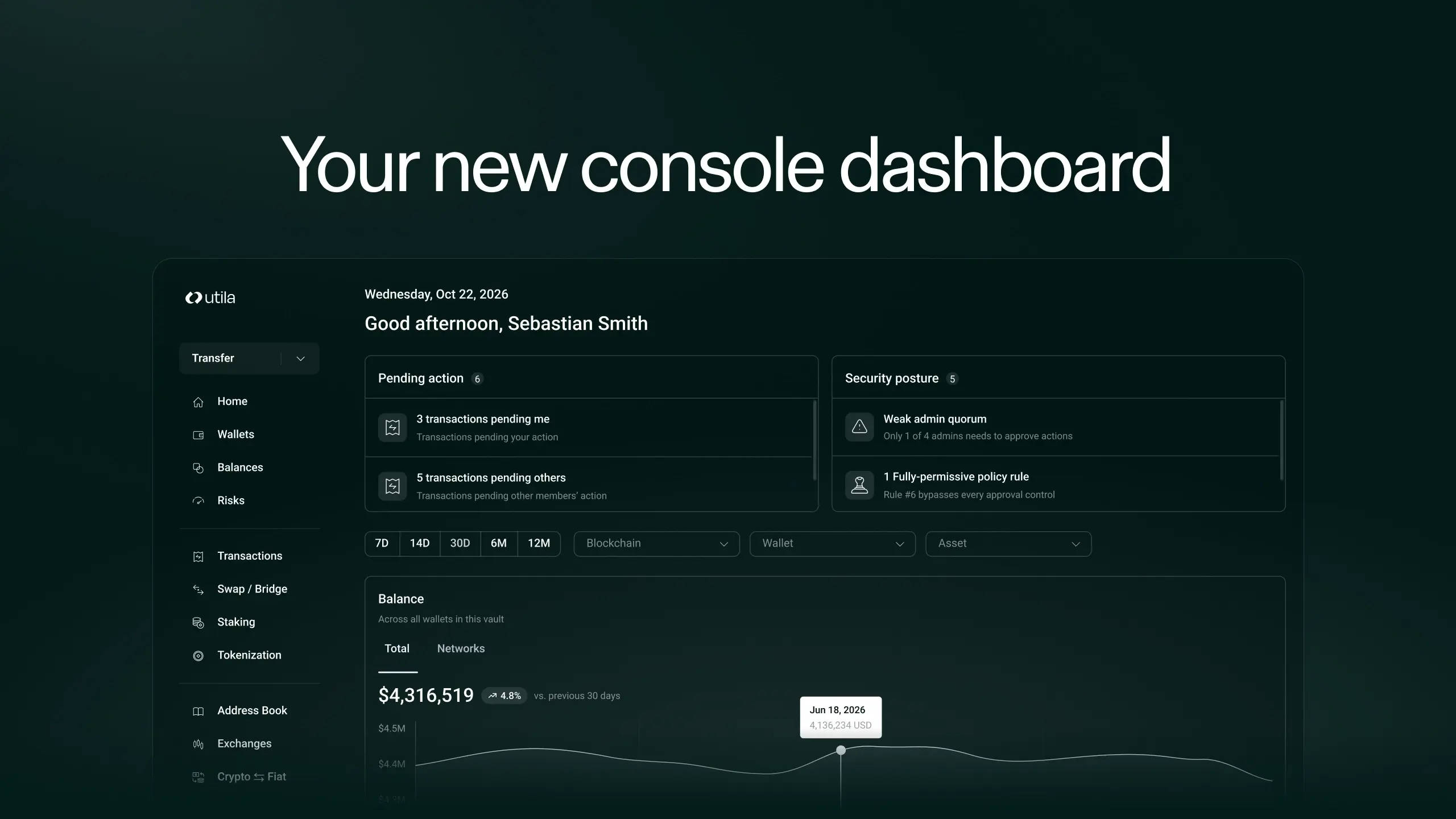
Utila provides institutional wallet infrastructure for fintechs, PSPs, banks, exchanges, treasury teams, and global enterprises. At Utila, we give institutions non-custodial MPC wallets with policy-driven controls over who can initiate, approve, and execute transactions. APIs, webhooks, compliance integrations, gas abstraction, batching, reporting, and reconciliation support high-volume operations across 100+ blockchains, so payment and treasury teams can scale without giving up governance or visibility. Utila Link extends those workflows to institutional counterparties for liquidity and settlement.
Those capabilities become relevant when stablecoin payments move from isolated USDC or USDT transfers into repeatable operating workflows. Such workflows may include:
receiving funds into thousands of addresses,
identifying the payer
running KYT screening,
sweeping balances into treasury,
selecting a network, funding gas (transaction fees), and routing liquidity,
obtaining approvals,
initiating a cross-border payout,
off-ramping into local currency,
and preserving the complete transaction history for finance and compliance teams.
Wallet infrastructure keeps those steps connected under the same operational controls, so institutions can scale payment volume without fragmenting execution, oversight, and reconciliation across separate systems.
What Wallet Infrastructure for Stablecoin Payments Actually Covers
Stablecoins live on blockchains rather than inside wallets. A wallet controls the cryptographic credentials that prove ownership and authorize transfers. Traditional wallets often place that responsibility directly on the user, who must safeguard a private key or seed phrase and use it to authorize transactions. Institutional infrastructure adds operational controls around the key so organizations can manage digital money across many employees, applications, wallets, legal entities, and blockchains.
That difference explains why evaluating a stablecoin wallet solely on token support misses most of the infrastructure problem. An institution typically needs several interconnected layers: secure signing, wallet provisioning, transaction policies, blockchain execution, compliance screening, treasury automation, fiat connectivity, liquidity, reconciliation, and APIs. Utila's stablecoin architecture groups these capabilities around pay-ins, payouts, custody, governance, liquidity, reporting, and developer automation.
The wallet therefore becomes the control point through which stablecoin activity enters the wider financial stack. Once that layer can safely govern money movement, institutions can apply it to cross-border payments, customer balances, treasury operations, payroll, merchant payments, trading, and other digital asset products.
Market Needs and Use Cases
Most enterprise stablecoin use cases share the same operational requirements even when the customer experience looks different. Funds need an address, transactions need authorization, activity needs screening and attribution, balances need treasury management, and the final recipient may still need a bank account or local currency payout.
At Utila, we support stablecoin payments, treasury management, trading operations, Wallet-as-a-Service, business continuity, and tokenization. Our infrastructure also supports internal treasury, embedded stablecoin acceptance and payouts, and stablecoin issuance.
Cross-border payments and treasury deserve particular attention because they expose weaknesses in traditional financial systems that stablecoin rails can address directly: restricted banking hours, fragmented correspondent relationships, pre-funded liquidity, and reconciliation across multiple intermediaries.
Cross-Border Payments and Moving Money Globally
Cross-border stablecoin payments are moving into meaningful B2B volumes. Artemis tracked more than $6 billion in monthly B2B stablecoin payments by August 2025, up from under $100 million at the start of 2023. As more of that volume moves through fintechs, banks, and payment companies, institutions need infrastructure that can manage the full payment flow. That means receiving funds, sourcing stablecoin liquidity, choosing the appropriate network, screening transactions, executing settlement, and delivering proceeds in the recipient’s preferred asset or local currency.
That flow typically begins with funding. The sender may enter through a bank account or an existing stablecoin balance. The operator then needs to convert or route those funds into the stablecoin and network used for the corridor, while balancing liquidity across wallets and counterparties. Network choice affects transaction fees, settlement speed, and the availability of liquidity at the destination, which is why support for chains such as TRON, Solana, and major EVM networks matters for cross-border operations.
Utila provides the wallet and execution layer for that process. Institutions can create dedicated deposit addresses, screen incoming and outgoing transactions, automate treasury sweeping, manage approvals and transaction policies, and execute payouts across 100+ blockchains. Gas abstraction and sponsored transfers reduce the need to maintain native tokens across operational wallets, while batch and concurrent payouts support higher-volume stablecoin payment flows.
The final step depends on the counterparties available in each corridor. Through Utila Link, an institution can connect with an on/off-ramp, OTC desk, liquidity provider, or payment provider, then route settlement into local currency while keeping counterparty selection and transaction controls within its own operating model.
Stage | Responsibility | Completion record | Example exception |
Funding | Your application attributes the receipt. A bank or ramp handles fiat collection; we supply wallet deposit data. | Matched receipt reference and confirmed funding. | Missing reference or unconfirmed deposit. |
Conversion and network choice | Your team chooses the asset, network and counterparty. The selected provider handles conversion. | Executed quote, fees and amount received. | Expired quote or insufficient liquidity. |
Authorization and transfer | Your application initiates the instruction. We apply configured policies and signing controls. | Approval record and confirmed blockchain transaction. | Missing approval or delayed confirmation. |
Destination payout | The selected partner converts funds where required and executes the local payment. | Partner reference and confirmation of beneficiary credit. | Rejected recipient details or a bank cutoff. |
Reconciliation | Your back office matches the payment instruction to Utila, partner and bank records. | Matched amounts, fees and identifiers. | Duplicate event or unmatched record. |
For wallet deposits, your application should verify that a transaction is incoming and confirmed before crediting the receipt, and prevent duplicate credits. Our deposit-monitoring guide explains the confirmation and reconciliation logic required for this step.
In cross-border payments, scale comes from controlling the full movement of funds rather than optimizing the blockchain transfer in isolation. The stronger the connection between wallet infrastructure, stablecoin liquidity, network execution, compliance, and local payout rails, the easier it becomes to add corridors and increase volume without adding a separate operational process for each market.
Afriex uses our infrastructure for treasury movements, B2B client wallets and settlements with liquidity partners across multiple stablecoins and networks. Read the full customer story to see how a payment operator can consolidate wallet operations while accommodating its counterparties’ asset and network requirements.
Utila for Payments
Digital asset & stablecoin infrastructure for payments firms.
Merchant Acceptance and Retail Flows
Merchant acceptance introduces a different requirement: the consumer or business may want to pay with stablecoins while the merchant wants local currency, immediate balance visibility, predictable reconciliation, or conventional card acceptance.
A direct stablecoin merchant flow typically needs a deposit address or payment instruction, transaction monitoring, payer attribution, confirmation logic, and a settlement rule. The merchant can retain the stablecoin, move it into a treasury wallet, or convert it through an integrated liquidity and off-ramp provider. Where the wallet infrastructure emits real-time webhooks, merchant systems can update order status or account balances without repeatedly polling a blockchain node. Utila supports dedicated deposit addresses, real-time transaction events, compliance screening, and automated treasury sweeping for this type of payment workflow.
Cards create another route into real-world payments. A stablecoin-linked card can connect a user's balance with an existing global payments network, with conversion taking place through the card and liquidity stack when required. Visa reported roughly $5.2 billion of stablecoin-linked card volume during 2025 and more than 130 stablecoin-wallet card programs. Some providers also let users provision those cards into Apple Wallet or Google Pay.
Card issuance, acquiring, FX, and merchant settlement sit in separate product layers from Utila's core wallet infrastructure. A fintech could connect such services to wallet balances, but it should not treat card linking or point-of-sale conversion as an intrinsic feature of the wallet itself.
That separation becomes important when designing the broader stack: wallet infrastructure should preserve control over assets and transaction logic while specialist providers handle regulated services that require their own licenses or network relationships.
Treasury and Payroll Use Cases
Treasury teams often use stablecoins for a more operational purpose: moving liquidity between entities, bank accounts, exchanges, counterparties, or markets without waiting for every underlying banking system to operate at the same time.
A treasury architecture can assign wallets to legal entities, business units, corridors, or specific operational functions. Policies can then determine who may move funds, which destinations receive approval, what transaction limits apply, and when a second or third approver must sign. Utila supports wallet grouping, granular role-based access, multi-step approvals, automated sweeping, rebalancing, consolidated balance visibility, and exportable audit records.
Global payroll introduces similar requirements at higher recipient counts. Payroll platforms need to distribute funds across countries and currencies while preserving payout controls, compliance, and reconciliation for each recipient. Utila supports high-volume stablecoin payouts with batch transfers, policy-driven approvals, AML/KYT screening, gas abstraction, and settlement across EVM and non-EVM networks, while APIs and webhooks let teams automate those flows within existing systems. For recipients who need fiat rather than stablecoins, on/off-ramp and liquidity partners can complete settlement into local bank accounts.
Banks and neobanks face additional governance requirements because stablecoin activity must fit existing controls across legal entities, operations teams, compliance, and internal audit. Utila supports policies covering wallet creation, transaction initiation, approval, address controls, and transaction execution, together with AML/KYT integrations and audit records.
Those use cases place custody architecture at the center of the design because every payment or treasury workflow ultimately depends on who controls the signing authority.
Treasury Management
Securely manage your company’s day-to-day digital asset treasury operations.
Core Wallet Models and Custody
Custody matters because regulators may impose different requirements depending on the institution, jurisdiction, and activity involved. A bank safeguarding client assets may face different rules from a fintech moving its own treasury funds, while a payments company holding customer balances may need a licensed custodian or another regulated entity within the operating model. Those requirements can determine who is permitted to hold key material, whether customer assets must be segregated, what safeguarding arrangements apply, and whether the institution can operate the wallets directly or must rely on a regulated partner.
The custody model therefore affects both regulatory structure and day-to-day control over funds. Institutions need to understand who can authorize transactions, who is responsible for recovery and safeguarding, and how much control remains with the business versus a third party. The sections below explain the differences between custodial and non-custodial wallet models, then look separately at embedded wallets as a way of delivering wallet functionality inside a product.
Custodial and Non-Custodial Wallet Models
In a custodial wallet model, a third party manages the private keys and moves assets on behalf of the wallet holder. That structure can simplify recovery and user experience, and a regulated custodian may also handle parts of KYC, AML, safekeeping, and transaction operations. The institution accepting that model also accepts counterparty dependency and a different allocation of regulatory responsibility.
Self-custodial and non-custodial models keep control with the user or institution. Consumer implementations may rely on seed phrases or direct interaction with crypto wallets, but institutional infrastructure can use MPC to distribute signing authority so no single device or provider holds the complete private key.
Utila follows a non-custodial MPC security model. The customer and Utila hold separate key shares, and neither share alone can authorize a transaction. Utila cannot access or move customer funds unilaterally, while policies, multi-admin controls, authentication, and recovery mechanisms govern how transactions are executed.
A hybrid custody strategy can also make sense where different products or jurisdictions impose different requirements on customer funds. An institution might use qualified custody for one asset pool while operating other wallets through a non-custodial architecture.
Embedded Wallets and Institutional Wallet Infrastructure
Embedded wallets typically place wallet functionality directly inside an application, often giving individual end users their own wallets and signing authority. They can work well for consumer-facing products that want to abstract seed phrases and blockchain interactions behind familiar authentication methods.
Utila provides a different operating model. The signing entity remains the fintech, PSP, bank, or other institution, which can create and operate wallets programmatically on its own behalf, on behalf of customers, or across internal payment and treasury workflows. REST APIs support wallet creation, address generation, balance queries, transaction initiation, and signing, while webhooks connect wallet activity with the institution’s own application and operational systems.
This lets a financial institution incorporate stablecoin functionality into its product without positioning Utila as an end-user embedded wallet provider. The institution controls the customer experience and application logic, while Utila provides the MPC wallet, policy, compliance, and transaction infrastructure underneath.
Security, Policy, and Compliance
High-frequency stablecoin payment infrastructure cannot depend on a single password, private key, administrator, or API credential. An enterprise security model needs layered controls around signing, authorization, transaction policy, compliance screening, device access, recovery, and auditability.
The distinction matters because a technically valid blockchain transaction can still violate internal policy, exceed a treasury limit, reach a prohibited address, or originate from a compromised operator. Effective wallet infrastructure evaluates those conditions before execution rather than relying exclusively on after-the-fact monitoring.
Security Controls
Role-based access should restrict initiation, approval, administrative actions, and signing according to job function. Higher-value or higher-risk stablecoin transfers should trigger stronger approval requirements, while routine payment flows can use pre-approved programmatic execution within defined limits.
Utila separates transaction initiation from approval and signing and allows organizations to configure roles, permissions, transaction policies, limits, address whitelists, signing quorums, and multi-admin protection. Its security architecture also supports MFA through device biometrics and passkeys, with key shares bound to specific users and devices.
Compliance controls need similar proximity to execution. Utila integrates AML/KYT providers including Chainalysis, TRM Labs, and Elliptic, allowing organizations to screen deposits and outgoing transfers inside the transaction workflow. Your team should use screening results to review incoming funds and apply the configured approval rules to onward transfers.
Security and compliance therefore need to operate at transaction level, which makes the signing architecture particularly important.
Institutional-Grade Security: MPC, Secure Enclaves, and HSMs
Institutional-grade security for stablecoin infrastructure needs to protect both the cryptographic keys that authorize transactions and the governance processes that determine when those transactions can execute.
MPC addresses the key-protection side of that security model by distributing control of a wallet key across separate cryptographic shares. During signing, the parties jointly produce a valid signature without bringing the complete private key together in one location. Utila uses MPC for distributed key generation, transaction signing, and key refresh, with key shares held separately by Utila and the customer.
This removes the complete private key as a single point of failure. Utila also binds key shares to approved devices, while key refresh allows compromised shares to be replaced without changing the underlying wallet key or address. For automated transaction workflows, the Utila co-signer can run within customer-controlled infrastructure and can optionally be protected using AWS Nitro Enclaves. Service-account authentication credentials can also be stored in a KMS.
Some entities require a different key-custody model. Banks may need wallet keys to remain inside institution-controlled HSMs because of internal security standards, regulatory requirements, or existing cryptographic infrastructure. An HSM keeps the complete wallet key inside a protected hardware boundary and can make that key non-extractable, while authorized systems submit signing requests to the hardware.
Utila supports an HSM-backed architecture in which the institution retains its wallet keys inside its HSM while Utila manages the surrounding transaction workflow, including wallet administration, policy evaluation, approvals, AML controls, blockchain connectivity, broadcasting, and audit records. This allows institutions to choose the key-management model that fits their regulatory and security requirements without separating custody from the operational controls required to move digital assets.
MPC, secure enclaves, and HSMs therefore address different parts of the security architecture. Key protection determines who can produce a valid signature; transaction governance determines whether that signature should be produced in the first place.
Policy Engine and Governance
A policy engine converts treasury and risk requirements into executable transaction rules. Instead of depending on an operator to remember a spreadsheet limit or manually verify every address, the wallet infrastructure can enforce conditions before signing.
Utila supports transaction limits, address whitelisting, wallet-level controls, role-based permissions, multi-step approvals, signing quorums, and admin quorum protection. Policies can govern user actions and payment workflows while service accounts and API co-signers automate transactions that meet predetermined requirements.
Because policy enforcement becomes part of the transaction approval process, institutions also need a clear record of how each decision was made. Finance, compliance, and internal audit teams may need to see who initiated a transaction, which policy evaluated it, who approved it, and what administrative or signing actions followed. Utila records transactions, policy approvals, administrative changes, and signing events in a timestamped audit history, so the governance applied before execution remains traceable after settlement.
Some infrastructure providers market cryptographic attestations for policy execution. Institutions that require cryptographic proof for each policy decision should test that requirement explicitly during procurement. Utila's documented control centers on a complete, timestamped audit trail rather than a public claim that every policy evaluation produces a standalone cryptographic proof.
Once governance can reliably control execution, the institution can connect the wallet layer to fiat rails and external counterparties without surrendering the same controls at the edge of the system.
Integrations: Stablecoin Rails, On/Off-Ramps, and Cross-Border Settlement
A wallet that can only move tokens between blockchain addresses leaves most commercial payment requirements unresolved. Institutions still need to convert bank deposits into stablecoins, redeem stablecoins into fiat, reach local bank accounts, rebalance liquidity, and sometimes move value across different blockchains.
Multi-chain support reduces dependence on a single network and lets payment operators select settlement rails according to stablecoin liquidity, network fees, recipient demand, and corridor economics. Utila's stablecoin infrastructure supports 100+ blockchains and connects EVM and non-EVM operations under common wallet and policy controls. The current stablecoin product page also lists more than 30 integration partners across payment, liquidity, compliance, exchange, DeFi, and related infrastructure.
Blockchain transactions require a network fee, usually paid in the blockchain’s native token, such as ETH on Ethereum or TRX on TRON. If every operational or customer wallet has to maintain those native tokens, payment teams have to fund, monitor, and reconcile gas balances alongside the stablecoins themselves.
Our sponsored transfers let a separate Utila wallet pay network fees for supported transfers. Native sponsorship supports selected EVM networks, Solana, Sui and Aptos. On TRON, token-approval sponsorship requires a one-time approval and initial gas funding in the source wallet. This keeps fee management centralized and reduces the treasury overhead of maintaining native-token balances across large numbers of wallets.
Fiat connectivity completes the money movement loop. Utila Link connects institutions with exchanges, OTC desks, liquidity providers, on/off-ramps, payment providers, and other counterparties. The institution can define providers and routing at the corridor level rather than locking every stablecoin payment into one liquidity source.
To implement this, evaluate each corridor against the payment you intend to deliver, including the recipient’s access to local currency. Confirm the following with each shortlisted partner:
Route and recipient eligibility. Check the origin and destination countries, fiat currencies, beneficiary type and receiving method against the partner’s actual service scope.
Onboarding and permissions. Establish which entity provides each regulated service, what agreements and checks are required, and which responsibilities your business retains. Our Licensed Partner Network connects institutions with partners according to the activity and jurisdiction involved.
Asset and network compatibility. Confirm that the receiving partner accepts the exact stablecoin and blockchain combination, including its deposit instructions and minimum amounts.
Pricing and funding. Compare FX spreads, conversion and payout fees, quote expiry, liquidity availability and required funding balances at the intended payment size.
Delivery and exceptions. Verify operating hours, cutoffs, expected beneficiary-credit timing, transaction limits, returns and the escalation process for delayed payments.
Record these terms for the proposed route before committing funds or promising a delivery time to customers.
Our modular approach also gives treasury teams the ability to negotiate commercial terms directly and adjust routing as liquidity changes across corridors. The next operational requirement involves integrating those capabilities into the institution's own applications and systems.
Developer APIs and Crypto Wallet Operations
Wallet infrastructure needs to fit payment systems rather than forcing them to conform to a wallet console. For high-volume operations, APIs, webhooks, service accounts, and automated signing matter as much as manual interfaces.
Utila's REST API gives developers programmatic access to wallet creation, balance monitoring, transaction initiation, signing workflows, and other platform resources. Real-time webhooks cover deposits, transfers, confirmations, approval requests, and governance changes, while the co-signer can automate signing inside customer-controlled infrastructure.
Payments introduce several chain-specific requirements that developers should evaluate during integration. Bitcoin requires UTXO management. EVM operations may require nonce controls and transaction acceleration. TRON introduces resource-management considerations. Solana, Stellar, and other networks use different transaction and account models. Utila supports these networks within a single platform while preserving the chain-specific functionality each network requires.
Documentation should therefore answer operational questions rather than only provide endpoint definitions. Teams need clear information on supported assets, confirmations, gas behavior, transaction states, webhook retries, idempotency, policy evaluation, error handling, network-specific constraints, and recovery procedures. Utila publishes an API reference and OpenAPI documentation for its current endpoints.
Developer ergonomics feed directly into provider selection because a wallet infrastructure decision can affect every payment workflow that sits above it.
How to Evaluate the Best Stablecoin Wallets for Business
The best stablecoin wallets for an individual user and the best wallet infrastructure for a financial institution solve very different problems. Consumer comparisons often emphasize interface design, supported tokens, self custody, or access to DeFi. An institution needs to examine whether the infrastructure can govern customer funds and treasury operations under production conditions.
A provider scorecard should test operational requirements rather than rely on a feature-count comparison.
Evaluation area | What to verify in a production test |
|---|---|
Key control and security model | Identify who holds each key share, who can sign, how recovery works, how shares get refreshed, and whether the provider can ever move funds independently. |
Policy and governance | Test role separation, transfer limits, whitelisting, multi-user approvals, admin quorum controls, and automated policy enforcement. |
Compliance connectivity | Confirm supported AML/KYT providers, screening timing, sanctions handling, Travel Rule workflows, and audit evidence. |
Payment operations | Test deposit attribution, automated sweeping, gas abstraction, batch payouts, concurrent transactions, retries, and reconciliation. |
Multi-chain support | Verify the stablecoins and networks required by actual corridors, including the operational details behind each chain rather than headline chain counts. |
Developer experience | Test API coverage, webhook reliability, service-account security, signing automation, filtering, documentation, and chain-specific behavior. |
Fiat and liquidity connectivity | Confirm access to on/off-ramps, exchanges, OTC desks, liquidity providers, bank settlement, and the ability to choose counterparties. |
Audit and recovery | Reconstruct a transaction from initiation through policy evaluation, approvals, signing, settlement, and reporting. Then test wallet and organizational recovery procedures. |
A six- to eight-week pilot can provide a useful working window when internal procurement and compliance processes allow it, but teams should treat that duration as a planning assumption rather than an industry benchmark. The pilot should carry realistic transaction patterns: real wallet counts, representative payout batches, the intended networks, compliance screening, treasury sweeps, and failure scenarios. Pure sandbox throughput reveals little about the operational controls that matter once stablecoin transactions involve customer funds.
Provider selection then feeds into implementation planning, where legal, product, engineering, treasury, and compliance requirements need to converge into one executable design.
Implementation Roadmap
A stablecoin implementation starts by mapping how funds will move through the business: where they enter, who controls them, how they are screened and approved, which counterparties handle conversion, and where settlement ends. Legal and compliance teams need to determine who provides the regulated service, who holds customer funds, which entities participate in each corridor, and what KYC, AML, Travel Rule, safeguarding, or reporting obligations apply. Product and treasury teams can then specify which party holds stablecoin balances, who converts them, and where fiat settlement takes place.
Technical design should map those responsibilities into wallets, vaults, policies, service accounts, approval workflows, liquidity connections, and reconciliation records. An embedded wallet rollout may create a wallet per customer; a B2B payment operation may instead use wallets per client, payment flow, or corridor; a treasury implementation may group wallets by legal entity or bank account.
Testing should move through controlled stages. A sandbox phase validates wallet creation, policies, webhooks, signing, and transaction state handling. A pilot introduces representative payment traffic, stablecoin liquidity, reconciliation, gas sponsorship, and real compliance controls. A limited launch then adds production counterparties and customer flows while transaction limits and enhanced monitoring contain exposure.
Before increasing volume, teams should deliberately test adverse conditions: failed webhooks, insufficient gas, delayed blockchain confirmations, rejected compliance checks, unavailable liquidity providers, incorrect destination addresses, compromised user credentials, and recovery procedures. Production readiness depends on how the system behaves when a transaction cannot follow the happy path.
Those tests also define the metrics that matter after launch.
Metrics, Scaling, and Emerging Markets
Stablecoin wallet success metrics will depend on how the institution uses stablecoins and where value is created in the flow. Generally, metrics should follow the business model. An embedded consumer wallet may care about user activation, stablecoin balances, retention, transaction frequency, and customer LTV. A B2B payment company should place more weight on settlement latency, straight-through processing, cost per cross-border payout, failed transaction rate, reconciliation exceptions, liquidity utilization, and manual interventions.
Measure total cost per completed payout across the full payment flow. Include conversion and FX spreads, partner and payout-rail fees, funding costs, network fees and wallet-rebalancing transfers. Allocate the operating cost of failed payments, returns and reconciliation across the payments completed during the same period. Fee sponsorship changes which wallet pays gas; assess its effect on operational work separately from the network fee itself.
Track blockchain confirmation and beneficiary credit as separate milestones. Record when the payment was accepted, when the onchain transfer was confirmed and when the recipient could use the funds. A payout partner’s processing hours, compliance review or receiving bank can add time after the stablecoin transfer has completed. Compare costs and delivery times for the same corridor, payment size and receiving method.
Geographic expansion becomes another scaling decision once the operating model has proven to work. Markets with strong stablecoin adoption can be attractive for new payment corridors, but adoption alone is not enough. Institutions also need to assess local liquidity, regulatory requirements, bank connectivity, off-ramp coverage, and the cost of settling into local currency before entering a new market.
A deployment decision should therefore combine stablecoin adoption with local liquidity depth, fiat off ramps, bank transfer coverage, licensing requirements, stablecoin preference, blockchain preference, customer demand, and unit economics. High wallet activity does not automatically produce a viable payment corridor.
As stablecoin growth continues, the institutions that can measure those economics at wallet, network, counterparty, and corridor level gain much better information for deciding where to expand.
Frequently Asked Questions
How do stablecoin wallets work?
A stablecoin wallet controls blockchain addresses and the cryptographic authority needed to sign transactions. The stablecoins remain recorded on the blockchain, while wallet infrastructure manages key material, signing, policies, transaction history, and connections with other systems.
Do businesses need a special wallet for USDC or USDT?
Businesses need wallet infrastructure that supports the specific stablecoin, blockchain, transaction type, and operational controls their use case requires. A wallet that supports USDC on Ethereum does not automatically provide the same operational support for USDC on Solana or USDT on TRON.
What distinguishes custodial wallets from non-custodial wallets?
Custodial wallets give a third party control of private keys and responsibility for moving assets on the user's behalf. Non-custodial wallets preserve direct ownership outside a third-party custodian. MPC can support enterprise non-custodial models without requiring one employee or device to hold a complete private key.
Can embedded wallets use self custody?
Yes. Embedded describes how wallet functionality gets integrated into an application, while custody describes control over funds and signing authority. Embedded wallets can therefore use custodial, self-custodial, non-custodial MPC, or hybrid models.
How does MPC improve stablecoin wallet security?
MPC distributes private-key control across multiple cryptographic shares. A single compromised share does not provide the complete key, and participating shares can jointly generate a signature without reconstructing the full private key in one place. Utila also supports MPC key refresh, which replaces individual shares while preserving the same underlying wallet key.
Can stablecoin users transact without holding native tokens for gas?
Wallet infrastructure can abstract gas when the underlying network and provider support sponsored transactions. Utila lets a separate sponsor wallet cover network fees for supported transfers, reducing the need to maintain native tokens in every operational or deposit wallet.
How should financial institutions handle AML and KYT for stablecoin transactions?
The institution should map KYC, AML, KYT, sanctions, and Travel Rule responsibilities according to the jurisdiction, custody structure, and regulated entities involved. Wallet infrastructure can integrate transaction screening and block or route transactions according to configured policies, but it does not remove the institution's need to establish the applicable compliance framework.
Can stablecoin wallets connect with bank accounts and fiat payment rails?
Yes, when the wider stablecoin infrastructure includes regulated on/off-ramps, banking partners, exchanges, or payment providers. The wallet manages onchain funds while those integrations handle conversion and fiat settlement into or out of a bank account.
What should a bank or fintech look for in wallet infrastructure for stablecoins?
Start with asset control, MPC or another institutional key-management model like HSM, granular policies, multi-user approvals, compliance integrations, auditability, multi-chain execution, gas management, APIs, webhooks, recovery, and access to the liquidity and fiat rails needed by the intended corridors. Token and chain coverage only answer one part of the procurement decision.

Content Marketing Lead
Marcin Miłosierny is Content Marketing Lead at Utila, with experience creating content for regulated finance at Sygnum and technical analytics products at Glassnode.